Homemade Hot Pepper Jelly: Your Ultimate Guide to Sweet, Spicy, and Tangy Perfection
There’s something truly special about having a jar of homemade hot pepper jelly tucked away in your pantry. It’s a culinary treasure that perfectly balances spicy heat with a delightful sweetness and a zesty tang. Far from just a simple spread, this versatile jelly elevates everyday meals and transforms appetizers into memorable experiences. Our unique recipe offers a less-sweet profile than many traditional versions, yet it maintains an impeccable flavor harmony, ensuring every spoonful is a treat without being overly sugary. The best part? You have complete control to customize the heat level, making it as mild or as fiery as your palate desires.
Life truly gets a little more exciting when you introduce a dash of spice, doesn’t it? And if that spice comes with a perfectly calibrated touch of sweetness and an invigorating tang, then you’ve truly hit a culinary jackpot. This homemade hot pepper jelly delivers precisely that winning combination, allowing you to indulge in a sweet-and-spicy sensation that’s utterly irresistible.
Imagine vibrant flecks of sweet bell pepper intertwined with fiery hot peppers, suspended in a glistening, quivery jelly. It’s not just beautiful to look at; it’s also incredibly versatile. Whether you’re spreading it generously or simply dolloping a spoonful, it’s guaranteed to add that much-needed ‘oomph’ to any dish or snack, transforming the ordinary into something extraordinary.
Versatile Ways to Enjoy Your Hot Pepper Jelly
One of the most classic and universally loved applications for hot pepper jelly is as a show-stopping appetizer. Simply spoon a generous dollop over a block of cream cheese and serve with an assortment of crackers. For larger gatherings, place the entire block of cream cheese on a platter and create a luscious mound of jelly on top, letting it gently cascade around the sides. Guests will find it effortlessly addictive, scooping up creamy cheese and piquant jelly onto their crackers for a delightful bite. It’s a simple concept that consistently impresses with its fantastic flavor and ease of preparation.
Beyond appetizers, hot pepper jelly shines as an exceptional condiment. Use it to create a glossy, tantalizing glaze for grilled chicken wings, roasted pork chops, or even a succulent ham. It makes a vibrant and flavorful alternative to ketchup on your favorite meatloaf, adding a gourmet touch to a comfort food classic. Spread a thin layer on burgers, elevating their flavor profile, or incorporate it into sandwiches; a subtle smear beneath an egg salad or tuna sandwich can introduce an unexpected burst of sweetness and heat. You can even stir a spoonful into homemade salad dressings for a sweet-spicy kick or blend it into pasta salads for an intriguing twist. The possibilities are truly endless!
Hot pepper jelly enjoyed immense popularity in the 1980s and 90s, becoming a staple at many gatherings. This retro food is experiencing a well-deserved comeback, and for very good reason: it’s simply too delicious to be relegated to the past. Once you make a batch of this vibrant jelly, you’ll understand its enduring appeal and be delighted you joined the “pepper wagon.”
Crafting Your Own Less-Sweet Hot Pepper Jelly
This recipe distinguishes itself by being significantly less sweet than many traditional hot pepper jelly versions, yet it maintains a perfect equilibrium of heat, sweetness, and acidity. The secret to achieving this delightful balance without excessive sugar lies in utilizing ‘no sugar needed’ pectin. This special type of pectin allows for a lower sugar content while ensuring the jelly sets beautifully. To illustrate, this recipe calls for just 3 cups of sugar, a considerable reduction compared to the 5 cups typically required when using regular pectin to set the same volume of liquid. The resulting jelly boasts a beautifully soft set, making it incredibly versatile as a condiment or even as a flavorful hot sauce – it works wonderfully as a substitute for Thai sweet red chili sauce.
Despite its gourmet appeal, this condiment is surprisingly easy to make, especially if you have the convenience of a food processor or a mini-chopper (working in batches is often recommended for best results). You’ll begin by finely chopping a selection of sweet bell peppers, which form the colorful base of the pepper ‘flecks’ in your jelly. Next, you’ll incorporate your chosen hot peppers – whether it’s classic jalapeños, other spicy varieties you have on hand, or even readily available dried red pepper flakes. Feel free to play with the colors of your bell peppers; you can opt for a uniform, monochromatic look or create a vibrant rainbow effect with a mix of hues.
Customizing the Heat Level: From Mild to Wild
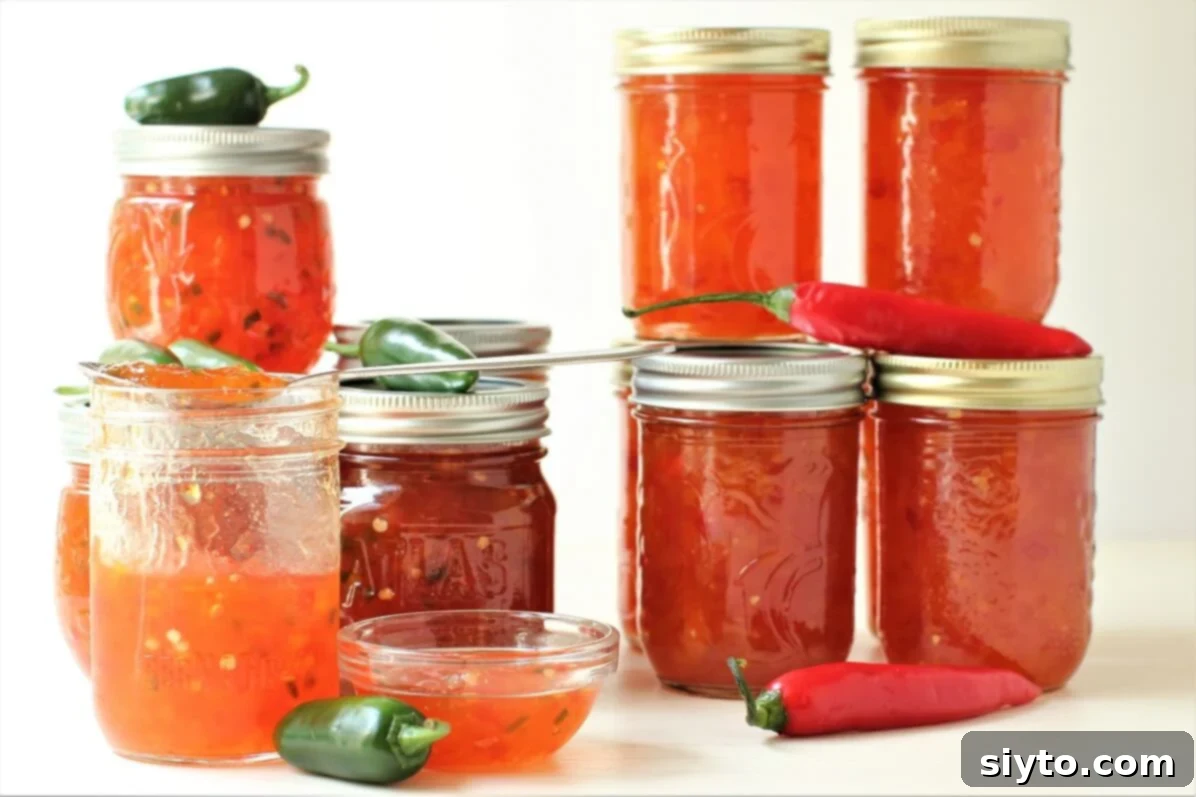
One of the most exciting aspects of making your own hot pepper jelly is the ability to precisely control its spiciness, tailoring it to your personal preference – or daring! The batch of jars on the left in the image below, for instance, was crafted using a combination of red and yellow bell peppers alongside fresh jalapeños for a manageable yet satisfying kick. The addition of jalapeños introduces lovely little green specks, creating a beautiful rainbow effect and a delightful, accessible level of heat. If you’re aiming for a green pepper jelly, simply use all green bell peppers, or for a vibrant yellow jelly with appealing green flecks, combine yellow bell peppers with green jalapeños. The color combinations are only limited by your imagination!
In contrast, the batch of pepper jelly shown on the right in the same image was also made with red and yellow bell peppers, but I opted for those nine tiny, incredibly potent dried chilis visible in the photo above. Despite totaling only about half a tablespoon when chopped, these peppers made the jelly unequivocally ‘HOT’! These particular chilis were an unknown, intensely spicy variety cultivated by a friend (a big thanks to Jan!). Having witnessed him bravely eat one raw and almost visibly react to its extreme heat, I knew they would infuse this jelly with an extraordinary level of spice. And they certainly did! This batch is definitely not for the faint of heart – a tiny taste is enough to make one’s brow sweat!
Fortunately, the burning sensation caused by capsaicin, the compound responsible for heat in peppers, can be somewhat mitigated by the presence of acid or sugar. This pepper jelly recipe incorporates both, which helps to temper the overall spiciness once all the ingredients are combined and the vinegar and sugar have had time to meld their flavors. Furthermore, dairy products are excellent at counteracting excessive heat; their fat molecules bind with capsaicin, effectively neutralizing some of its intensity. This is precisely why serving hot pepper jelly with the traditional block of cream cheese isn’t just delicious, but also helps to make even the spicier versions perfectly palatable and utterly “more-ish.”
No matter the colors of bell peppers you choose or the specific type of spicy pepper you incorporate, you have full creative freedom to determine the final color and, crucially, the heat level of your jelly. Remember that the majority of a spicy pepper’s heat resides in its seeds and inner membranes. Therefore, you can easily adjust the intensity: leave them in for maximum heat, or remove them for a milder flavor profile. This allows for unparalleled customization.
The preparation is straightforward: simply trim and finely chop all your peppers. For the most consistent and efficient results, a food processor is your best tool. It quickly transforms peppers into the desired fine mince, ensuring even distribution throughout the jelly.
When handling hot peppers, especially during the chopping phase, wearing disposable rubber gloves is highly recommended to protect your skin from capsaicin. If you don’t use gloves, be extremely careful not to touch your eyes or face until you have thoroughly washed your hands with soap and water. For jalapeños, I often prefer to keep the seeds in for that extra kick and chop them by hand, which allows for a more controlled, even small dice and beautiful flecks in the finished jelly.
Once your peppers are prepared, the rest of the process is quick and simple. Combine the chopped peppers with vinegar, a pinch of salt, and a clove (or more, to taste) of minced garlic. Bring this mixture to a boil with the powdered ‘no sugar added’ pectin. Once boiling, add the measured sugar, return it to a vigorous boil for just one minute, and then carefully ladle the hot jelly into your sterilized canning jars. While water-bath processing offers an extra layer of preservation assurance, many find that pouring boiling-hot jelly into hot, sterilized jars and sealing them immediately results in a perfectly good seal.
And just like that, you’ll have a beautiful collection of amazing hot pepper jelly jars, ready to be enjoyed as snacks throughout the cooler months or to be given as thoughtful, homemade hostess gifts. The satisfaction of making your own delicious preserves is truly unmatched!
Guten Appetit!
* * * * *
Hot Pepper Jelly – Sweet & Spicy
Hot Pepper Jelly is a vibrant delight, perfectly blending spicy, tangy, and sweet flavors. It’s a fantastic choice for an easy appetizer or a versatile condiment. This particular recipe features a less-sweet profile than many traditional versions, yet it achieves a perfectly balanced taste. You have full control to adjust the heat level to your preference.
Save to Pinterest
Equipment
Ingredients
Instructions
- Wash and sterilize 6 half-pint (250ml) canning jars (see instructions here), and keep them hot until you need them. Put the snap lids into a pot of barely simmering water to keep hot. Wash, rinse and drain the jar screw-rings and have them ready.
- To finely mince the peppers, a food processor or mini-chopper works best to get the juices. It’s often best to process them in 2 batches for more uniform mincing with smaller amounts. Remove stems, seeds, and inner membranes from bell peppers, cut into chunks, then process until finely minced but not mushy, scraping down sides. Remove any larger pieces to chop by hand rather than over-processing. Measure chopped peppers with their juices; you should have 2 cups when firmly packed.
Mince jalapeños or hot peppers similarly, or chop finely by hand. For less heat, remove seeds and inner membranes; leave them in for full heat. Use rubber gloves when handling hot peppers and avoid touching your face until hands are thoroughly washed.
- Combine the chopped peppers, salt, garlic, vinegar, and pectin in a large saucepan (at least 3 quarts/litres, as the jelly will foam significantly).
- Measure out the sugar into a separate bowl or a spouted cup and place it conveniently near your stove.
- Bring the pepper mixture to a full rolling boil, stirring occasionally to prevent sticking.
- Pour in the measured sugar and bring the mixture back to a full rolling boil that cannot be stirred down.
- Boil hard for exactly 1 minute.
- Remove the saucepan from the heat. Carefully pour the hot jelly into the hot sterilized jars, stirring the jelly between each pour to ensure the pepper pieces are evenly distributed among all jars. Wipe the rims of the jars clean with a damp cloth. Place the hot metal snap lids directly from the simmering water onto the jars and screw on the metal screw-bands until finger-tight.
- Set the filled jars upside-down onto a clean tea towel. This step helps to distribute the pepper pieces evenly throughout the jelly as it cools and sets. After 30 minutes, carefully turn the jars upright and leave them undisturbed until they are completely cool.
For extra assurance against spoilage, the jars can be processed in a water bath for 10 minutes before being set onto the towel (refer to instructions here).
- The jelly will fully set once the jars are completely cooled, typically within several hours. If any jars have not sealed properly (indicated by a lid that flexes when pressed), store them in the refrigerator and consume them first. Unsealed jars will last for months in the fridge.
- Allow the sealed jars to rest for at least a week before opening and using them. This resting period is crucial for the flavors to fully develop and meld, resulting in a richer, more complex taste.
- This recipe yields approximately 6 half-pint (250ml) jars of delicious hot pepper jelly.
Notes
- Pepper Measurements: Peppers can measure differently based on whether they are chopped with a food processor or by hand. For accuracy, it’s best to go by weight after trimming. You will need a total of 500 grams (about 2¼ cups when finely minced by food processor) of peppers, including both bell peppers and hot peppers. If chopping bell peppers by hand, run your knife repeatedly over the pile until finely minced with released juices, then pack firmly into the measuring cup. For a “confetti” appearance with visible green flecks, consider chopping jalapeños finely by hand, even if you use a processor for bell peppers.
- Substituting Hot Peppers: If fresh jalapeños or other hot peppers are unavailable, you can use the total amount of bell peppers (2¼ cups / 500 grams) and add 1 tablespoon of dried red chili flakes instead. For a truly fiery, super-hot pepper jelly, increase the chili flakes to 2 tablespoons.
- Adjusting Jalapeño Heat: The heat level in jalapeños can vary significantly. To gauge their potency and decide whether to include the seeds and membranes (which contain most of the heat), you might want to carefully taste a tiny piece of the raw pepper first.
- Pectin Type is Key: It is absolutely essential to use no-sugar-needed pectin for this recipe. If you substitute with regular pectin, your jelly will likely not set, as regular pectin requires a much higher sugar content (at least 5 cups) to activate properly.
- Nutrition Information: The provided nutrition facts are calculated for 1 whole jar of jelly (250ml/1 cup). Since a 1-cup jar contains approximately 16 tablespoons, to find the values per tablespoon, simply divide the listed numbers by 16 (this amounts to about 28 calories per tablespoon).
Nutrition
Calories: 450kcal
Carbohydrates: 112g
Protein: 1g
Fat: 1g
Saturated Fat: 0.1g
Polyunsaturated Fat: 0.1g
Monounsaturated Fat: 0.01g
Sodium: 217mg
Potassium: 186mg
Fiber: 2g
Sugar: 103g
Vitamin A: 2427IU
Vitamin C: 106mg
Calcium: 14mg
Iron: 1mg
Tried this recipe?
Let us know how it was!
Want to receive new Kitchen Frau recipes directly to your email? Sign up here and you’ll get a handy and useful kitchen tip along with each recipe, too. (No spam ever.)
If you like my recipes, follow me on Instagram, Pinterest, Twitter, and Facebook. You’d make my day!
PIN IT HERE to save the recipe for later:
You might also like these related recipes:
Spicy Zucchini Salsa
Peach Salsa – A Delicious Canning Recipe
Old Pickle Relish (Made with Overripe Cucumbers)
Pickled Garlic Scapes