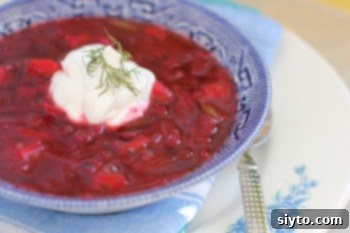
Traditional Vegetarian Borscht: An Easy & Flavorful Eastern European Soup
This delightful meatless borscht recipe offers a bright, fresh, and remarkably light experience. Its signature rich, ruby-red hue comes from earthy beets, complemented by a vibrant medley of other garden vegetables. This soup captures the familiar tanginess characteristic of traditional Russian and Eastern European cuisine and is simply irresistible when served with a generous dollop of creamy sour cream. For those eager to dive right into the cooking, feel free to skip directly to the recipe.
Food has a remarkable way of transcending borders and connecting us to diverse cultures, histories, and shared human experiences. Just as major international events, like global sporting competitions, bring people together in a spirit of camaraderie and appreciation for excellence, the aromas and flavors of traditional dishes can transport us across continents. It’s truly heartwarming to consider how the simple act of preparing and sharing a meal can evoke memories, spark curiosity about other lands, and deepen our understanding of the world.
For many, certain dishes resonate deeply with personal heritage. For me, that connection often leads back to my German and Eastern European roots. The mention of borscht instantly brings to mind cherished memories of my Oma’s kitchen, where a pot of this comforting soup would simmer, filling the air with its distinctive aroma. While Oma’s version was a rich, hearty, and meaty affair – built on a long-simmered broth from flavorful beef bones, brimming with ruby beets, and finished with handfuls of fresh dill – it’s a dish that, despite its variations, always signifies warmth and home. (Rest assured, I plan to share that beloved meaty recipe in the future.)
The Enduring Appeal of Borscht: A Culinary Journey
Borscht, spelled variously as borsch, or borshch, is far more than just a soup; it’s a cultural icon, a testament to the culinary ingenuity of Eastern Europe. Its origins are deeply rooted in Ukrainian cuisine, from where it spread to Russia, Poland, Lithuania, and beyond, adapting and evolving with each region. This adaptability is precisely why there are countless variations of borscht, each offering a unique twist on the classic. While the beautiful ruby color, primarily derived from beets, is the most common thread, the ingredients and preparation methods can differ dramatically.
Some versions feature generous cuts of meat, like beef, pork, or chicken, creating a substantial and filling meal. Others are purely vegetarian, often preferred during fasting periods or for those seeking a lighter, fresher taste. You might find borscht with potatoes, cabbage, or even apples. Some cooks might add garlic, bay leaves, cloves, or other herbs to enhance the flavor profile. Some recipes call for a smooth, pureed texture, while others celebrate chunky, rustic vegetables. Cream, usually sour cream, is almost always added for a finishing touch, balancing the soup’s characteristic tanginess and adding a creamy richness. Regardless of the specific ingredients, most versions of borscht share a delightful acidity, a quality that makes it incredibly invigorating and deeply satisfying, especially when paired with a dollop of sour cream or a swirl of heavy cream.
On this particular occasion, seeking a quicker borscht fix, I turned to a beloved recipe passed down from my friend Marianne’s Ukrainian Baba (grandma). Her rendition is a wonderful example of the meatless variety – bright, fresh, and light, yet incredibly flavorful. It’s a perfect choice for those who desire the quintessential taste of borscht without the heavier feel of a meat-based broth, demonstrating the incredible versatility and widespread appeal of this celebrated dish. Enjoying a bowl of this Russian Borsch soup is not just about satisfying your hunger; it’s an armchair journey, a flavorful trip to lands known for onion domes, caviar, vodka, and hearty rye bread, bringing a taste of history and culture right to your table.
Crafting the Perfect Meatless Borscht: Key Ingredients & Flavors
The success of a vibrant meatless borscht lies in the careful selection and preparation of its core ingredients. At the heart of this soup are, of course, the beets. These earthy root vegetables are responsible for the soup’s characteristic stunning ruby color and a subtly sweet, grounding flavor. Beyond their aesthetic appeal, beets are nutritional powerhouses, packed with vitamins, minerals, and antioxidants, making this soup not only delicious but also incredibly healthy.
Alongside the beets, a host of other vegetables contribute layers of flavor and texture. Carrots add a touch of sweetness and depth, while onions provide an aromatic base. Frozen peas or chopped cabbage are excellent choices for adding substance and a fresh, garden-like quality. Green beans offer a delicate crispness, enhancing the overall texture of the soup. The bay leaf infuses a subtle, savory note, complementing the earthiness of the beets.
The distinctive tanginess of borscht is achieved through the addition of vinegar, which brightens the flavors and gives the soup its iconic acidic finish. This acidity is beautifully balanced by the richness of butter and the creamy luxury of sour cream or heavy cream when served. Fresh dill is another non-negotiable ingredient, providing a burst of herbal freshness that is intrinsically linked to the authentic taste of Eastern European cuisine. Black pepper adds a gentle warmth, and salt is crucial for bringing all the flavors into harmony.
Kitchen Frau’s Expert Tips for Baba’s Borsch
While Marianne’s Baba’s original borscht recipe uses plain water, I often prefer to incorporate a few cups of beef stock to achieve a richer, more profound flavor, even in a meatless soup, as it adds an umami depth. However, for a truly vegetarian or vegan version, substituting all water or a good quality vegetable broth works beautifully. Remember to adjust the amount of salt accordingly; if you use any amount of broth, you’ll likely need less than the 1½ teaspoons stated in the recipe, as broths often contain sodium. I typically find about ½ teaspoon of black pepper to be the perfect amount for a subtle kick. The original recipe specifies peas, but I’ve found that chopped cabbage, a very common ingredient in many borscht variations, is an excellent and equally delicious substitute. Don’t be afraid to experiment to find your preferred texture and vegetable medley.
Our family has a strong preference for tangy borscht, so I confidently add both tablespoons of vinegar right at the beginning of the cooking process. If you’re unsure of your preference, I recommend starting with just one tablespoon of vinegar. Allow the soup to simmer, then taste it before adding the second tablespoon. This way, you can customize the tanginess to your liking, ensuring the soup is perfectly balanced for your palate. For those following a dairy-free diet, simply omit the sour cream and replace the butter with an equal amount of olive oil. The result will still be a wonderfully flavorful and satisfying soup.
Baba’s Borsch: The Recipe
Adapted from Marianne’s Baba’s cherished family recipe, this version brings a taste of tradition to your kitchen.
- 4 medium beets (about 1 lb or 500 gms)
- 6 cups (1.5l) water (or part beef or vegetable stock for added depth)
- 2 carrots, chopped
- 1 small onion, diced
- 1 bay leaf
- 1 cup (250ml) frozen peas or chopped cabbage
- 1 cup (250ml) fresh or frozen green beans, cut into 1” pieces
- 1½ teaspoons salt (reduce if using broth)
- Black pepper to taste (about ½ teaspoon recommended)
- 1 tablespoon fresh or frozen chopped dill, or 1 teaspoon dried dillweed
- 1 – 2 tablespoons vinegar, to taste
- ⅓ cup (75gms) unsalted butter
- ½ cup (125ml) additional chopped onion
- Sour cream or heavy cream to serve (optional, but highly recommended)
Instructions:
- Prepare the Beets: Begin by boiling the beets in their skins. Place them in a pot, cover with water, and bring to a boil. Reduce heat and simmer for ½ hour, or until they are tender when pierced with a fork. Drain the water, then trim the ends. Once cool enough to handle, peel the beets by gently slipping them out of their skins. A helpful tip: I often do this in the sink under cool running water over a colander to easily catch the peels and minimize staining.
- Shred the Beets: Once peeled, shred the cooked beets using a box grater. This should yield approximately 2½ cups of shredded beets. Place these vibrant shredded beets into a large, heavy-bottomed pot.
- Combine Soup Ingredients: To the pot with the shredded beets, add the water (or stock/broth combination), chopped carrots, diced small onion, bay leaf, frozen peas or chopped cabbage, green beans, salt, black pepper, fresh or dried dill, and 1 tablespoon of the vinegar.
- Simmer the Soup: Bring the mixture to a rolling boil over medium-high heat. Once boiling, reduce the heat to low, cover the pot, and let it simmer gently for 30 minutes. This allows the flavors to meld beautifully and the vegetables to tenderize.
- Prepare the Onion Sauté: While the soup is simmering, melt the butter in a small skillet over medium heat. Add the remaining ½ cup of chopped onion to the skillet. Cook slowly, stirring occasionally, until the onion softens and begins to turn a lovely golden color. This step adds a subtle sweetness and depth to the soup.
- Finish the Soup: Once the soup has finished simmering for 30 minutes, stir in the sautéed onions and melted butter from the skillet. Taste the soup for seasoning. Adjust with more salt and pepper as needed. If you prefer a more pronounced tanginess, now is the time to add the remaining tablespoon of vinegar.
- Serve: Ladle the hot borscht into individual bowls. Serve immediately with a generous dollop of sour cream or a drizzle of heavy cream in each bowl. A slice of buttered rye bread makes a perfect accompaniment.
This recipe yields 6 to 8 satisfying servings.
Guten Appetit!
Want to receive new Kitchen Frau recipes directly to your email? Sign up here and you’ll get a handy and useful kitchen tip along with each recipe, too. (No spam ever.)
If you like my recipes, follow me on Instagram, Pinterest, Twitter, and Facebook. You’d make my day!
You might also like these hearty and wholesome soup recipes:
Beet and Fennel Salad
Gingered Pumpkin Soup with Crunchy Creamy Toppings
Baked Potato Soup
Root Vegetable Soup with Buckwheat and Blue Cheese Biscuits
Creamy Roasted Root Vegetable Soup