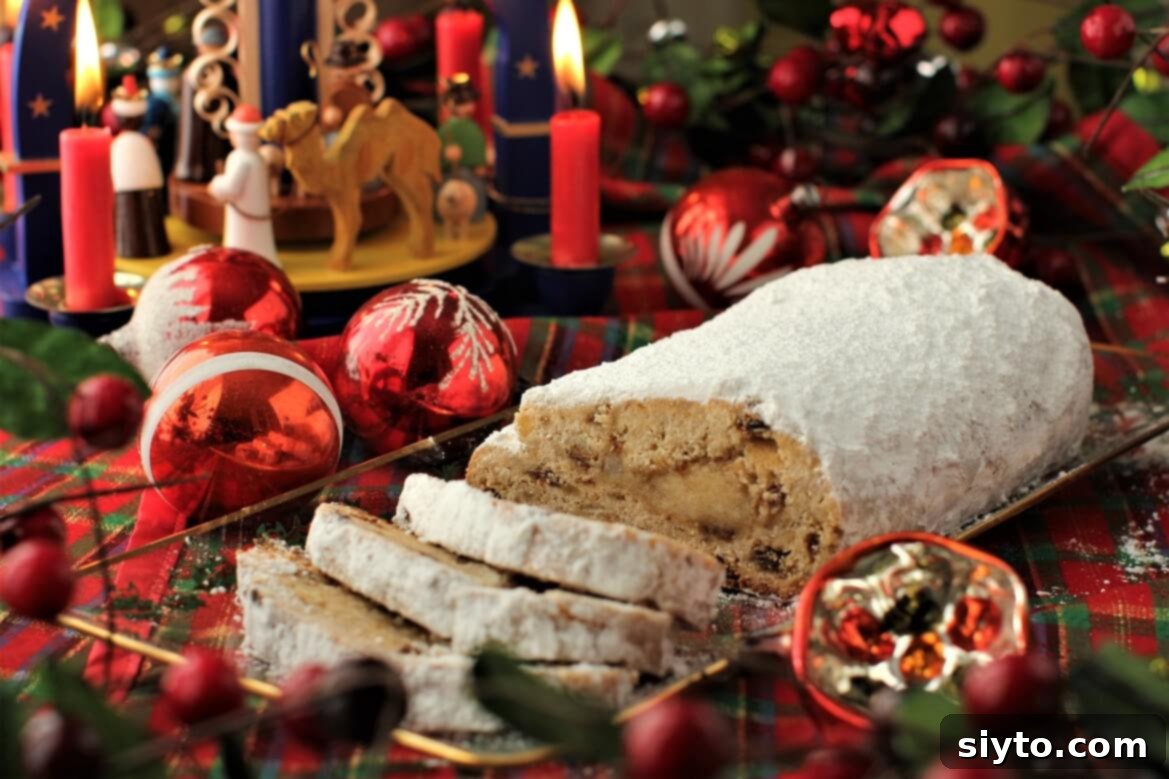
Easy German Quark Stollen: A Yeast-Free Christmas Bread Recipe for the Holidays
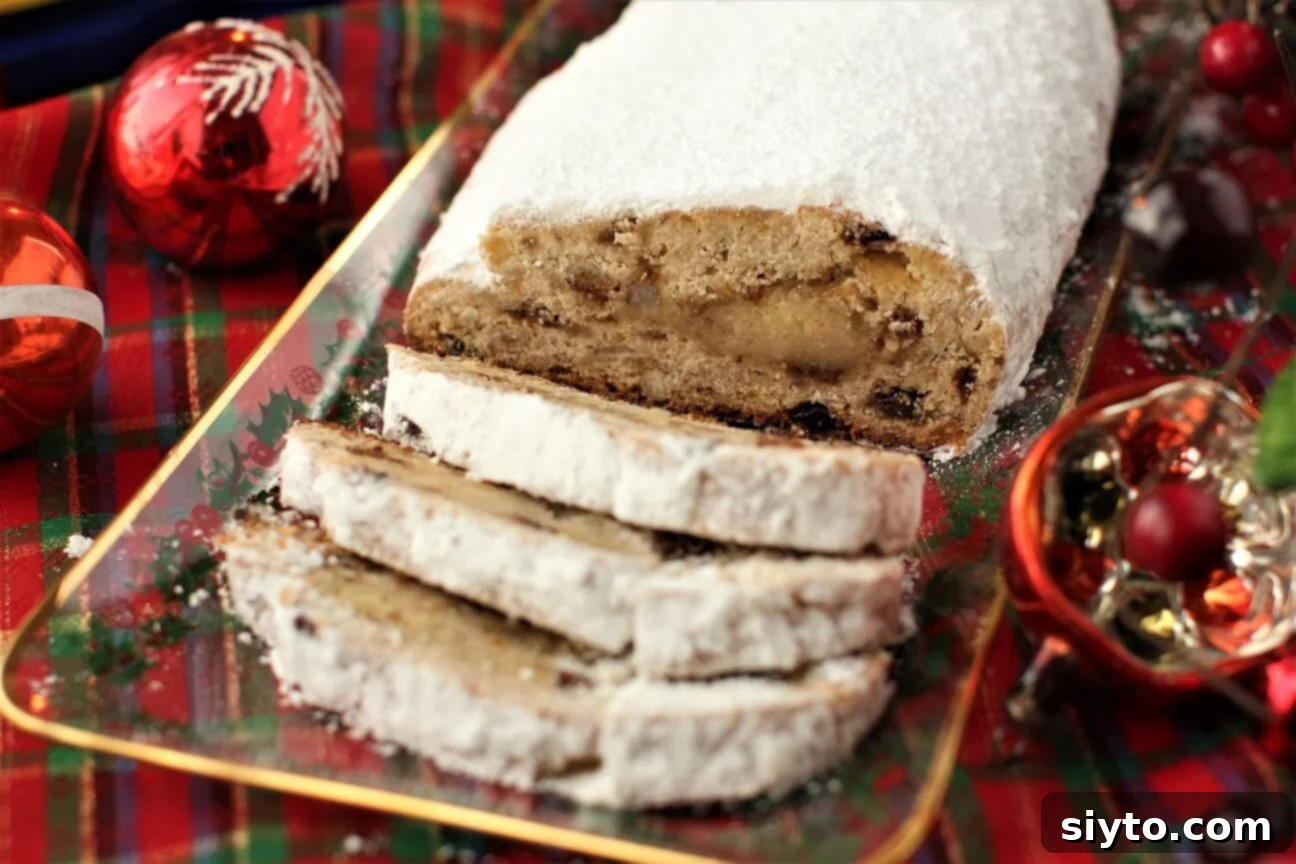
The irresistible aroma of a traditional German Stollen, with its signature raisin-studded dough, luscious marzipan filling, and thick blanket of powdered sugar, is a quintessential signal that Christmas has arrived. For me, a tender slice of this sweet, fruity loaf, perfectly paired with a warm cup of milky tea or robust coffee, transforms a simple morning into a festive light breakfast or an utterly delightful afternoon treat. While classic Stollen often requires time-consuming yeast preparation and weeks of aging, this particular recipe focuses on the simpler yet equally delicious Quarkstollen. This means you can skip the fuss of working with yeast, the lengthy rising times, and the two-week waiting period, allowing you to enjoy your homemade Stollen much sooner. We’ve even included a versatile option for a gluten-free version, ensuring everyone can partake in this beloved holiday tradition. (Skip to recipe.)
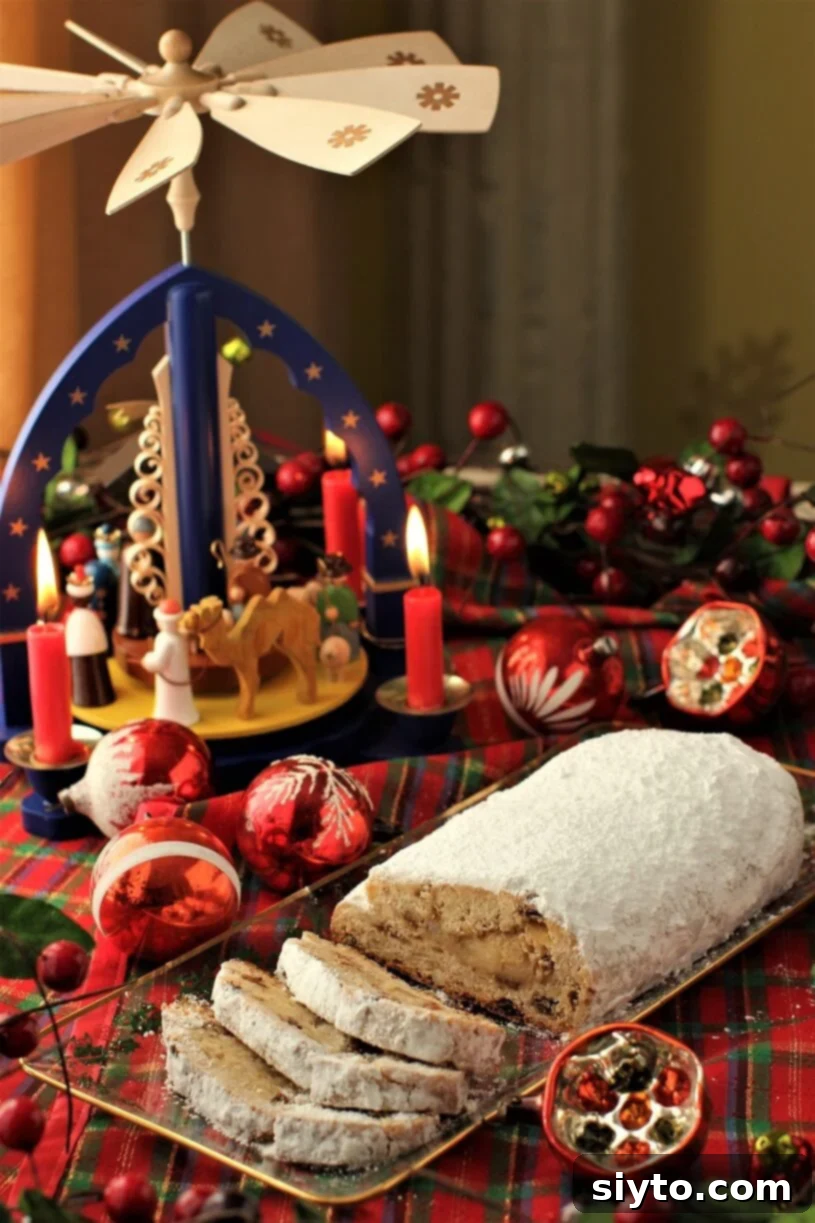
As the “Pa-rum-pum-pum-pummmmm” of Christmas carols fills the air, the holiday season truly feels upon us. It’s remarkable how quickly time seems to fly, isn’t it? Just yesterday it was autumn, and now our home is beautifully decked out in festive decorations. Regardless of the scale of our celebrations this year, the spirit of the season gently wafts through the air, bringing with it a much-needed sense of joy. For a while, I feared I wouldn’t find that special Christmas feeling, but thankfully, it has returned, and for that, I am truly grateful. It remains the blessed celebration it has always been, a time for reflection, gratitude, and simple pleasures.
A heartwarming little saying recently resonated with me:
‘The first Christmas was pretty simple. It’s okay if yours is too.’
Those words struck a chord. Indeed, it is absolutely okay for our celebrations to be simple. In these times, the ability to celebrate at all, in any capacity, is a gift to be cherished. This year, my personal way of embracing the Christmas spirit has been a delightful culinary endeavor: perfecting a traditional Quarkstollen recipe, specifically adapting it to be gluten-free, aiming for the exact taste and texture of the Stollen I fondly remember from my childhood Christmases.
Growing up, this traditional fruit-studded bread was often purchased from German delicatessens or arrived as a thoughtful gift from relatives and friends. Some years, my mother would bake a batch for us. As a child, however, I confess I never truly appreciated this iconic Christmas treat. My strong aversion to raisins was a significant factor, as was what I perceived as the cake’s dryness. Its only redeeming quality, in my young mind, was the luxurious little bite of marzipan nestled in the center of each slice. If I could get away with it, I would discreetly crumble off the bread around the edges, devouring only the sweet, almond-infused middle. Oh, how times change!
Now, as an adult, I’ve magically developed a profound liking for a fruity, moist slice of Stollen to accompany my morning coffee or afternoon tea. My true appreciation blossomed years ago when the parents of our first German exchange student sent us a colossal, authentic Dresdner Christstollen directly from Dresden. It arrived in its characteristic decorated box, straight from the birthplace of Stollen, where these Christmas breads are still meticulously crafted with pure ingredients, adhering to centuries-old recipes and methods. There was an undeniable magic about that Stollen, a taste of history and tradition that instilled in me a deep sense of nostalgia. (I still use that very box to store some of our precious blown-glass German Christmas ornaments.)
Inspired by this yearning for that authentic taste, this past fall I embarked on a mission to create a Stollen that would fully satisfy that craving. While in Germany last Christmas, I picked up a Christmas baking magazine in Gröbenzell, the charming little town where we stayed. It featured a recipe for Quarkstollen that immediately piqued my interest. This, I thought, I could manage. Traditional Stollen is a rich yeast dough, generously laden with raisins, candied citrus peel, almonds, spices, and often a marzipan core. A Quarkstollen boasts all these wonderful elements, but ingeniously utilizes quark (a type of German fresh cheese) for its delightful tang and natural rising power instead of yeast. The yeasted version demands multiple rising stages typical of yeast doughs, and crucially, it needs to be aged for a full two weeks before it reaches its optimal flavor and texture. The beauty of Quarkstollen, however, is that it can be enjoyed as soon as it cools, although allowing it a day for the flavors to meld and mellow certainly enhances its complexity. This makes it a perfect last-minute Christmas bake!
Another iconic characteristic of a truly traditional Stollen is its thick, pristine blanket of powdered sugar. This isn’t merely for aesthetics; it serves a vital historical purpose. Immediately after emerging from the oven, the hot cakes are generously brushed and soaked with melted butter. Once cooled, they receive their heavy coating of icing sugar. This process historically helped to seal and preserve the cakes in the days before widespread refrigeration. Legend has it that a properly buttered and sugared Stollen could remain edible and delicious well into Easter time. While it might have been a bit drier by then, enjoying it with a hot beverage would reawaken that unique, exquisite blend of raisins, citrus peel, and marzipan flavors, a true testament to its preserving power and enduring taste.
My Stollen Adventures and the Path to Perfection
In my quest for the ultimate Quarkstollen, I baked this recipe four times within a few weeks, meticulously tweaking each batch to achieve just the right balance and texture. My initial attempts involved using dry cottage cheese as a substitute for quark, which is often challenging to find here. The first batch, unfortunately, wasn’t quite right for human consumption, so it became a festive treat for our chickens (they deserve Christmas joy too!). The second batch, while edible, wasn’t perfect enough for Stollen, but it found a delicious second life as a wonderful Stollen bread pudding, which we plan to enjoy again during the holidays. The third attempt was close enough to be proudly included in Christmas parcels for our children, spreading some early holiday cheer. Finally, this last batch achieved perfection. It boasts the ideal balance of rum-infused raisins, fragrant citrus peel, and finely ground almonds that I adore, complemented by just a hint of warming spices and a generous, irresistible filling of marzipan – undeniably the best part. This delightful cake also keeps exceptionally well, becoming even more moist and developing a richer, more complex flavor profile as it ages.
And should you find yourself with any leftover almond paste or marzipan, fret not! It freezes beautifully (even if it’s been frozen before, it’s perfectly fine to refreeze it) and can be used later in other delicious recipes, such as these Almond Cranberry Scones, adding another touch of gourmet flavor to your baking.
While making a Quarkstollen involves a few distinct steps, even without the demands of yeast, the time and effort invested are truly worth it for such a special Christmas treat. In fact, I found the entire process to be a beautiful and meditative Christmas activity, enjoying every minute of creation. This perfected Stollen recipe is now firmly etched into our family’s holiday traditions, and I look forward to baking it for many Christmases to come.
Step-by-Step Guide to Crafting Your Perfect Quark Stollen
This section provides detailed instructions, complete with illustrative photos and general guidance, to help you visualize each stage of the Stollen-making process. It is quite comprehensive. For those who prefer to jump straight to the exact ingredient measurements and concise instructions without the visual aids, please feel free to skip directly to the recipe below.
To begin, you’ll need to prepare the fruit a day in advance. Finely chop the candied citrus peel and combine it with the raisins and rum. Allow this mixture to soak overnight, stirring or shaking the jar a few times to ensure the rum is evenly distributed. A mason jar works wonderfully for this purpose.
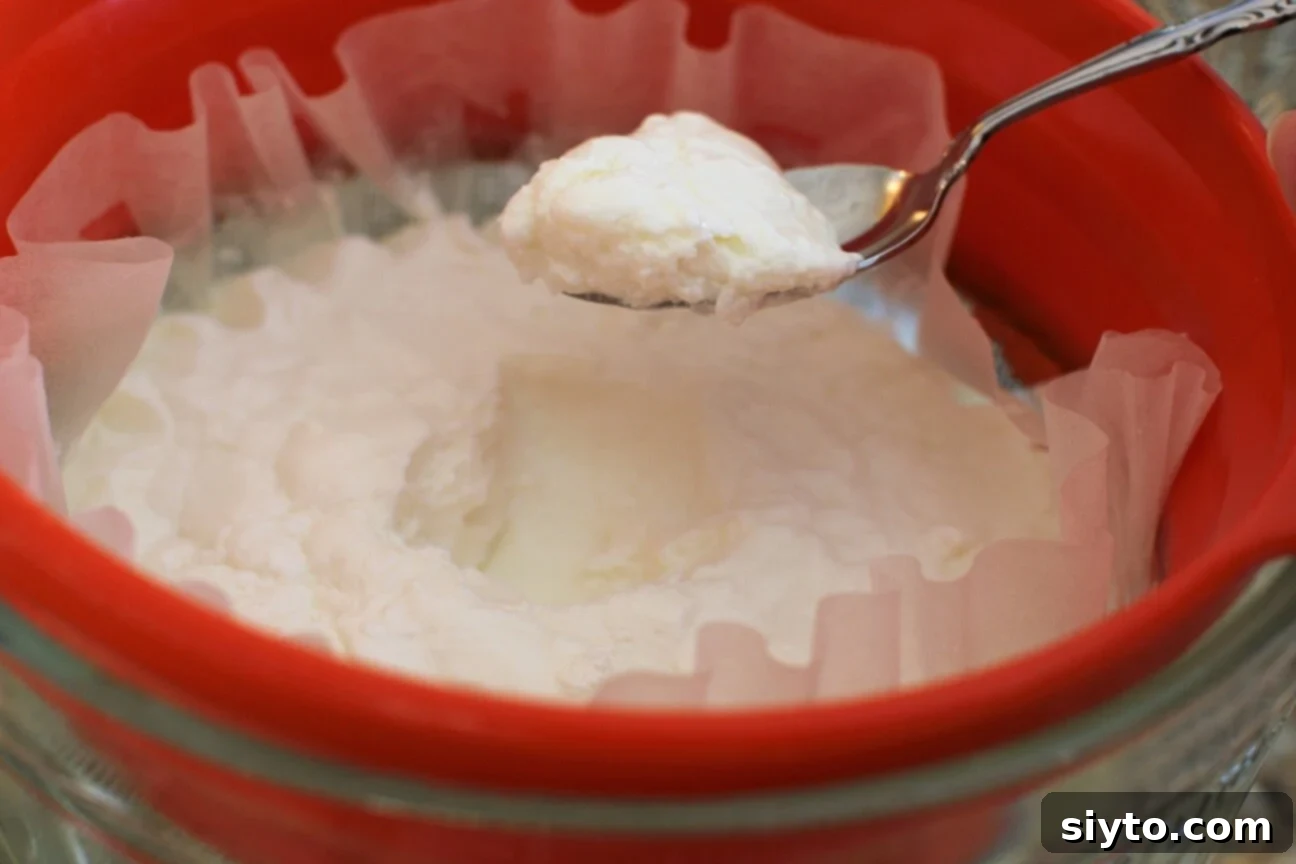
If authentic German quark is not readily available in your area, you can easily create a close substitute by straining regular plain yogurt. Line a sieve with a coffee filter, a double thickness of paper towel, several layers of cheesecloth, or a clean tea towel. Pour the yogurt into the lined sieve, set it over a bowl, and cover it with plastic wrap or a plate. Place it in the refrigerator and allow it to drain for a full day. This process removes the excess whey, resulting in a thick, creamy consistency similar to quark, ideal for your Quarkstollen.
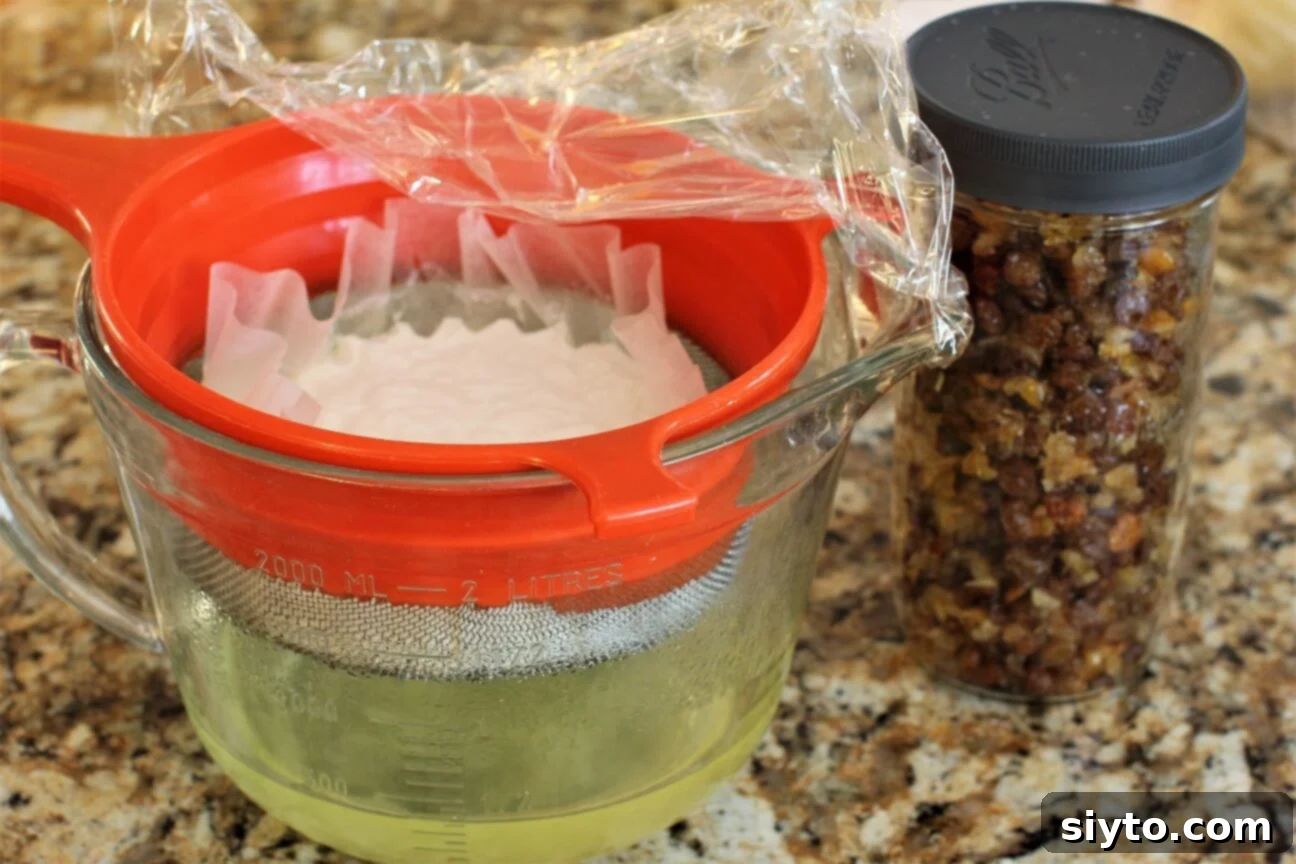
Once the whey has drained away, your yogurt will have achieved a beautifully thick and creamy consistency, perfectly mimicking quark for our delicious Quarkstollen.
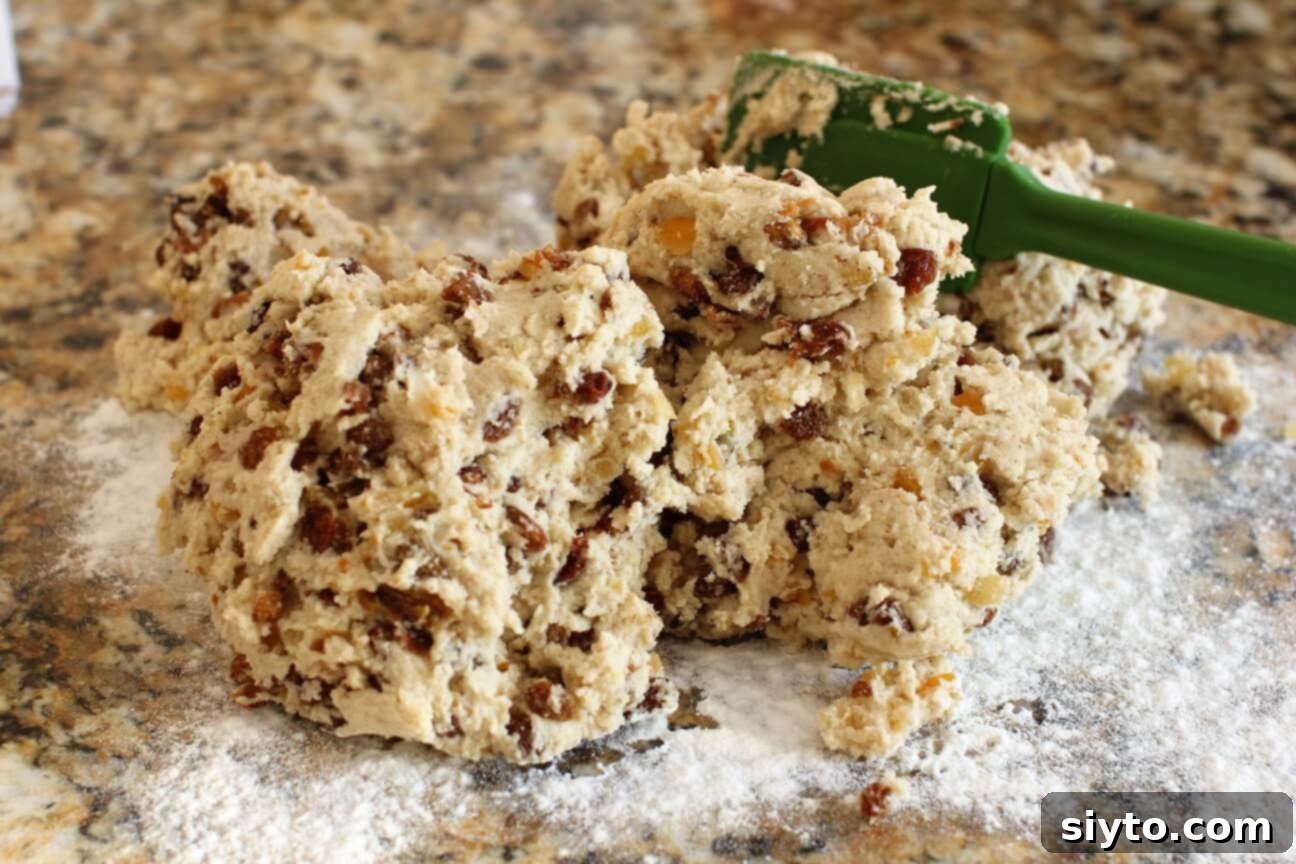
With our strained yogurt ready, we can now assemble our rich and fragrant dough. This comes together with flour (choose regular all-purpose or a gluten-free blend as specified in the recipe), softened butter, farm-fresh eggs, sugar, a warming blend of spices, finely ground almonds, the prepared strained yogurt (or quark), and our rum-soaked raisins and candied citrus peel. Each ingredient plays a crucial role in developing the Stollen’s characteristic flavor and texture.
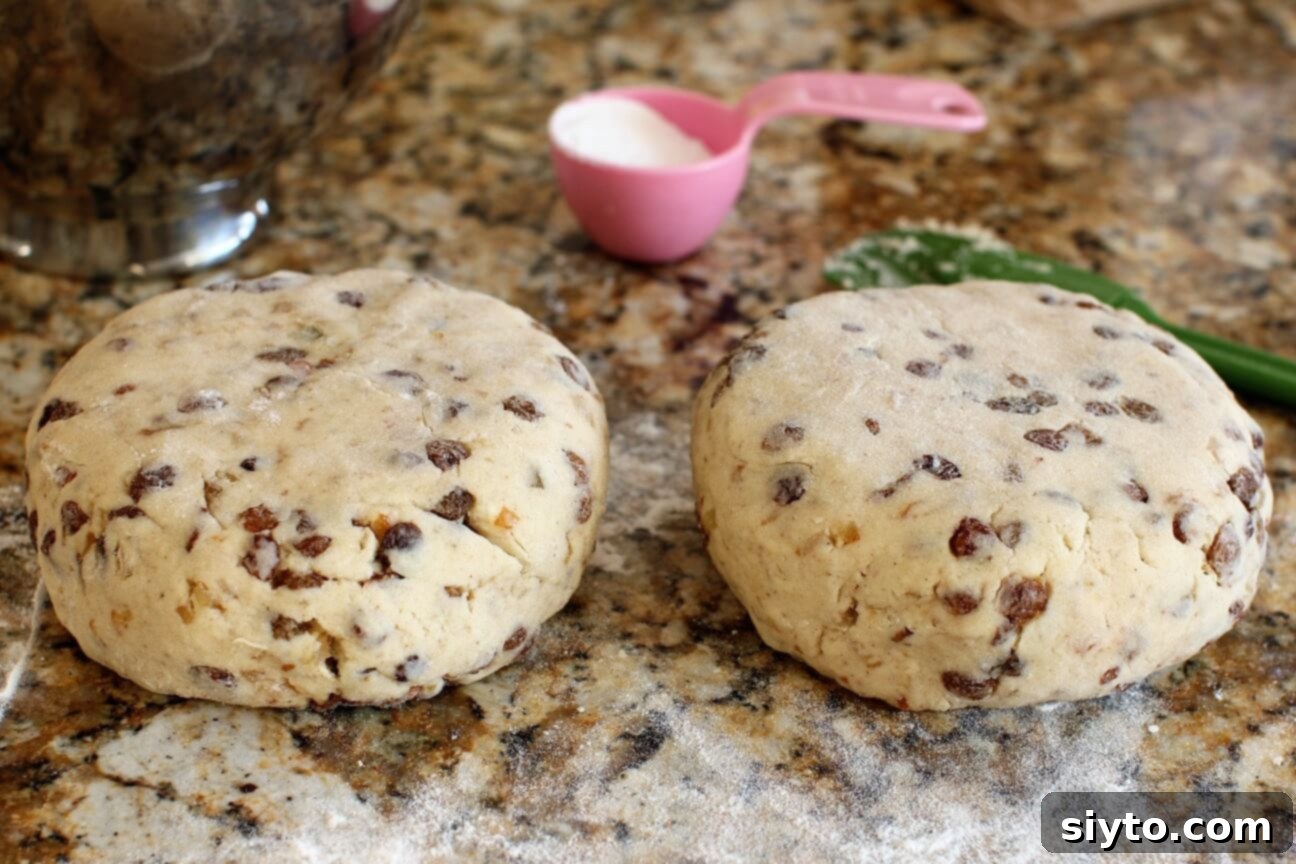
Once the dough is fully mixed, gently pat it into two smooth, evenly sized balls, preparing them for the next stage of shaping.
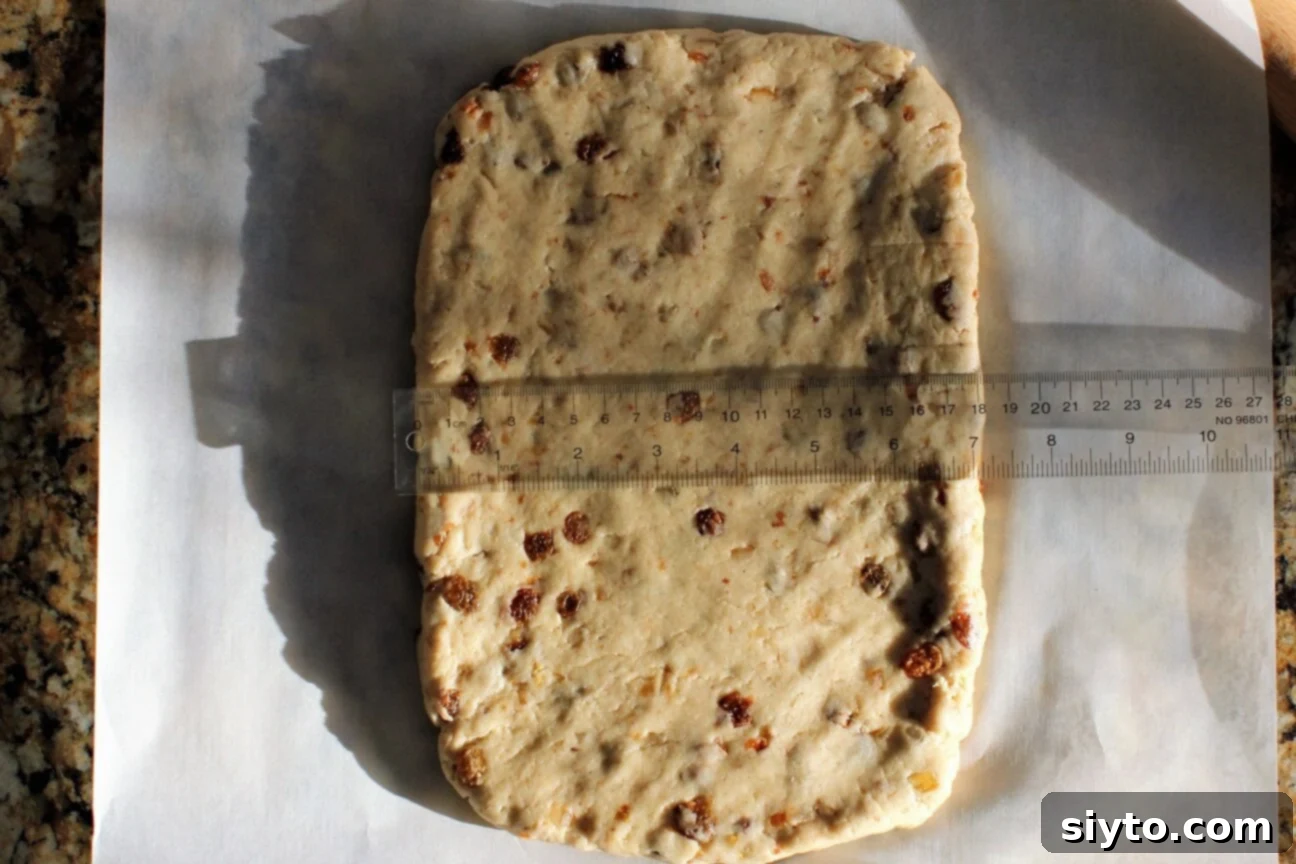
Lay each dough ball onto a piece of parchment paper. Roll each into an approximate 7 x 10-inch rectangle, aiming for gently rounded corners. Don’t hesitate to use your hands to pat, push, and smooth the edges, giving the dough a neat, uniform shape.
Next, prepare the decadent marzipan filling. Roughly dice the almond paste and knead it together with two tablespoons of soft butter until it becomes a smooth, soft, and pliable mass. This ensures an even and delicious layer of marzipan in every slice of your Stollen.
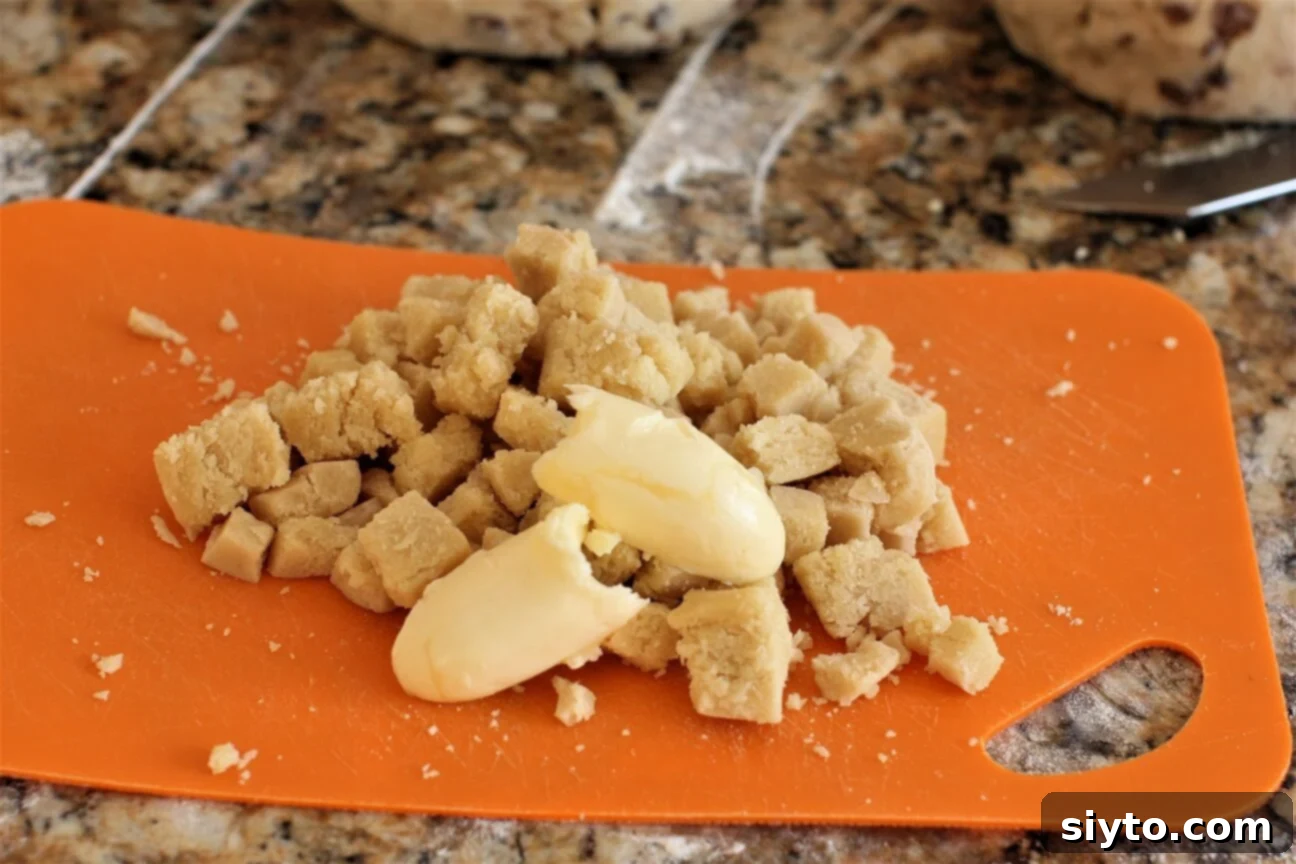
Divide the kneaded marzipan into two equal portions and roll each into a neat 9-inch rope. This part can be quite satisfying, almost like playing with modeling clay! Carefully place one marzipan rope down the center of each prepared Stollen dough rectangle.
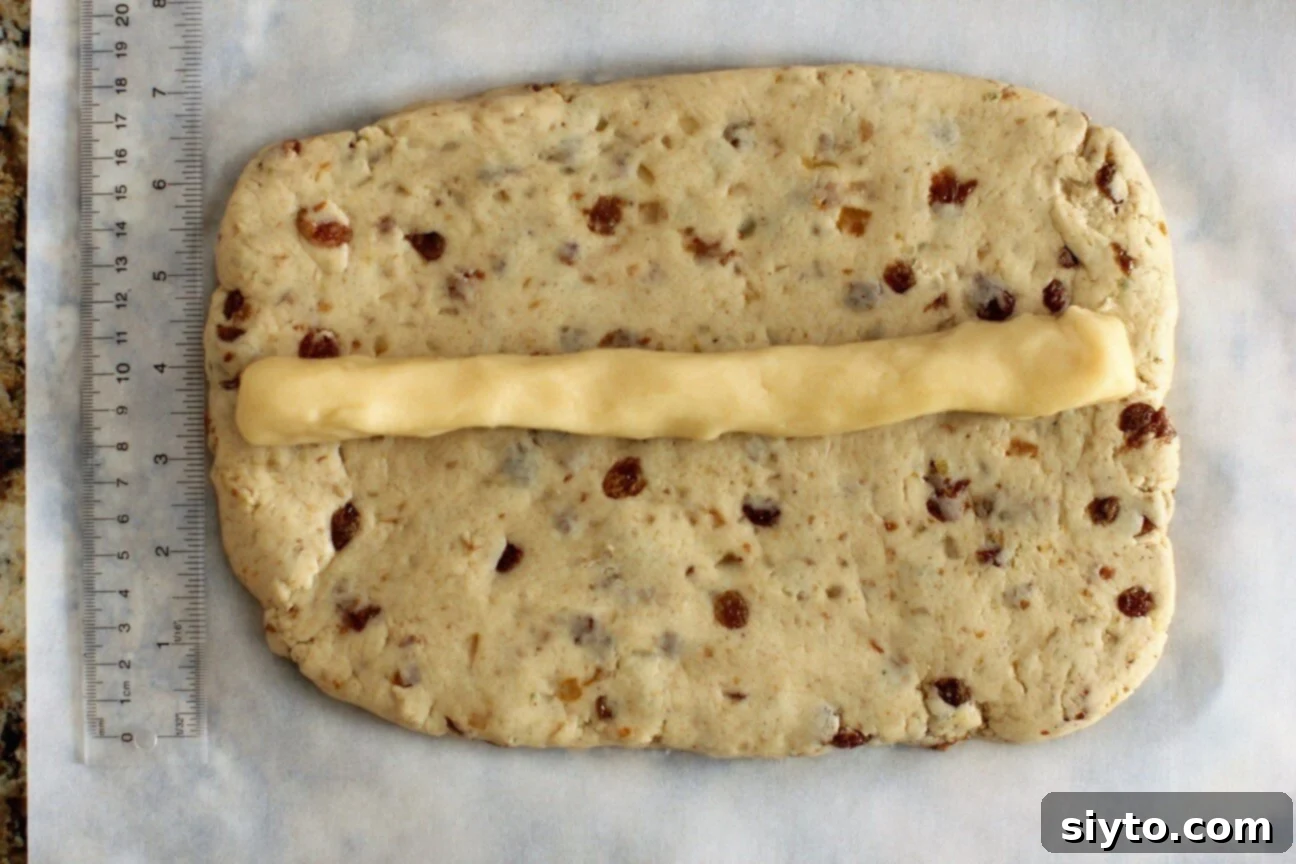
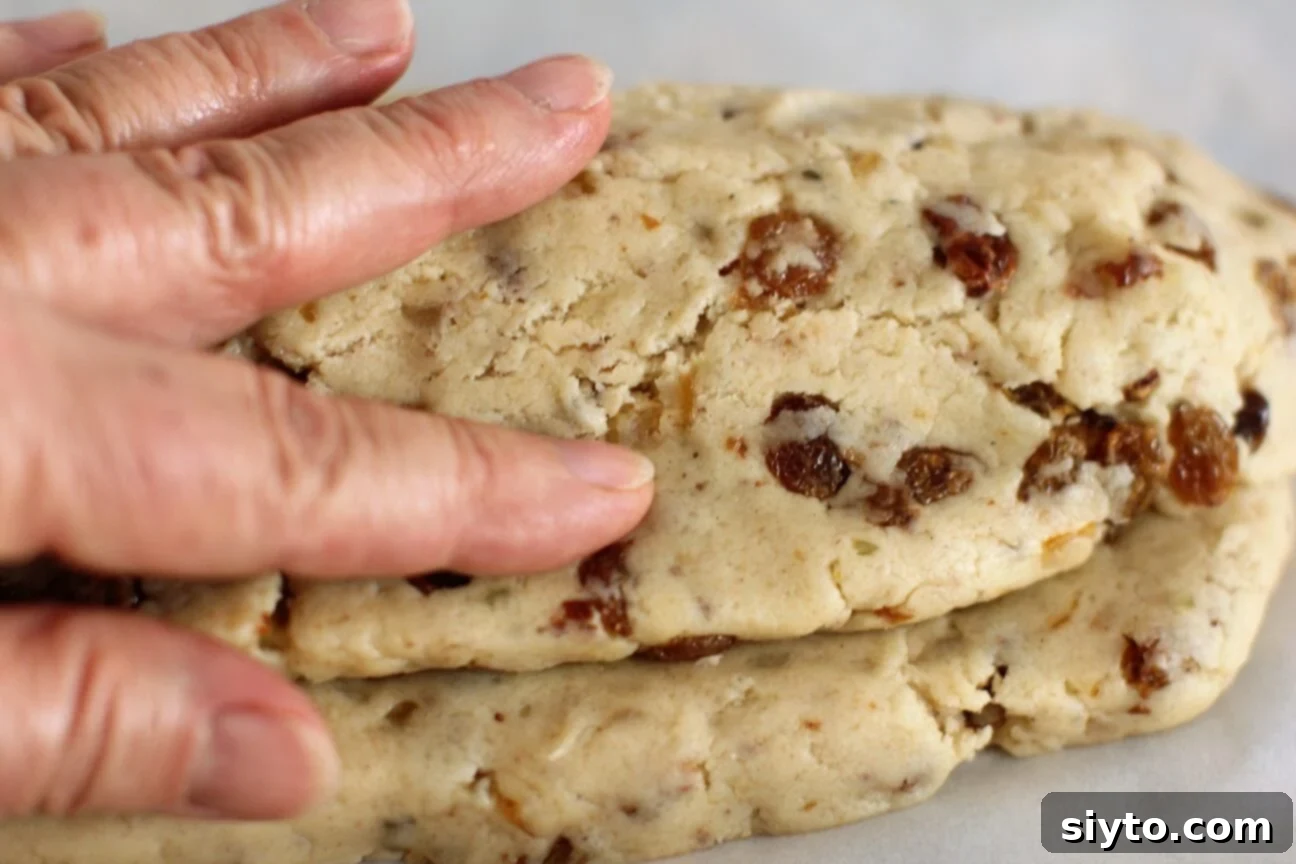
Now, gently use the parchment paper to assist you in lifting the dough. Carefully fold the wider piece of dough over the marzipan filling, ensuring that the top edge just slightly overlaps the bottom edge, leaving about a half-inch margin. This classic Stollen shape is reminiscent of the Christ Child in swaddling clothes.
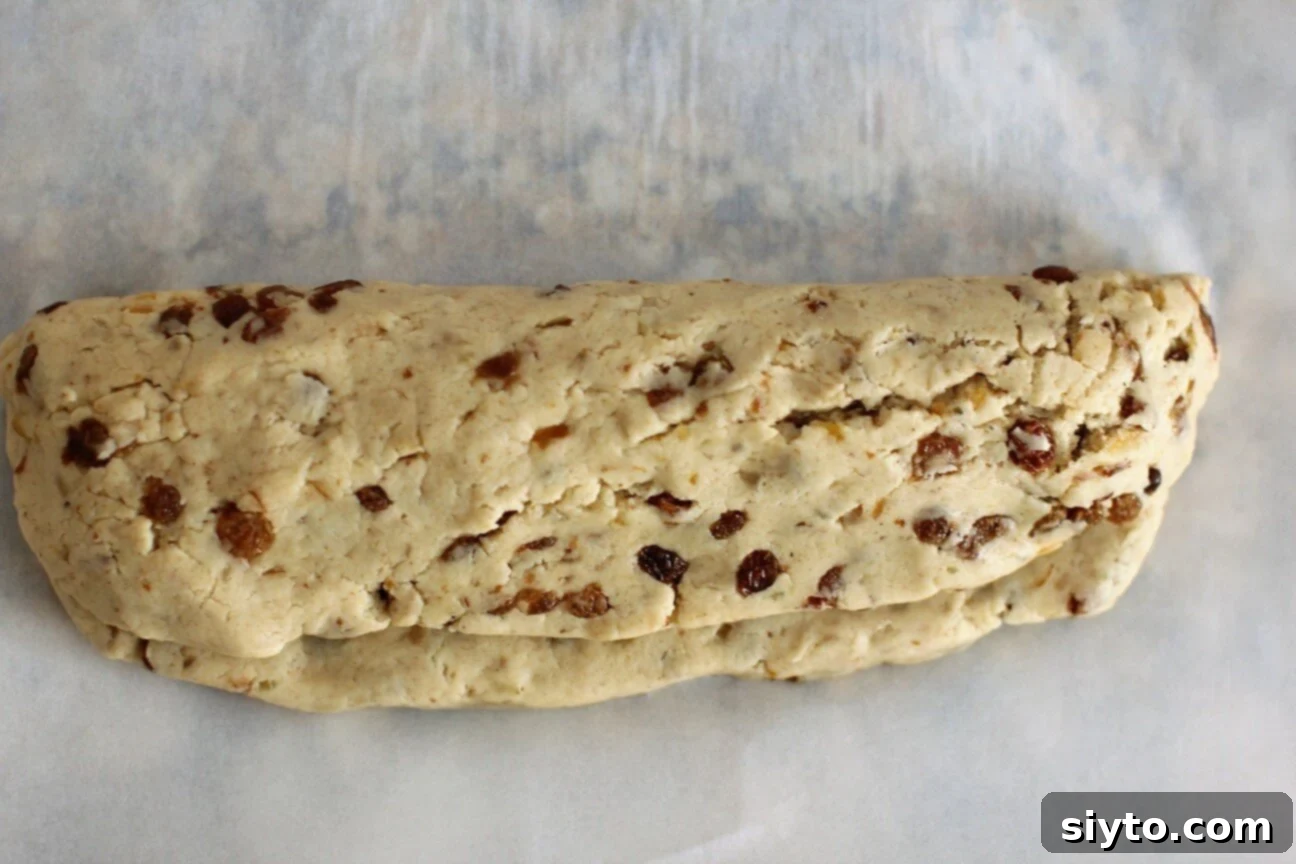
Inspect the dough for any larger cracks that may have formed during folding and gently pinch them together with your fingers to seal them neatly.
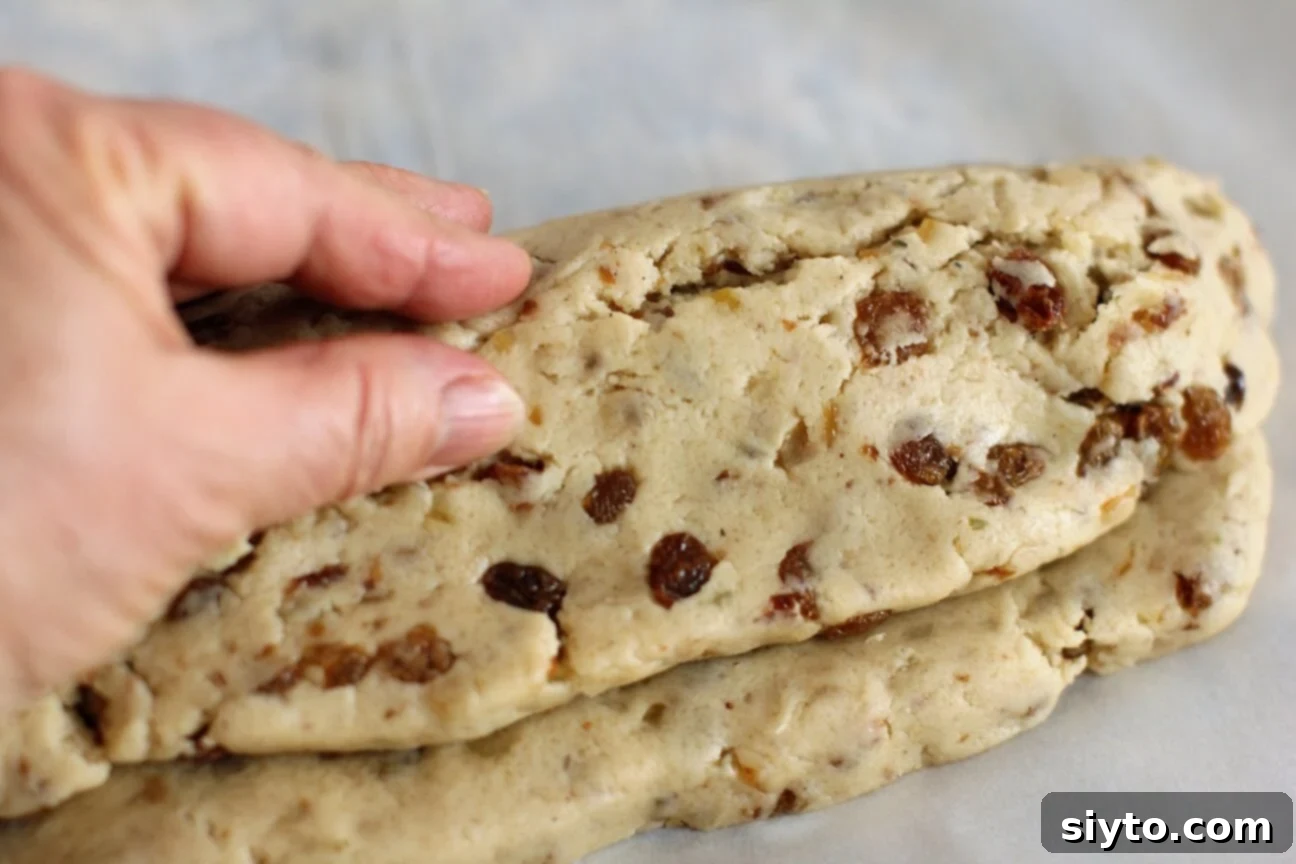
Finally, gently push down the top lip of the dough, firmly but carefully, to ensure it creates a tight seal with the bottom portion. This keeps the marzipan securely inside during baking.
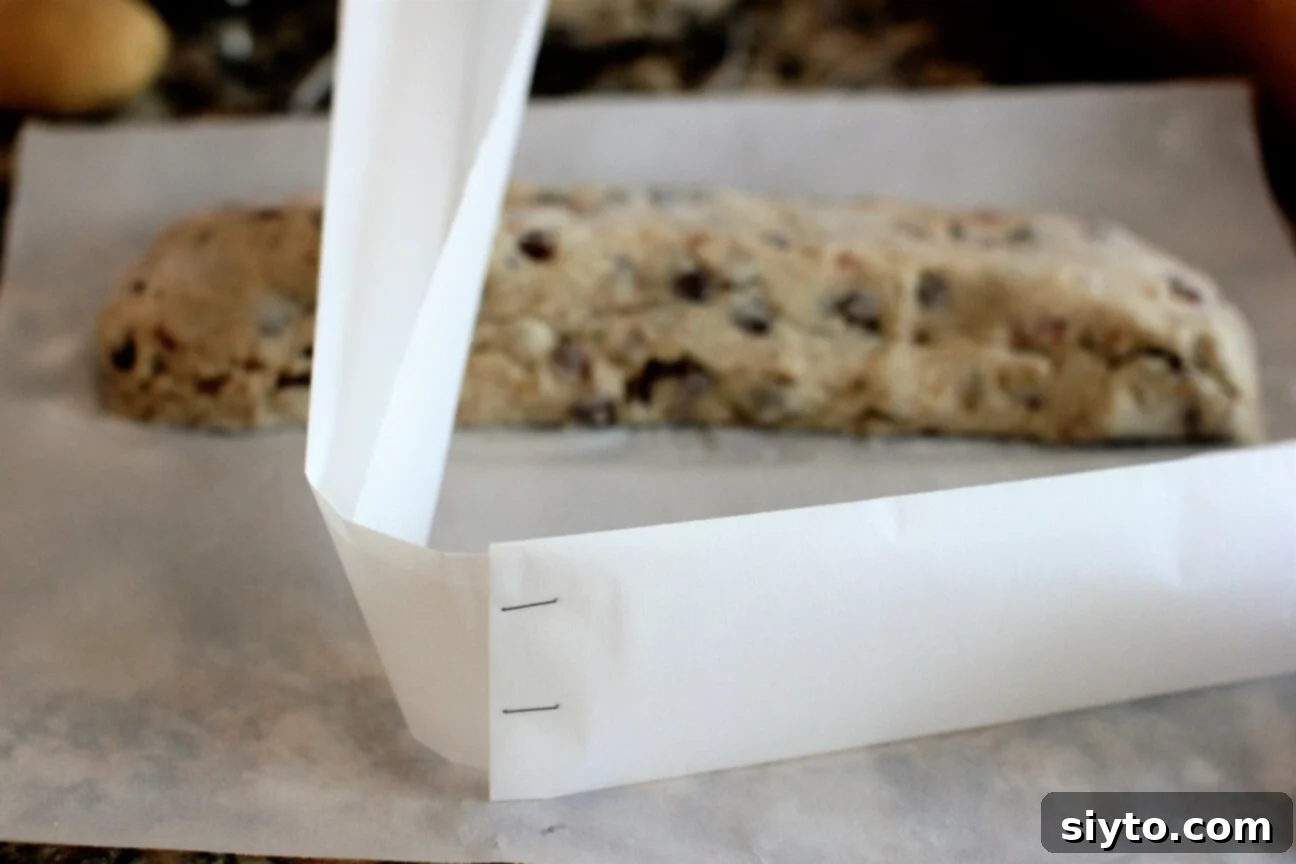
To help the Stollen maintain its characteristic oval shape and prevent excessive spreading during baking, you’ll create simple parchment paper bands. Start by folding 6-inch wide strips of parchment paper lengthwise into thirds, creating a robust, three-layer strip that’s about 2 inches wide. Join two of these strips together (stapling or sewing works well) to form a longer strip, then trim it to a total length of 27 inches. Finally, staple the ends together, overlapping by about an inch, to create an oval band. Repeat this process for the second Stollen. In Germany, specialized Stollen pans are often used for shaping, but these homemade parchment bands are equally effective and, I find, allow for a more rustic and appealing natural shape on top.
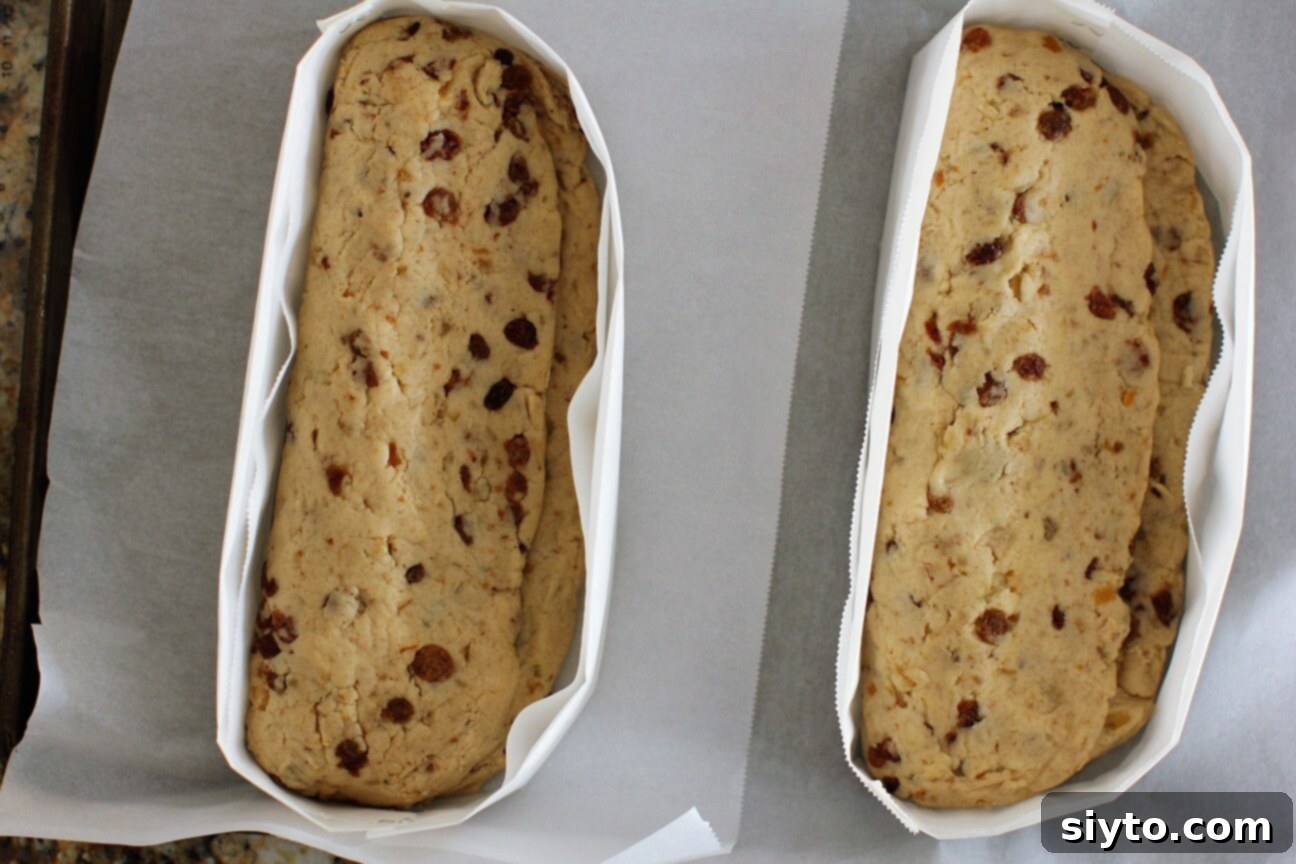
Carefully transfer the shaped Stollens, still on their parchment paper, onto baking sheets. Place one of the prepared parchment rings around each Stollen. You might need to gently push in the ends of the Stollens slightly to ensure the band fits loosely around them, providing support without constriction.
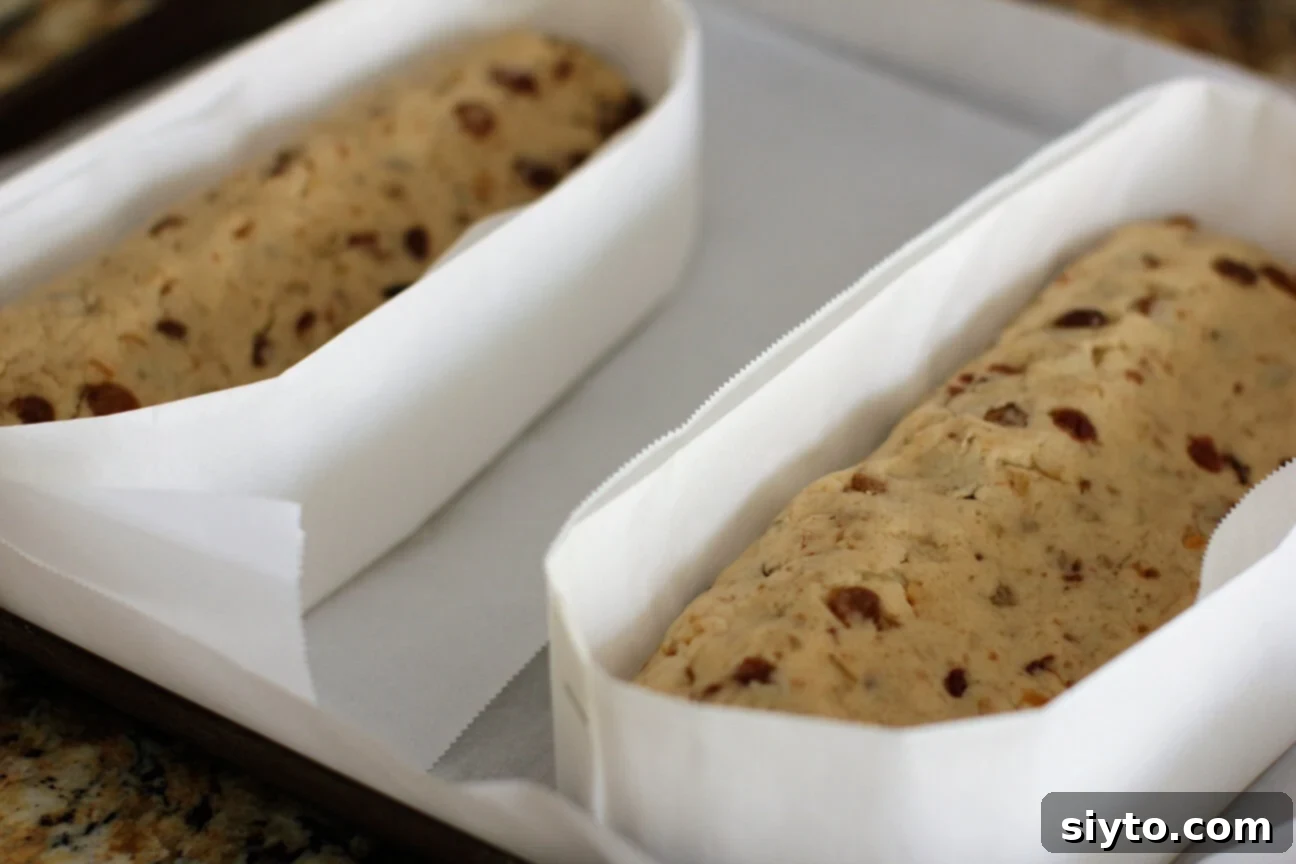
Ensure that the parchment bands are pushed firmly down, resting directly on the baking pans. This stability is key to helping the Stollen maintain its beautiful form as it bakes to golden perfection.
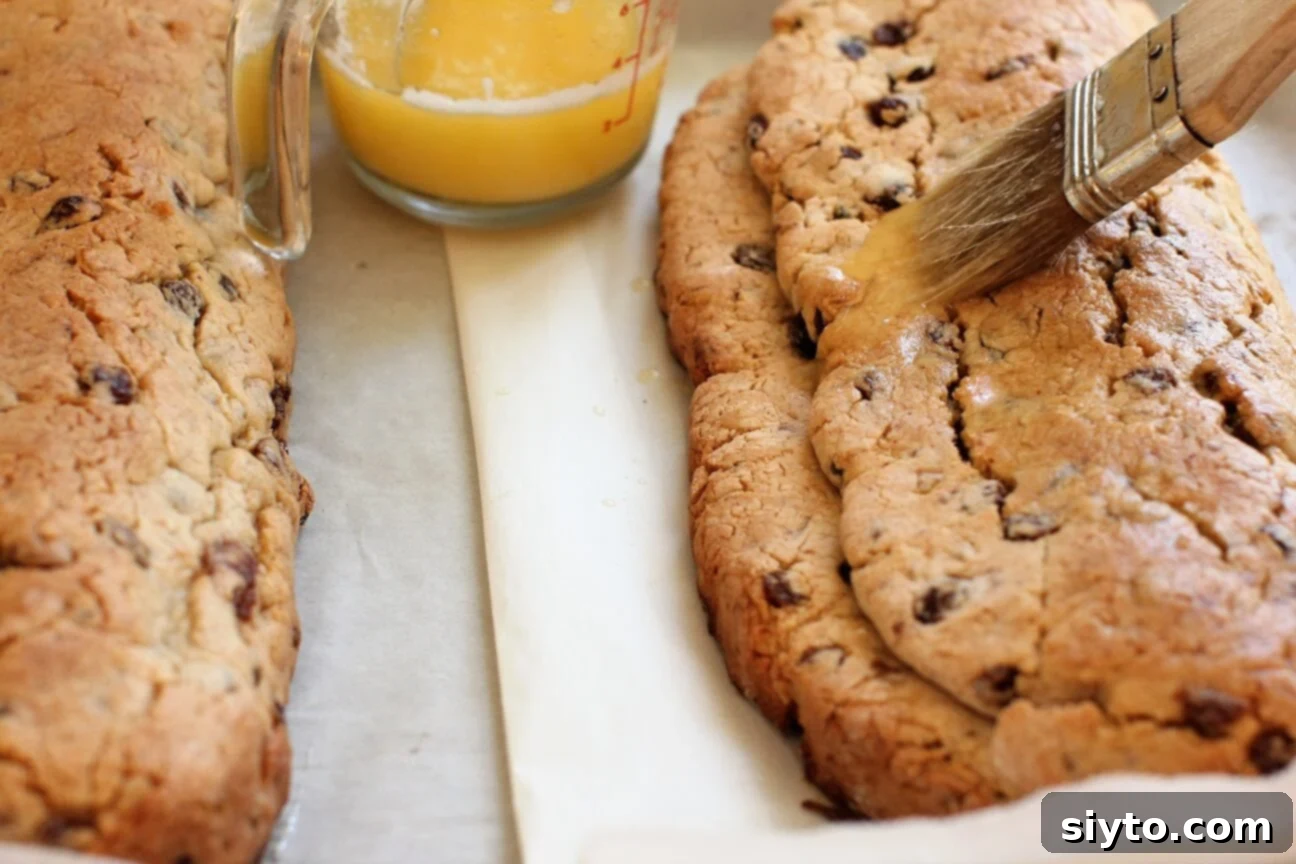
Now, bake the cakes until they are beautifully golden brown and a toothpick inserted into the center comes out clean. The moment they emerge from the oven, while still hot, generously brush each Stollen with melted butter, allowing it to soak into the warm crust.
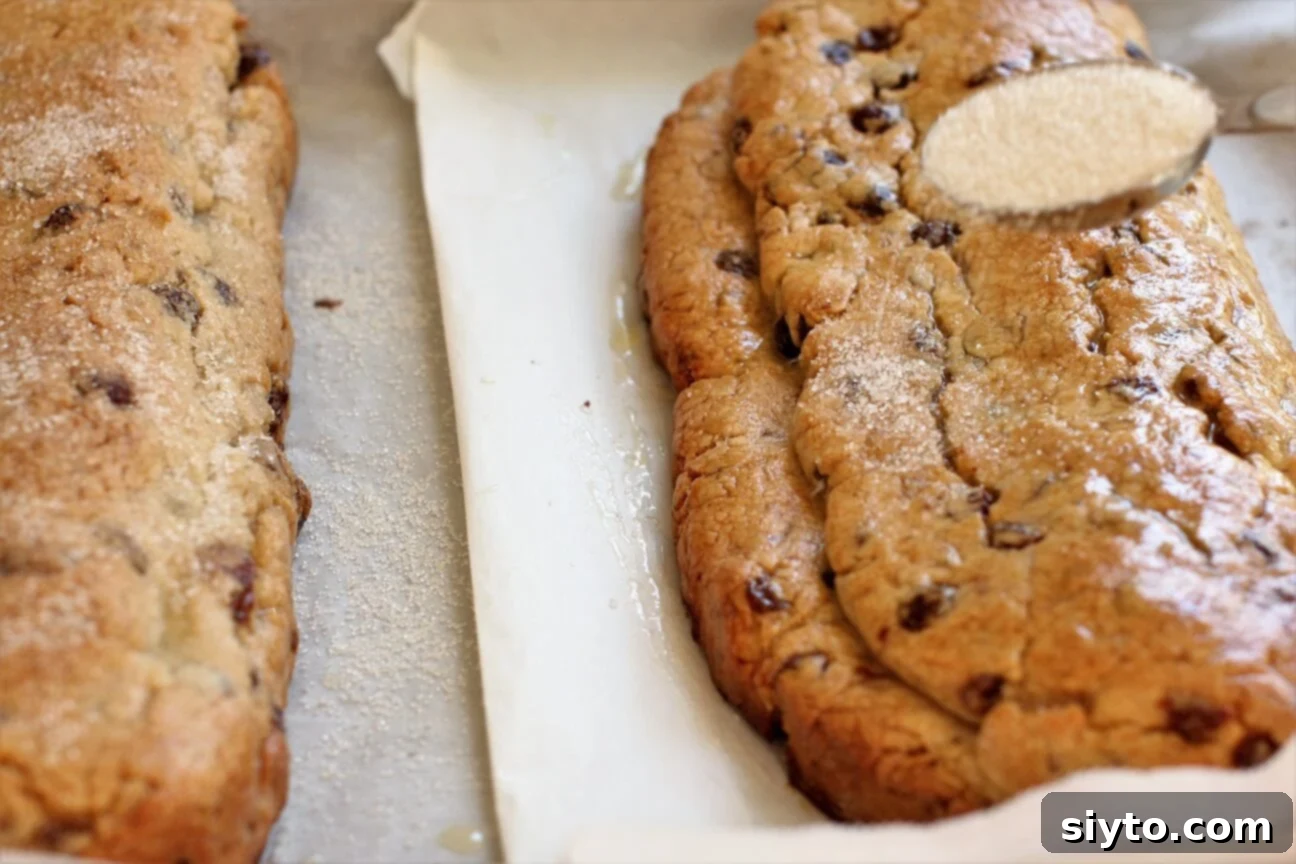
Immediately after buttering, sprinkle each cake with a tablespoon of granulated sugar. This initial layer of sugar adheres beautifully to the melted butter, creating a delightful sugary crust.
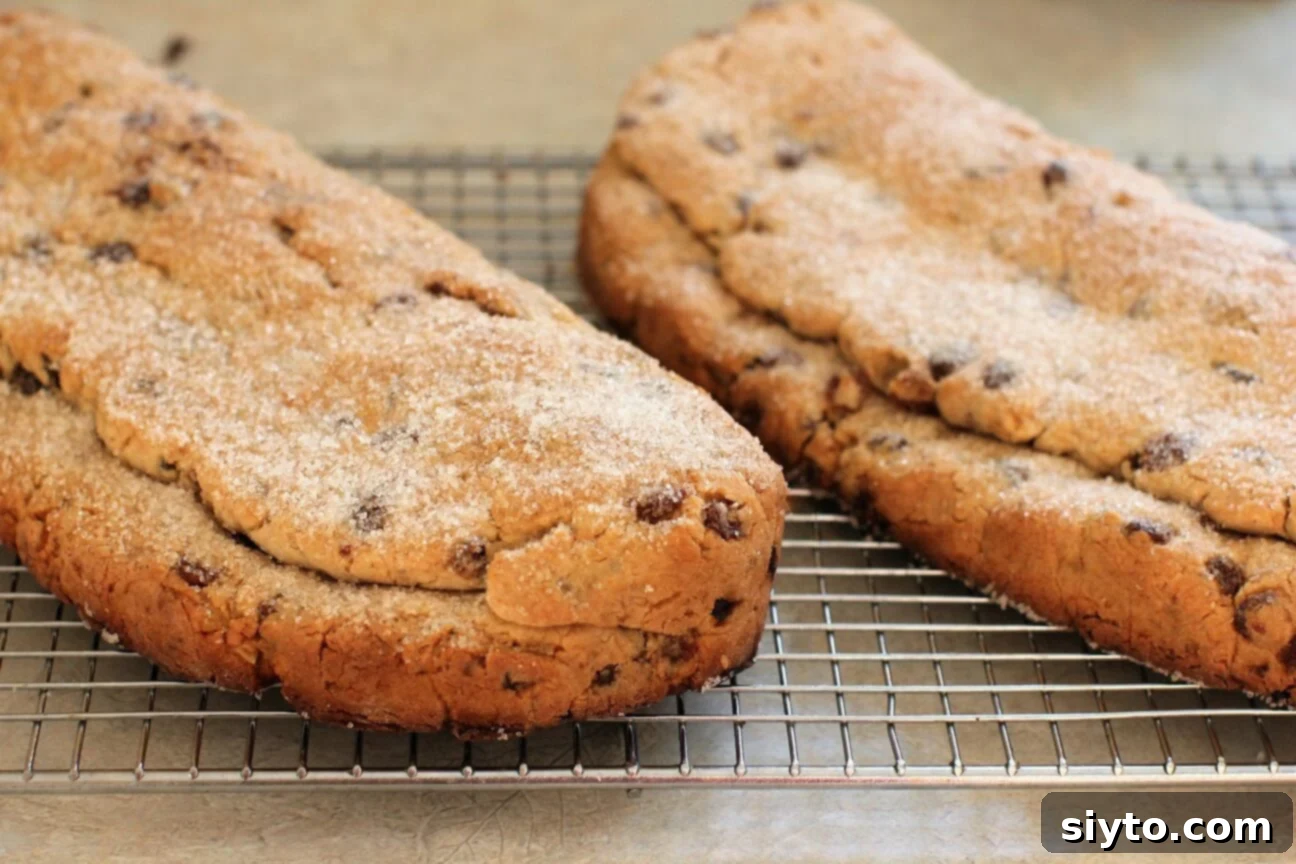
Once sugared, carefully slide the Stollens, still on their parchment paper, onto a cooling rack to cool completely. Allowing them to cool gradually helps set the butter and sugar layers and prevents them from becoming soggy.
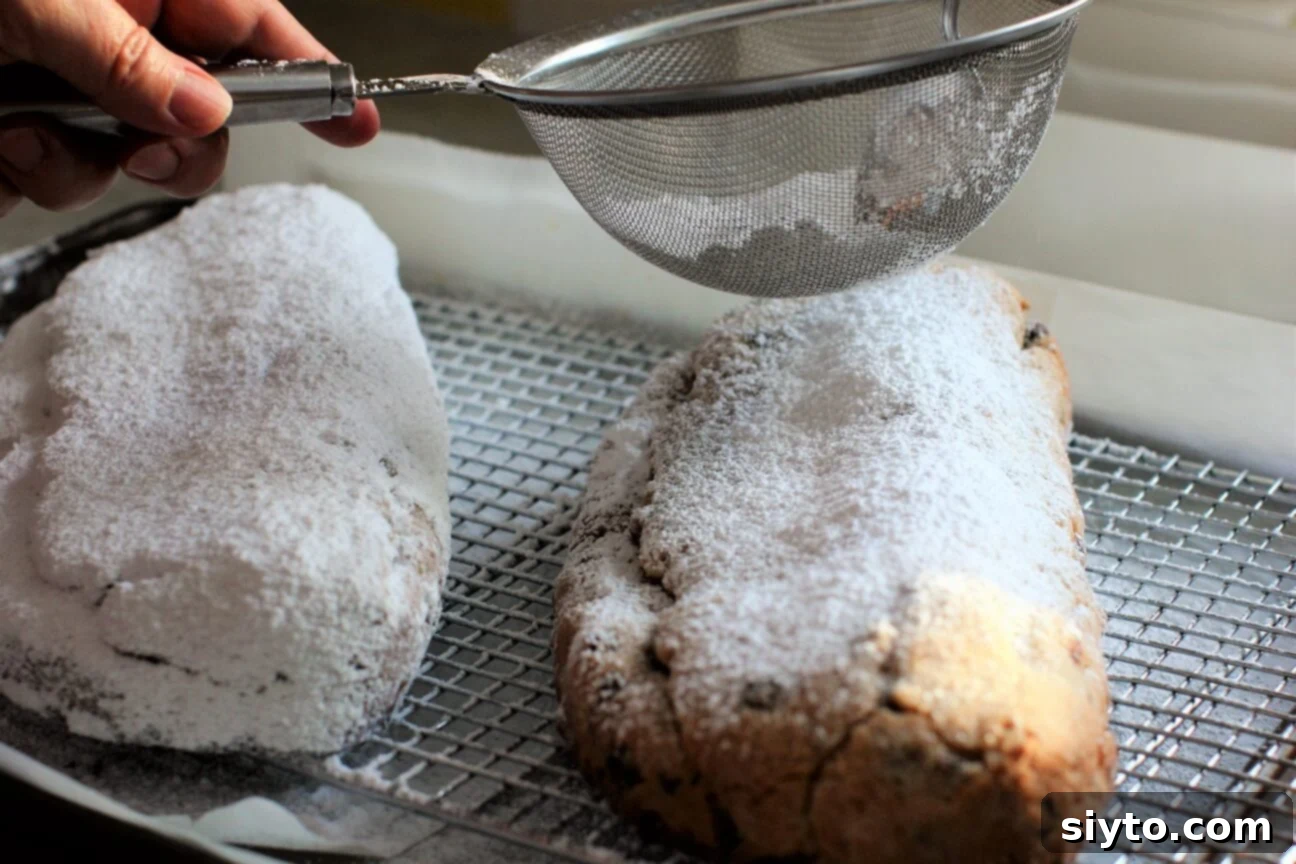
When the Stollens are completely cool, place the cooling rack over the used parchment paper (to catch any excess), and liberally dust them with a thick layer of icing sugar, shaken through a fine sieve. For complete coverage, flip them over and sprinkle the bottoms first, then return them upright to cover the tops and sides. This generous butter and icing sugar coating is not just for beauty; it forms a protective layer that historically helped preserve the cakes and keeps them wonderfully moist, allowing the flavors to deepen over time.
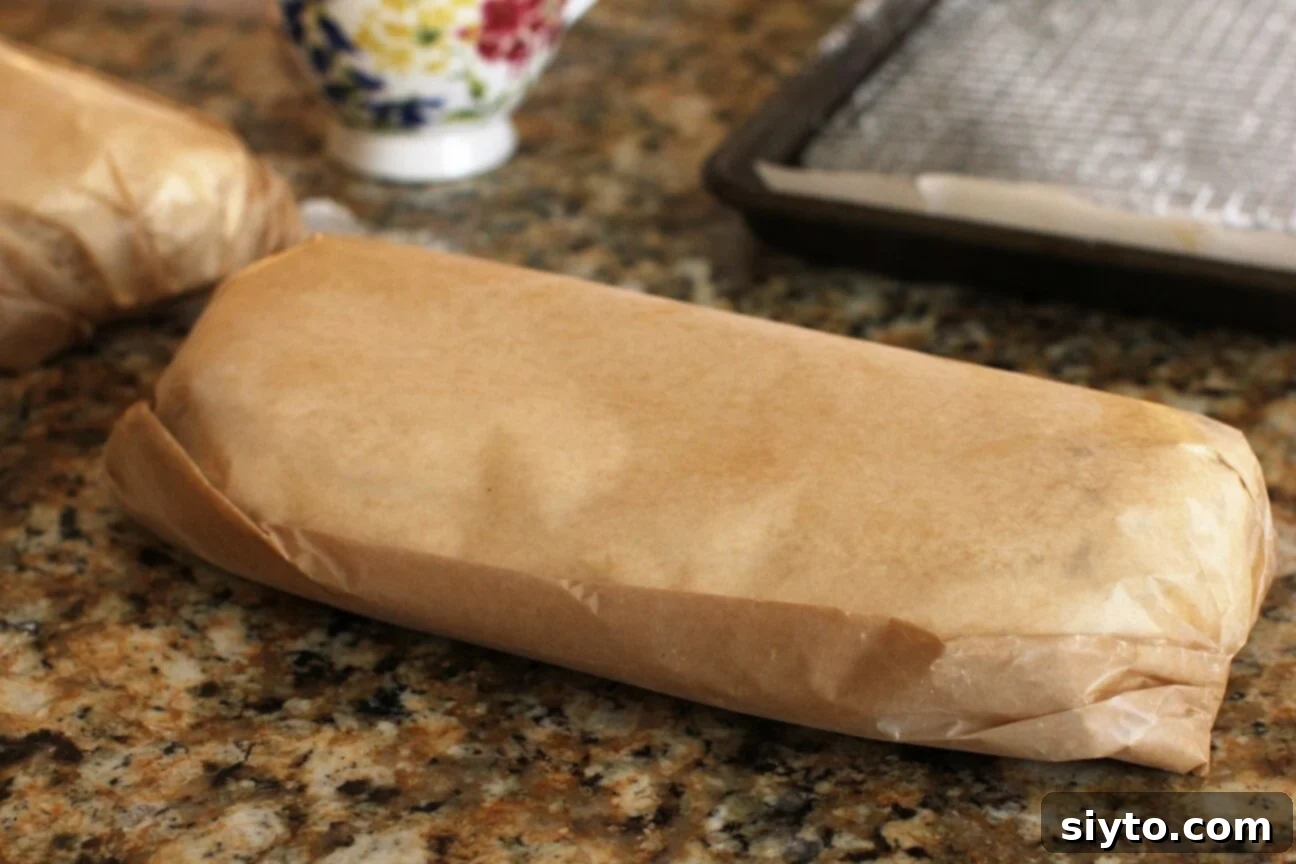
At this point, you can slice into one to enjoy immediately, or prepare them for storage. To store, wrap each Stollen first in wax paper or parchment paper, then slide them into a sealed container, a plastic bag, or wrap them tightly in aluminum foil. This multi-layered wrapping helps maintain their freshness. Stollens can be kept at room temperature for at least a month, and traditionally, they are said to keep until Easter in Germany. For longer storage, especially in warmer climates, refrigerating them is advisable. The combined butter and icing sugar layer acts as a natural preservative, keeping the cake moist and allowing its flavors to mature beautifully. Remember to rewrap the cake tightly each time you cut a slice or two to ensure maximum freshness.
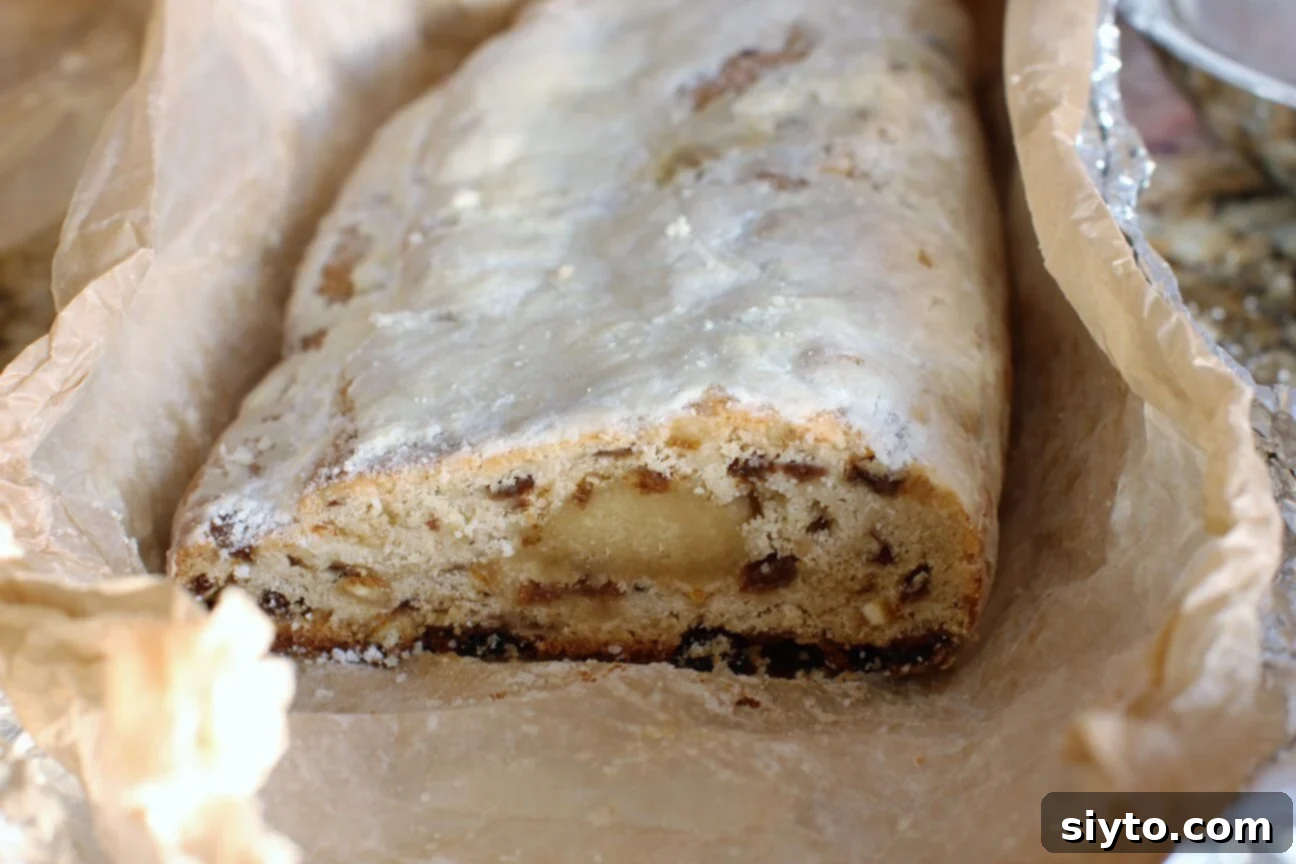
With your homemade Stollen ready, it’s the perfect moment to brew a fresh pot of coffee and slice yourselves a little piece of Christmas magic. Sit back, relax, and share Christmas secrets and plans over this delightful, fragrant treat. It’s these simple, delicious moments that truly define the holiday season.
* * * * *
Perhaps you’d also like to try making a traditional Canadian fruitcake? This incredible family recipe includes gumdrops and is guaranteed to convert even the most staunch fruitcake hater into an enthusiast. Kids of all ages simply gobble this one up!
Or how about Panforte, the Italian Christmas Cake? It’s deliciously chewy and almost candy-like, yet not overly sweet. Rich with exotic spices, nuts, dried fruit, and honey, it’s also remarkably quick and easy to prepare (and the gluten-free version works absolutely perfectly!).
* * * * *
Kitchen Frau Notes: It’s worth noting that the Stollen cake batter itself contains a moderate amount of sugar. The majority of the sweetness in the finished Stollen comes from the succulent raisins, the bright candied citrus peel, the rich marzipan, and, of course, the lavish icing sugar coating. This balance creates a nuanced sweetness that isn’t overpowering.
Creating the parchment paper collars for shaping the cakes is a step I highly recommend. These simple bands significantly help the Stollen maintain its beautiful oval shape and prevent it from spreading too much during baking. They are truly not difficult to make and make a noticeable difference in the final appearance and structure of your Stollen. In my early attempts without them, I found the cakes tended to spread out too flat.
For the most consistent and accurate results in your baking, especially with a recipe like Stollen, using a kitchen scale to weigh your ingredients is always preferred over volumetric cup measurements. Weight measurements are far more precise and will contribute to a more reliable outcome.
*If you are opting to make the Stollen gluten-free, it is absolutely crucial to use sweet rice flour (which might also be labeled as mochiko or glutinous rice flour), not regular white rice flour. Sweet rice flour provides a crucial elasticity and pliability to the dough, which is often lacking in gluten-free baking. In a batch where I mistakenly used regular rice flour, I ended up with significant cracks across the tops of my cakes, and the luscious marzipan filling unfortunately bulged out between them. The right flour makes all the difference!
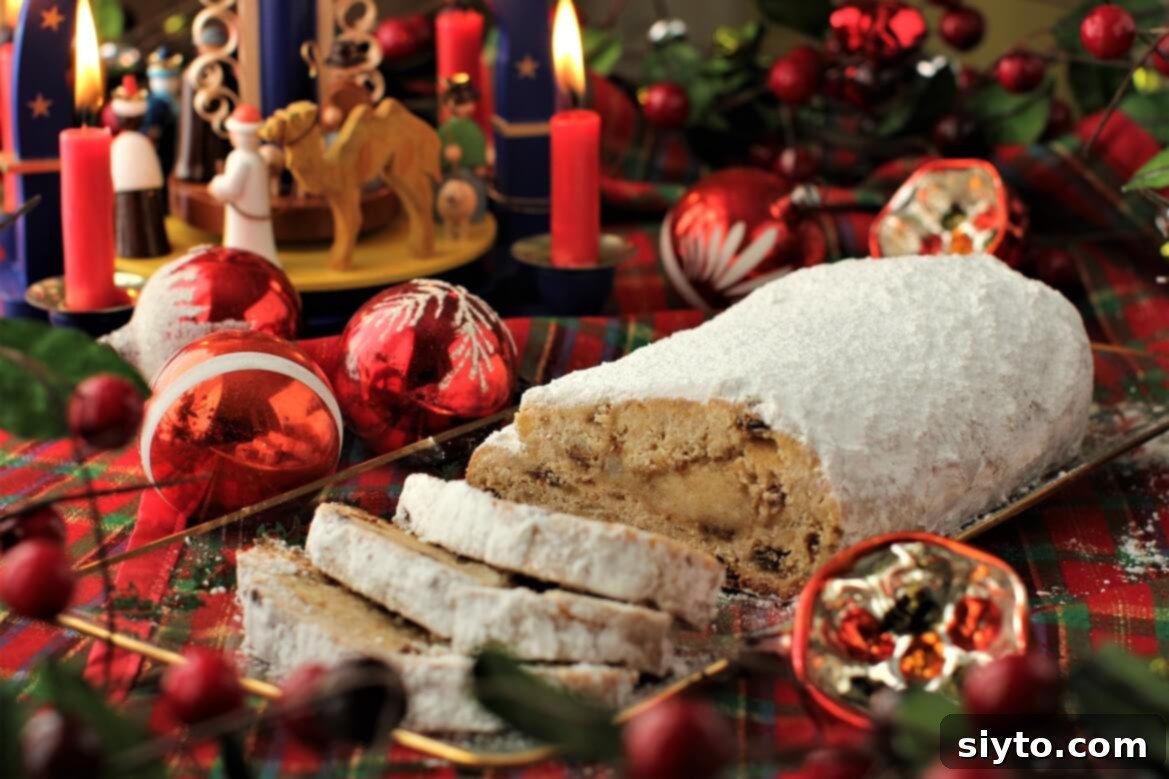
German Quark Stollen, Traditional Christmas Cake
inspired by LandIdee Weihnachtsküche, 120 Rezepte vom Land für einen festlichen Advent, LandIdee Verlag GmbH, 1.1.2019, and other family recipe sources
Yield: 2 loaves Time: 1 day soaking time + 2 hours preparing and baking time
INGREDIENTS
- 2 cups (300 g) sultana raisins
- 1 cup (150 g) mixed candied peel, loosely measured (or ½ cup/75 g Orangeat + ½ cup/75 g Zitronat)
- ¼ cup (60ml) rum
- 1 cup (250 g) German quark or 1 cup strained yogurt (to make, start with 2¼ cups natural yogurt with no added gelatin, strained overnight – see below)
- ⅔ cup (150 g) unsalted butter, at room temperature (plus more for filling and finishing – see below)
- ½ cup (100 g) sugar
- 2 large eggs
- 1 teaspoon pure vanilla extract
- ½ teaspoon pure almond extract
- ½ teaspoon fine sea salt (reduce to ¼ teaspoon if using salted butter)
- ⅛ teaspoon of each: cinnamon, cloves, ginger, nutmeg, cardamom
- 1 cup (100 g) almond flour
- 4 cups (500 g) all purpose flour [or for gluten-free: use 400 grams (3 cups) gluten free flour mix + 100 grams (½ cup + 2 tablespoons) sweet rice flour + 2 tablespoons whole psyllium husks]
- 3 teaspoons (1 tablespoon) baking powder
for the marzipan filling:
- 225 grams/8 oz. almond paste (1½ cups diced into ½-inch cubes)
- 2 tablespoons soft butter
for finishing the baked cakes:
- 6 tablespoons (90ml) melted butter
- 2 tablespoons granulated sugar
- ¾ to 1 cup (90 to 120 g) of icing sugar/confectioners sugar/powdered sugar
DIRECTIONS
The day before baking the Stollens:
- Place the raisins in a bowl or mason jar. Chop the candied citrus peel fine and add it to the raisins. Add the rum and stir to moisten everything. Then cover the bowl with plastic wrap or the jar with a lid, and stir the bowl or tilt the jar every few hours to redistribute the rum. Leave to marinate for 12 to 24 hours (or more).
- If using strained yogurt: line a sieve with a coffee filter, double thickness of paper towel, several layers of cheesecloth or a clean tea towel or dishcloth and put the yogurt into it. Set the sieve over a bowl, and cover with a plate or plastic wrap. Set the bowl and sieve into the fridge to drain for 12 to 24 hours. To use the strained yogurt for this recipe, measure out 1 cup/250 grams and save the rest for another use (or eat it with fruit or jam).
At baking time: Preheat the oven to 350°F (180°C). Prepare two parchment paper bands to shape the Stollen while baking: Cut four parchment paper strips off the roll that are 6 inches (15cm) wide and fold them into thirds lengthwise. Staple two of them together into one long strip (or sew them together with needle and thread). Measure and trim the excess so that you have a triple-layered parchment band that is 2 inches (5cm) wide and 27 inches (69cm) long. Overlap the ends by 1 inch and staple or sew them together to make a circular band. Repeat with the other two strips so you have two oval collars.
Cream the ⅔ cup (150 g) butter. Add the sugar and beat until fluffy. Add the eggs one at a time, and beat until creamy.
Add the quark or strained yogurt, vanilla, almond extract, salt, spices, and almond flour. Beat well.
Add the flour (or gluten free flour mix, sweet rice flour, and psyllium husks) and the baking powder and beat on slow speed to combine.
Add the rum-soaked raisins and candied citrus peel and any rum still in the bowl or jar. Continue beating on low until they are well mixed in.
Scrape the dough onto the counter, divide it into two, and shape each half into a ball.
Lay out a square piece of parchment paper and place one ball of dough onto it. Roll it out to a 7 x 10 inch (18 x 25 cm) rectangle, using your hands to push in the edges to help shape the rectangle.
Repeat with the other ball of dough.
Prepare the marzipan filling: Dice the almond paste into cubes and dump them onto the work surface. Add the 2 tablespoons of soft butter and knead them together to make a smooth mass. Divide the mass into two balls. Roll each ball into a rope that is 9 inches (23cm) long.
Lay one marzipan rope onto each Stollen dough rectangle the long way, just to one side of the center line.
Flip the wider piece of dough over the marzipan rope, using the parchment paper to help you lift the dough, and fold it over so the top long edge doesn’t quite meet the bottom edge – about ½ inch/1 cm of the bottom edge of the dough is uncovered.
If the dough has cracks anywhere, use your fingers to gently pinch them back together.
Trim off excess parchment paper – leaving about 4 inches/10 cm all around the Stollen. Lift the parchment paper with the Stollen onto a baking pan. Repeat with the other Stollen.
Place the circular collar of parchment paper you prepared at the beginning around the Stollen to create an oval ‘fence’ to keep the Stollen from spreading and help it retain its oval shape while baking. Make sure the parchment band is pushed down and sits with its bottom resting on the baking sheet.
Bake the Stollens for 50 to 60 minutes, until they are golden and a toothpick comes out clean when poked in.
After baking: Remove them from the oven and immediately brush each cake with half of the melted butter (3 tablespoons for each cake) while they are still hot. Sprinkle each cake with 1 tablespoon of granulated sugar. Allow to cool for 15 minutes in the pans, then lift each cake with the parchment paper onto a cooling rack and slide out the parchment paper (don’t throw out the paper yet). Let them cool completely.
Set the cooling racks with the cakes on top of the saved parchment paper. Flip the cakes over and cover the bottoms with a thick layer of icing sugar shaken over it with a sieve. Flip them back upright, and sieve a thick layer of icing sugar over them to completely cover the tops and sides. The butter and sugar layer helps preserve the cakes and keep them moist.
Wrap the cakes in a layer of parchment paper or wax paper, them put them into a sealed plastic bag or an airtight tin, or wrap them in another layer of tin foil and crimp the edges well. The Stollen can be eaten after one day of resting time, and will keep for several months if well sealed and kept refrigerated or in a cool place. It will get moister and and more flavourful as it ages.
Makes 2 Stollen.
Guten Appetit!
Want to receive new Kitchen Frau recipes directly to your email? Sign up here and you’ll get a handy and useful kitchen tip along with each recipe, too. (No spam ever.)
If you like my recipes, follow me on Instagram, Pinterest, Twitter, and Facebook. You’d make my day!
Don’t forget to PIN IT to save the recipe:
You might also like some other German Christmas baking:
Elisenlebkuchen
Basler Leckerli
Zimtsterne
Lebkuchen Loaf
or some Hot Mulled Wine and the Christmas Markets in Munich