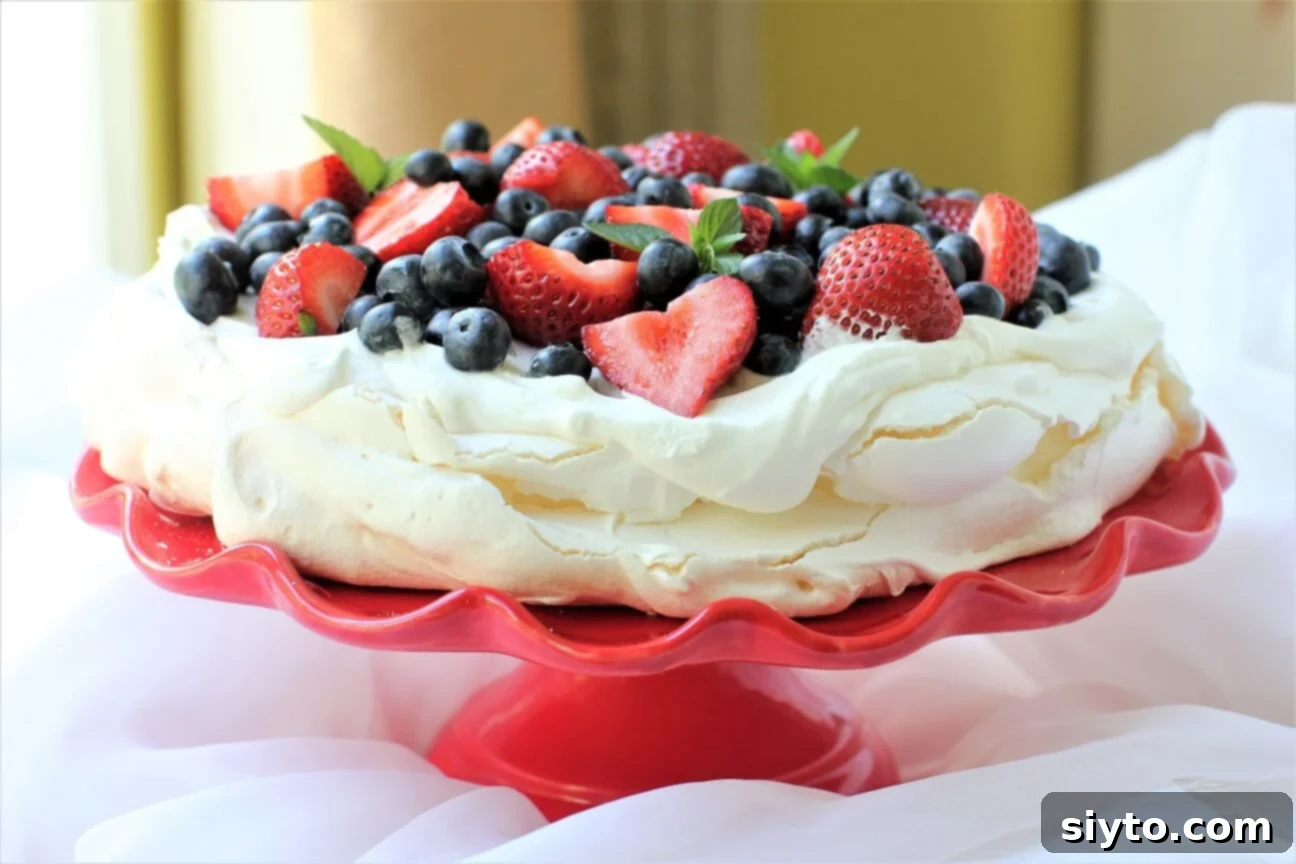
Classic Pavlova: A Divine, Effortless New Zealand Dessert
A classic pavlova is an effortlessly elegant dessert that consistently impresses. Delicate, absolutely fantastic, and naturally gluten-free, it’s a sweet cloud of meringue, whipped cream, and fresh fruit adaptable to all different kinds of seasonal produce. Whether you’re hosting a formal dinner or a casual get-together, this swoon-worthy treat will solidify your reputation as a masterful baker, even though it’s surprisingly simple to prepare.
Imagine a dessert that’s pristine white, incredibly fluffy, and as light as a whisper of cloud, tasting as if it were divinely crafted. Picture a truly spectacular sweet that not only looks stunning and sophisticated but is also a genuine joy to create. Envision a treat that melts on your tongue like the softest marshmallow, bursting with vibrant, sweet, and tangy fruit flavors. What could this enchanting confection be?
Why, a classic pavlova, of course! This iconic New Zealand dessert is all that and more, offering a delightful culinary experience that’s both impressive and accessible to home bakers of all skill levels.
Exploring New Zealand: The Home of the Pavlova
This month, our Eat the World Recipe Challenge takes us on an exciting journey ‘down under’ to New Zealand. This breathtaking island nation, often described as a stunning green jewel nestled in the South Pacific Ocean, is renowned for its unparalleled natural beauty and incredible contrasts. From the dramatic ruggedness of snow-capped mountains and the serene expanse of long sandy beaches to spectacular fjords, lush green valleys, brilliant glaciers, and sparkling lakes, New Zealand truly has it all. It’s a land richly endowed with an abundant and unique diversity of flora and fauna, serving as the iconic backdrop for famous movies like The Hobbit, Lord of the Rings, and The Chronicles of Narnia. Here, mysticism and magic intertwine seamlessly with a vibrant culture of outdoor pursuits and active living.
New Zealanders proudly carry the nickname ‘Kiwis,’ a homage to the flightless kiwi bird, which is endemic to this extraordinary archipelago. Comprising two main islands and hundreds of smaller ones, New Zealand is the sole natural habitat for this iconic bird. Fittingly, kiwifruits also bear the name of these islands. While originally from China, where they were known as Chinese gooseberries, these vibrant green fruits were introduced to New Zealand in the early 1900s. They quickly flourished and became a commercially farmed fruit. In 1962, New Zealand brilliantly began marketing them globally as ‘kiwifruits,’ a name that has since firmly stuck, forever linking them to their adopted homeland.
Beyond its stunning landscapes and unique wildlife, New Zealand is celebrated for another significant contribution to the world:
The Sweet History of Pavlova: A Culinary Debate
This exquisite confection, a masterpiece composed of a crispy meringue shell, soft whipped cream, and an abundance of fresh fruit, is famously known as pavlova. Its origins are steeped in a friendly yet fervent dispute between New Zealand and Australia, both laying claim to this beloved dessert.
The pavlova was named in honor of Anna Pavlova, the renowned Russian ballerina, who captivated audiences during her tours of both countries in the 1920s. Shortly after her visits, recipes for a dessert bearing her name began to appear in cookbooks and kitchens across both nations, sparking a long-standing debate over its true birthplace. Who, then, can rightfully claim ownership of this legendary sweet?
The Oxford English Dictionary, a formidable authority, has officially weighed in, stating that ownership belongs to New Zealand. However, it’s worth noting that dispute over its origins continues to simmer, with passionate arguments from both sides of the Tasman Sea. For the purpose of this culinary journey, I will happily align with the Oxford Dictionary’s verdict and credit New Zealand as the rightful home of the pavlova (apologies, dear Australia, for now!).
My Journey with Pavlova: Endless Adaptations
Having lovingly prepared pavlovas for many years, this dessert holds a special place in my culinary repertoire. It’s a joy to create and an even greater joy to share. Our family’s perennial favorite features a decadent lemon curd base, crowned with billows of whipped cream and a medley of fresh berries. But the beauty of pavlova lies in its incredible versatility. I’ve ventured beyond the traditional, creating delightful individual coconut pavlovas and impressive strawberry rhubarb pavlova layer cakes. My experiments have also included exotic combinations like pomegranates, rich chocolate and raspberries, or bright mandarin oranges. Truly, when it comes to pavlova toppings, anything goes! The possibilities are limited only by your imagination and the seasonal availability of fresh ingredients.
One of the most remarkable advantages of a pavlova, and a key reason it’s perfect for entertaining, is its make-ahead potential. The delicate meringue base can be baked a day or two in advance, allowing you to focus on other preparations. Then, just an hour or two before serving, you can add the cloud-like whipped cream and the vibrant, fresh fruit. This strategic timing leaves you entirely free to relax and enjoy your guests, only to amaze them later when you unveil this stunning showstopper of a dessert – a masterpiece that, despite its grand appearance, was an absolute breeze to create.
Crafting Your Perfect Classic Pavlova: Step-by-Step Guide
Making a pavlova is a delightful process that yields spectacular results. Let’s walk through the steps to create this incredible dessert.
The Meringue Base: Achieving Fluffy Perfection
The foundation of any great pavlova is a perfectly whipped meringue. Begin by separating your egg whites carefully, ensuring no trace of yolk makes its way into the bowl, as fat can prevent the whites from whipping properly. Whip the egg whites until they transform into thick, glossy, and marshmallowy peaks. This stage requires patience; it’s a process that can easily take ten minutes or more, depending on your mixer. Consider it a perfect opportunity to tackle a quick crossword puzzle or do some light dusting while your mixer does the hard work!
Once your meringue has reached that perfect stiff and glossy consistency, gently transfer it onto a piece of parchment paper. It helps to have a circle drawn on the underside of the parchment as a guide – a small plate or saucepan lid works perfectly for this. This ensures your pavlova forms a beautifully rounded base.
Carefully spread the meringue into a neat disk, shaping it to have slightly raised, relatively straight sides and a gently flattened top. Don’t fuss too much about achieving absolute perfection; a pavlova’s rustic charm is part of its appeal. Any natural cracks and crevices that form during baking will only add to its authentic character. With the meringue proudly positioned on your parchment-lined baking sheet, it’s ready for the oven.
The Art of Slow Baking and Cooling
Now comes the waiting game, which is crucial for the pavlova’s signature texture. Once the meringue is in the oven, you’ll immediately lower the temperature significantly. This slow, low-temperature baking process is essential for creating that delicate, crispy outer shell while preserving a soft, marshmallowy interior. And wait, and wait, and wait some more! You might even consider baking it in the evening, turning off the oven, and leaving your pavlova undisturbed overnight. This prolonged cooling within the oven is key to preventing cracks and ensuring the meringue dries out properly.
When you finally retrieve your creation in the morning, don’t be alarmed if it has developed some cracks and crevices. This is perfectly normal and contributes to its rustic beauty. Remember, it’s often called “the food of angels,” so its exact appearance is secondary to its divine taste and texture. Besides, the glorious toppings are incredibly forgiving and will artfully conceal any perceived imperfections!
Assembling Your Pavlova Masterpiece: Cream and Fruit
With your meringue base cooled and ready, it’s time to assemble your stunning dessert. Whip up some chilled heavy cream until it forms soft peaks. For a lighter, more complex flavor profile, I highly recommend folding in a bit of Greek yogurt. This simple addition beautifully offsets the sweetness of the meringue and introduces a lovely rich tang that makes the pavlova exceptionally delicious. Once combined, gently spread the cream mixture over the cooled meringue base, reaching almost to the edges.
Now for the artistic touch: arranging your chosen fruits. Put on your favorite music and let your creativity flow! Whether you opt for a symmetrical, meticulously placed design or a more free-spirited, “willy-nilly” scattering, the vibrant colors of fresh fruit will transform your pavlova into a casually artful masterpiece. If you’re feeling extra fancy, a few mint leaves or delicate strands of lemon zest can add a beautiful finishing touch.
Serve your pavlova immediately for the best experience, or keep it chilled until you’re ready to present it. Imagine the “oohs” and “aahs” of delight from your lucky guests as you bring out this showstopping dessert after dinner. They’ll be enchanted by the delicate crispy shell, the soft marshmallowy interior, the ethereal billows of fluffy cream, and the bright, fresh burst of fruit on top. Each bite is a harmonious blend of textures and flavors, making it an unforgettable culinary delight.
Thank you, New Zealand, for gifting us this incredible, iconic dessert!
* * * * *
Classic Pavlova
Margaret Bose Johnson
Save to Pinterest
Ingredients
For the meringue base:
- 4 large egg whites
- ⅛ teaspoon salt
- 1 cup (200gms) sugar
- 2 teaspoons cornstarch
- 1 teaspoon lemon juice or white wine vinegar
- ½ teaspoon vanilla
For the topping:
- 1 cup (240ml) heavy whipping cream, chilled
- ½ cup (120ml) Greek yogurt (or omit the yogurt and use a total of 1¼ cups/300ml of whipping cream instead – that is the classic option, but the yogurt adds a lovely rich tang)
- ½ teaspoon vanilla
- 2 kiwifruits and 1½ cups of strawberries or about 2 cups of mixed berries, or any fruit of your choice
- a few mint leaves or thin strands of lemon zest for garnish – optional
Instructions
- Preheat the oven to 350°F (180°C).
- Draw an 8 inch (20cm) circle onto a piece of parchment paper with a pencil or black marker pen. Use a small plate or saucepan lid that is about that circumference for a tracer. Flip the parchment paper over so the circle is on the bottom and lay it onto a cookie sheet.
- Whip the egg whites and salt to stiff peaks. Gradually add in the sugar, one tablespoon at time. Beat until it is very stiff and shiny and the sugar is completely dissolved and you can’t feel any sugar crystals when you rub a small amount of meringue between your fingertips. This will take at least 10 minutes of whipping. Beat in the cornstarch, lemon juice and vanilla.
- Plop the meringue onto the parchment paper within the circle. If the parchment moves around to much, put a little dab of meringue under each corner to stick it to the pan. Use a spatula to spread the meringue gently to the edges of the circle. Shape it so it has relatively straight sides and a flat top; don’t worry too much about getting it perfect. A loose rustic shape with a few crags and waves makes for a more attractive pavlova. Try to keep the meringue to the size of the drawn circle though, as it will expand with baking to make about a 9 inch (24cm) disk.
- Put the baking sheet into the oven and immediately lower the temperature to 225°F (110°C). Bake it for 1½ hours. Turn off the oven and don’t open the door. Leave the pavlova in the oven until it is cold, or overnight.
- You can assemble the pavlova an hour or two before serving. Whip the cream to soft peaks, then fold in the Greek yogurt and vanilla. Spread this onto the top of the pavlova, bringing the cream almost to the edges of the meringue.
- Peel and slice the kiwis, and halve or quarter the strawberries. Arrange the fruits on top of the cream in a pattern, or strew them atop with a random and casual elegance. Add a few mint leaves or lemon zest strands if you like.
- Cut in wedges to serve. The pavlova is best served the same day (but leftovers the day after have never been sneezed at in our household.)
- Serves 8. (But even if there are only 4 of you – you’ll want to make this pavlova anyway. I guarantee the rest of it will disappear like magic.)
Notes
Use any fresh fruit or berry you like, though softer fruits that are colourful are your best option. Kiwifruits, berries, mango, dollops of passionfruit; are all traditional.
Humidity can play a role in how your meringue turns out and how it keeps. Here in our dry Alberta climate, the meringue dries out with a nice crisp shell and soft marshmallow inside. I’ve kept it for two days, uncovered on the countertop, and it has stayed relatively unchanged – maybe just a little drier. In a more humid climate, it is best to keep the baked meringue stored at room temperature in a tightly sealed container. You can make it up to two days ahead, then fill it shortly before serving – up to several hours before serving if the outside of the meringue is nice and crispy.
Guten Appetit!
Check out all the wonderful New Zealand dishes prepared by fellow Eat the World members and share with #eattheworld. Click here to find out how to join and have fun exploring a country a month in the kitchen with us!
Evelyne: New Zealand Lolly Cake
Juli: Hokey Pokey Ice Cream
Camilla: Baked Fish Fritters + Wild Sauvignon
Amy: Kiwi Burger
Wendy: Kiwi Pavlova
Heather: Kiwi-Strawberry Trifle
Margaret: Classic Pavlova – lightened up
Sign up here to receive new Kitchen Frau recipes directly to your email inbox, and get a handy and useful kitchen tip with each recipe.
If you like my recipes, follow me on Instagram, Pinterest, Twitter, and Facebook. You’d make my day!
Don’t forget to PIN IT to save the recipe:
Check out some of my other ‘Eat the World’ Recipe Challenge posts:
(in alphabetical order)
- Argentina: Red Chimichurri Sauce
- Australia: Anzac Biscuits (Crispy Oatmeal Cookies)
- Bangladesh: Chingri Masala (Shrimp Curry)
- Bulgaria: Patatnik (Savoury Potato and Cheese Pie)
- Cambodia: Noum Kong (Cambodian Rice Flour Doughnuts)
- China: Kung Pao Chicken
- Colombia: Pan de Yuca (Warm Cheese Buns)
- Egypt: Fava Beans and Feta
- England: Gluten Free Fish and Chips and Mushy Peas
- Ethiopia: Four Ethiopian Recipes for a Fantastic Feast
- Fiji: Spiced Sweet Potato and Banana Salad
- Finland: Lohikeitto (Creamy Salmon, Potato, and Dill Soup)
- France: Axoa d’Espelette (A Simple Stew from the Basque Country)
- Georgia: Charkhlis Chogi (Beets with Sour Cherry Sauce)
- Greece: Moussaka
- Guyana: Fried Tilapia in Oil & Vinegar Sauce (fish dish)
- Hungary: Túrós Csusza (Pasta Scraps with Cottage Cheese)
- India: Kerala Upma (Fluffy, Kerala Style Breakfast Upma Recipe)
- Iraq: Tepsi Baytinijan (Eggplant & Meatball Casserole)
- Ireland: Dublin Coddle (A tasty Sausage and Potato Stew)
- Israel: Cucumber, Feta, and Watermelon Salad
- Jamaica: Rice and Peas (Coconut Rice and Red Beans)
- Japan: Chawanmushi (Steamed Savoury Egg Custard)
- Kenya:Maharagwe with Ugali (Red Beans with Cornmeal Slice)
- Laos: Ping Gai (Lao Grilled Chicken Wings)
- Lesotho: Chakalaka & Pap (Veggie & Bean Stew with Cornmeal Polenta)
- Luxembourg: Stäerzelen (Buckwheat Dumplings)
- Mexico: Cochinita Pibil Tacos (Pit Barbecued Pig to Make in Your Oven)
- Netherlands: Boerenkool Stamppot (Kale-Potato Mash with Sausages & Pears)
- New Zealand: Classic Pavlova
- Poland: Polish Honey Cake
- Portugal: Tuna and Sardine Pâtés
- Puerto Rico: Piña Colada Cocktail
- Scotland: Cranachan (Raspberry, Whisky & Oat Cream Parfaits)
- Senegal: Mafé (Beef and Peanut Stew)
- Sudan: Peanut Butter Creamed Spinach & Peanut Meringue Cookies
- Sweden: Swedish Meatballs with Cream Gravy
- Switzerland (Christmas): Basler Leckerli Cookies
- Thailand: Shrimp Laksa (Khung)
- Trinidad & Tobago: Peanut Butter Prunes
- Ukraine: Buckwheat Kasha with Beef
- United States (Soul Food): Smothered Pork Chops
- Uruguay: Torta de Fiambre (Baked Ham & Cheese Sandwiches)
- Vietnam: Caramelized Pork Rice Bowls