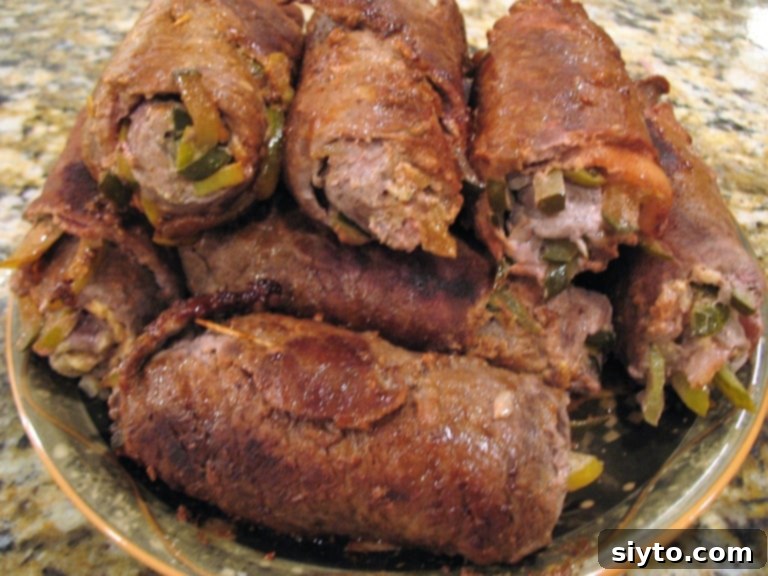
Traditional German Rouladen Recipe: A Heartwarming Beef Roll Masterpiece for Special Occasions
Rouladen are a quintessential German dish, featuring savory meat rolls expertly filled with mustard, crispy bacon, tangy pickles, and aromatic onions. These delectable parcels are browned to perfection and then slowly braised until exquisitely tender in a rich, flavorful gravy. They embody the essence of German comfort food, making them a cherished meal, especially during festive seasons. (Skip to recipe.)
What special culinary tradition marks your Christmas Eve celebrations? For many, it’s a deeply personal affair, a meal steeped in history and cherished family memories. Perhaps it’s a lavish seafood feast, the communal joy of a fondue, or the grandeur of a roast goose. It could be the significant twelve dishes of Ukrainian heritage, or a beloved Polish equivalent. For some, it’s the comforting French tourtiere, or the simple elegance of Scandinavian boiled cod and potatoes.
Whatever your chosen dish, the mere thought of that particular food often conjures a vivid tapestry of childhood Christmases – a kaleidoscope of glorious, warm, wonderfully chaotic, and love-filled family moments. This is certainly true for me, as I reflect on my own Christmas traditions.
My heart and mind instantly turn to Fleisch Rouladen. Literally translating to ‘meat rolls’ – though the German term undeniably sounds far more enticing – these are tender, savory rolls crafted from thinly-sliced beef roast. Each roll is generously stuffed with a delightful combination of crunchy pickles and smoky bacon, then seared to a golden-brown and gently simmered in a robust, wine-laced gravy. While I occasionally prepare them for other special occasions throughout the year, Rouladen are an absolute must-have on my Christmas Eve table. I envision them alongside a vibrant sweet and sour red cabbage, a refreshing fresh cucumber salad, and creamy mashed potatoes or delicate Spätzle, all perfectly poised to soak up every drop of that magnificent gravy.
The Heart of Christmas: A Culinary Tradition
Just last week, the aroma of sizzling beef and spices filled my kitchen as I meticulously prepared eighteen Fleisch Rouladen, carefully tucking them away in the freezer. This annual ritual of slicing, dicing, and rolling always marks the official beginning of my Christmas mood. The tangy, mouthwatering scent that emanates as the rouladen brown in the pan is more than just a smell; it’s a powerful conduit to Christmases past, each memory woven with the joyful presence of my father.
This year, the Christmas Eve table will hold a bittersweet note, as it will be the first time we gather to eat Rouladen without him. My father adored these meals. He would preside at the head of the table, his eyes crinkling with pleasure, one unruly eyebrow lifting in pure enjoyment as he savored every wonderful dish. He had an immense appreciation for good food, often smacking his lips in delight. Looking down the long table, brimming with his family, he would beam with pride. He cherished seeing us all united for the holidays, delighted that he and my mother were feeding us from the bounty of their labor – fresh produce from their garden, provisions from their freezer, and stores from their root cellar. He loved to see us return home, year after year, reinforcing the unbreakable bonds of family.
As I rolled each roulade, my thoughts drifted to him, and the pang of missing him was palpable. But even in sorrow, there is joy. This Christmas, I am hosting the festivities at my home, and I am absolutely brimming with excitement. Eighteen of us will gather, with twelve to fourteen staying overnight for nine days, and others joining us for daytime celebrations. My mind is a whirlwind of joyful planning: orchestrating meals for everyone, and ensuring a constant stream of engaging activities. Four of our guests are active, athletic 13 and 15-year-old boys who possess an appetite that could rival a lumberjack’s. The primary mission, therefore, is to keep their bellies full and their boundless energies happily engaged.
It promises to be a truly magnificent Christmas. We will share our Rouladen, then gather around the twinkling tree on Christmas Eve to light candles, sing carols, and exchange gifts. There will be moments of laughter that fill the room, and perhaps quiet tears for those no longer with us. Yet, our hearts will swell with gratitude for the immeasurable blessing of family. It will be glorious, warm, wonderfully crazy, and beautifully chaotic. For what, after all, is Christmas if not a vibrant tapestry of these very things?
Mastering German Rouladen: Essential Tips and Preparation
Kitchen Frau Notes for Perfect Rouladen
You might not need to prepare eighteen Rouladen at once, so I’ve provided quantities for a single serving, allowing you to easily scale the recipe to your desired crowd size. However, having a few extra stashed in the freezer is truly a gift, much like discovering a Christmas present in the middle of summer!
- Choosing the Beef: While you can certainly slice your own roast for Rouladen – a task often made easier if the meat is slightly frozen – I confess I’ve grown accustomed to the convenience of buying pre-sliced Rouladen meat or having my butcher prepare it for me. Over the years, I’ve experimented with various cuts of roast, but your butcher is the best resource for selecting the ideal cut; inside round is a consistently excellent choice. The key is to have the meat sliced as thinly as possible, ideally between ⅛ and ¼ inch (0.3 to 0.6 cm) thick. If you’re slicing it yourself and find the pieces aren’t thin or even enough, a quick pounding with a meat hammer will do the trick, tenderizing and flattening them perfectly.
- Scaling Ingredients: For a batch of 18 Rouladen, I typically use a 3.5 kg (7.7 lb) inside round roast. Accompanying this, I prepare about 5 medium onions, 2.5 pounds (1.1 kg) of streaky bacon, two 1.3-liter jars of pickles (dill or gherkins work well), and a 250ml jar of robust Dijon mustard. You may find you need slightly less of certain ingredients depending on the exact size of your beef slices and how generously you fill each roll.
Authentic German Fleisch Rouladen Recipe
Please note that the amounts provided below are approximate. The beauty of Rouladen lies in its flexibility; ingredient quantities can vary based on the size of your beef slices and how generously you choose to fill them. Rest assured, whatever variations you make, the result will always be undeniably delicious. Feel free to add a little more of this, or a little less of that – they always taste amazing.
Ingredients (Per Roulade):
- 1 thin slice of beef roast (inside round is highly recommended for tenderness and ease of rolling)
- Approximately 2 teaspoons of Dijon mustard (or other robust German mustard)
- 2 slices of streaky bacon
- 4 lengthwise pickle slices, cut into long, thin strips (gherkins or dill pickles work well)
- ¼ cup (60ml) finely chopped onion
- Wooden toothpicks or cotton kitchen string for securing
- 1 tablespoon olive oil (for browning)
For the Rich Gravy:
- About 1 cup (240ml) dry red wine (a robust variety like a Cabernet Sauvignon or Merlot adds depth)
- 2 bay leaves
- 5 juniper berries or 2 whole cloves (these add a classic German aromatic note)
- Water to cover (as needed)
- Salt and freshly ground black pepper to taste
- Flour, sweet rice flour, or cornstarch for thickening (choose based on dietary preference or desired texture)
Instructions:
- Prepare the Beef: Lay one beef slice at a time flat on your cutting board. Ensure it’s as thin as possible.
- Spread the Mustard: Generously smear the beef slice with Dijon mustard. The mustard not only adds a piquant flavor but also helps tenderize the meat.
- Add the Bacon: Lay two slices of bacon across the mustard-coated beef. You might need to trim the bacon if it extends too far, leaving about 2 inches (5cm) of beef uncovered at one end. This allows for a clean seal when rolling.
- Place the Pickles: Arrange the pickle strips crosswise over the bacon. The tanginess of the pickles provides a wonderful contrast to the rich beef and bacon.
- Sprinkle the Onions: Evenly sprinkle the chopped onion across the bacon and pickle layers, again stopping about 2 inches from the end of the beef slice.
- Roll Tightly: Starting from the end with the full filling, roll up the roulade as tightly as possible. Use both hands to tuck in the filling ingredients as you roll, ensuring a compact parcel.
- Secure the Rolls: At the very end of the roll, pull up the final 2 inches of unfilled meat to neatly cover any exposed filling. Secure the roulade with one or two wooden toothpicks, or tie the entire roll snugly with cotton kitchen string, much like a small package.
- Brown the Rouladen: Heat the olive oil in a large, heavy-bottomed pan or Dutch oven over medium-high heat. Carefully place the rouladen in the hot oil, working in batches if necessary to avoid overcrowding the pan. Sear them, turning frequently, until all four sides are beautifully browned. This step is crucial for developing deep flavor.
- Prepare for Braising: Once browned, transfer the rouladen to a covered casserole dish, arranging them in a single layer. Pour any accumulated pan juices from the browning pan over the rouladen. Tuck in the bay leaves and juniper berries (or cloves) amongst the rolls.
- Add Liquids: Pour in the red wine – feel free to be generous here; a few good glugs will enhance the flavor. Then, add enough water to cover the rouladen about three-quarters of the way up their sides. The liquid should almost submerge them, allowing for even braising.
- Braise to Perfection: Cover the dish tightly with its lid or tin foil. Bake in a preheated oven at 325°F (160°C) for approximately 2 hours, or until the rouladen are meltingly tender. While they will still be delicious if cooked for slightly less time, allowing them the full two hours ensures maximum tenderness.
- Rest the Rouladen: Once cooked, carefully remove the rouladen from the casserole dish and place them on a plate. Cover loosely with foil to keep them warm while you prepare the gravy. Remember to remove any toothpicks or string before serving!
- Make the Gravy: Pour all the braising juices from the casserole into a saucepan and bring to a boil on the stovetop over medium-high heat.
- Thicken the Gravy: In a small jar with a lid, shake several tablespoons of flour or sweet rice flour with about ½ cup of cold water until you have a smooth slurry with no lumps. Alternatively, stir the same amount of cornstarch into a glass of cold water. The precise amount of thickener needed will depend on the volume of broth you have. If the broth tastes too salty or if there isn’t much liquid left, you can add a little more water to thin it out to your desired consistency. While continuously whisking the boiling broth with one hand, gradually pour in enough of the slurry with the other hand until the gravy reaches your preferred thickness. You may not need all the slurry, or you might need to prepare a little more.
- Season the Gravy: Taste the gravy and adjust seasoning as needed. Due to the saltiness contributed by the bacon and pickles, I often find it requires little to no additional salt.
- Serve: Serve the luscious gravy alongside the tender Rouladen, allowing guests to liberally douse their meat and accompaniments.
Serving Suggestions and Festive Traditions
Traditional German Fleisch Rouladen are most commonly served with classic side dishes that complement their rich flavor perfectly. Think creamy mashed potatoes, hearty potato dumplings (Kartoffelklöße), or delicate Spätzle – all excellent for soaking up every drop of that wonderful gravy. A vibrant side of Sweet and Sour Red Cabbage (Rotkohl) and a crisp, marinated cucumber salad are also traditional and provide a refreshing counterpoint to the savory beef.
Beyond the plate, our Christmas traditions extend to our festive decorations. Each year, we hang a delicate blown-glass pickle ornament on our Christmas tree. It’s a beloved tradition for the kids, who delight in finding it amongst the branches. And often, mysteriously, it reappears on different branches each morning – mischievous elves at play, perhaps?
Can you spot the pickle in our tree?
Guten Appetit!
Want to receive new Kitchen Frau recipes directly to your email? Sign up here and you’ll get a handy and useful kitchen tip along with each recipe, too. (No spam ever.)
If you like my recipes, follow me on Instagram, Pinterest, Twitter, and Facebook. You’d make my day!
You might also like:
German Style Sauerkraut – Schmeckt Wunderbar!
A Typical German Meal – Authentic Recipes
German Potato Salad
German Style Sweet and Sour Lentil Eintopf