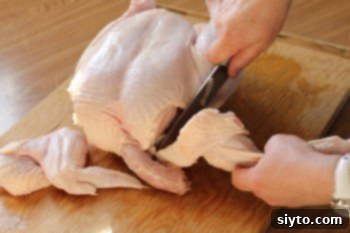
Master the Art: Your Essential Guide to Cutting Up a Whole Chicken with Ease
Unlock a fundamental kitchen skill with our simple, step-by-step instructions, complete with helpful photos, on how to expertly cut up a whole chicken. It’s easier than you think, remarkably rewarding, and opens up a world of culinary possibilities.
For years, I harbored a secret fear in the kitchen: the raw, whole chicken. Despite countless hours spent cooking, baking, and perfecting various cuisines, the task of dismembering a full chicken felt daunting. It wasn’t a lack of tools or proper instruction; my mother had tried to teach me, and opportunities certainly arose. Yet, I always found myself opting for pre-cut poultry, sidestepping what I perceived as a messy, intimidating chore. Perhaps it was a slight squeamishness about raw meat, a confession I might only make in hushed tones, but the truth was, I was simply… chicken.
This culinary avoidance meant that while I regularly enjoyed roasting the beautiful, naturally raised chickens I sourced annually from a local German farmer – transforming their carcasses into rich, aromatic homemade chicken stock for comforting soups – any recipe requiring specific cuts, such as crispy fried chicken, a hearty chicken stew, or a bubbling chicken casserole, sent me straight to the grocery store to buy pre-packaged pieces. It felt like a small culinary failing, but one I readily accepted.
Then, a pivotal moment arrived during a visit to my in-laws. My mother-in-law, an incredible cook and a true kitchen wizard (at 88, she still moves with grace and precision!), was slowed by arthritis in her shoulder. “Margaret, would you mind cutting up the chicken for me?” she asked. My heart skipped a beat. What could I say? Swallowing hard, I managed, “Sure, but you might need to guide me; it’s been a while.” (A considerable understatement, perhaps even a tiny white lie, but my determination was real.)
With her calm, expert coaching, I tackled that chicken. And to my utter surprise, it was incredibly easy. The next time we visited, she asked for help with two more chickens. This time, I responded confidently, “Absolutely, no problem at all!” I breezed through the task, cutting both birds in record time. It turns out, I’m a quick study. More importantly, I was no longer “chicken” about chickens.
Learning how to properly break down a whole chicken isn’t just about overcoming a fear; it’s a valuable skill that offers numerous benefits. You gain control over the quality and freshness of your meat, save money compared to buying pre-cut parts, and can utilize every part of the bird, from the tender breasts to the flavorful bones for stock. It’s also incredibly satisfying to transform a whole bird into versatile pieces ready for any recipe. Let’s conquer this kitchen challenge together.
Essential Tools and Ingredients for Cutting Up a Whole Chicken
- One whole raw chicken – any size (ensure it’s defrosted if frozen)
- One very sharp chef’s knife or boning knife (the sharper, the safer!)
- One large, stable cutting board (preferably non-slip)
- A fearless attitude (and perhaps some kitchen gloves if you prefer)
Preparation: Safety First
Before you begin, ensure your workspace is clean and sanitized. Always prioritize knife safety: a dull knife is more dangerous than a sharp one because it requires more force and is prone to slipping. Take a moment to sharpen your knife if needed. Place your cutting board on a damp towel or non-slip mat to prevent it from sliding during the process. This fundamental kitchen skill requires confidence and precision, which starts with proper preparation.
Lay the chicken on your cutting board, breast-side up, with the neck end facing you. This initial orientation makes the first few cuts more intuitive.
Step-by-Step Guide to Breaking Down a Chicken
1. Removing the Wings
Begin by cutting off the wings. Hold one wing firmly with one hand and gently pull it outwards from the chicken’s body. With your sharp knife in the other hand, make a careful cut through the skin and flesh around the base of the wing, feeling for the joint where the wing bone connects to the shoulder. Your goal is to sever the connection between the humerus (wing bone) and the scapula (shoulder blade). Cut cleanly through this socket space. To ensure the “wing-eaters” get a substantial piece, consider cutting slightly into the breast to include a small portion of breast meat with each wing. Repeat this process for the other wing.
2. Separating the Legs (Thighs and Drumsticks)
Next, move on to the legs. Gently pull one leg away from the chicken’s body with your non-cutting hand. Use your knife to cut through the skin and flesh between the leg and the body, following the natural seam. As you cut, pull the leg further away, bending it backward. This action will help you locate the joint where the thigh bone (femur) meets the hip socket. You’ll hear or feel a slight “pop” as the bone dislocates. Once dislocated, it becomes much easier to slice through the cartilage and connective tissue, cleanly separating the entire leg quarter from the carcass. Repeat for the second leg. These leg quarters can be kept whole for roasting or further divided.
3. Dividing Legs into Thighs and Drumsticks
Each leg quarter can now be separated into a drumstick and a thigh. Hold one leg quarter, with the skin-side down. Locate the natural joint that connects the drumstick to the thigh. You’ll typically find this by bending the leg at the joint; it will flex most easily at this point. Start cutting about in the middle of this bend, on the outer side, cutting down until you hit bone. Once you’ve scored the bone, cut the flesh all the way around the leg. Then, bend the drumstick and thigh aggressively backward until the joint pops open, making it simple to slice through the remaining cartilage and connective tissue with your sharp knife. You now have two distinct leg pieces: a drumstick and a thigh. Repeat this for the other leg quarter. These pieces are excellent for frying, braising, or grilling.
4. Extracting the Wishbone Piece
Return to the remaining carcass, orienting it with the neck end facing you. The wishbone, a Y-shaped bone, is located at the top of the breast, near the neck cavity. To remove it cleanly and secure a tasty portion of white meat, visualize an inverted “V” cut. Starting at the center of the breast, approximately two inches from the top, make a diagonal cut down each side, angling towards where the shoulder used to be. Gently pull this wishbone piece away from the breast, then cut through the small joints on either side where the collarbone attaches to the breastbone. This piece is often overlooked but can be a delightful chef’s treat or added to stock.
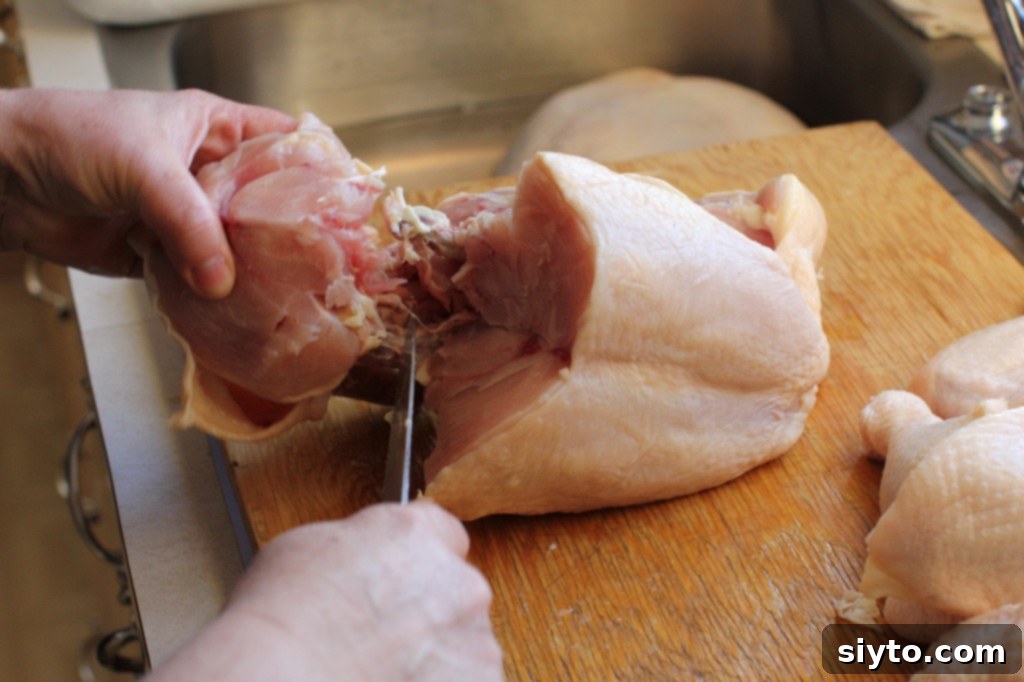
5. Removing the Breast Halves
Now, it’s time for the prize white meat: the chicken breasts. With the carcass still breast-side up, use the tip of your knife to make a shallow cut along one side of the breastbone, which runs down the middle of the chicken. Keeping your knife as close as possible to the bone, gently pull the breast meat away from the rib cage with your other hand. Use long, smooth strokes to slice the meat away from the bones, following the contour of the rib cage until the entire breast half comes free in one beautiful, intact piece. This technique ensures minimal meat is left behind on the carcass.
Depending on the size of your chicken and your culinary needs, you can leave the breast half whole or cut it in half across the middle to create two smaller, more manageable pieces. You can also choose to remove the skin for a leaner option, or leave it on for extra flavor and crispiness when cooked. Repeat this precise cutting technique on the other side of the breastbone to remove the second breast half. Chicken breasts are incredibly versatile, perfect for grilling, pan-frying, baking, or slicing into stir-fries.
6. Preparing the Carcass for Stock
At this point, you should have approximately 11 pieces of chicken (two wings, four leg pieces, one wishbone piece, and four breast pieces if halved) and the remaining carcass, often with the neck attached. The carcass is far too valuable to discard! It forms the foundation of an incredible homemade chicken stock. To make it more manageable for a soup pot or for freezing, you can divide it. Make a cut into each side of the rib cage, about two inches deep. You’ll need to cut through some of the rib bones, but a sharp knife will make this easy. Then, grip one end of the carcass in each hand and bend it backward. You’ll feel where it naturally wants to break in half along the backbone. Use your knife to cut cleanly through the backbone at this point.
You can now freeze these carcass pieces for future stock-making sessions or immediately place them into a large pot with vegetables and aromatics to start simmering a rich, golden broth. This ensures that no part of the chicken goes to waste, maximizing your culinary output and flavor.
Embrace Your Inner Butcher!
Congratulations! You’ve successfully cut up a whole chicken into its individual parts. This once-intimidating task is now a skill you possess, opening doors to more economical cooking, fresher meals, and a deeper understanding of your ingredients. There’s truly no need to be “chicken” about chickens any longer. If I can learn to do it, so can you! Enjoy the newfound confidence and culinary freedom that comes with mastering this essential kitchen technique.
Guten Appetit!
Ready to elevate your cooking even further? Want to receive new Kitchen Frau recipes directly to your email? Sign up here and you’ll get a handy and useful kitchen tip along with each recipe, too. (No spam, ever.)
If you like my recipes, follow me on Instagram, Pinterest, Twitter, and Facebook. You’d make my day!
You might also like:
Homemade Chicken Stock and Chicken Soup
Butter Chicken with Scented Basmati Rice
Maple and Mustard Glazed Turkey with Killer Gravy
Golden Vanilla Rice Pilaf