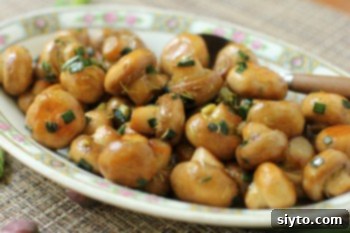
Flavorful Foraged Delight: Sautéed Mushrooms with Aromatic Spruce Tips and Chives
Embark on a culinary adventure with this exquisite sautéed mushrooms recipe, elevated by the unique zest of delicate spruce tips and fresh chives. This dish isn’t just a meal; it’s a taste of Canadian heritage, combining the earthy richness of mushrooms with the bright, resinous notes of freshly foraged spruce tips for an unforgettable experience. [Jump to the full recipe below.]
The Canadian food landscape is a vibrant tapestry, rich with diverse cultures and culinary traditions. A few years ago, initiatives like The Canadian Food Experience Project, hosted by Valerie of A Canadian Foodie, began to shine a spotlight on this unique identity. It brought together Canadian food bloggers to share stories and recipes, delving into what truly defines Canadian cuisine. For many, including myself, this journey into our culinary roots often leads back to the land itself, to the practice of foraging, and the bounty that nature generously provides.
My Authentic Canadian Food Memory: A Foraging Legacy
When I reflect on my earliest authentic Canadian food memories, one word immediately springs to mind: ‘foraging.’ It conjures images of endless summer days spent seeking out wild mushrooms, stinging nettles, fragrant tea herbs, vibrant wild rose hips, various edible roots, and a kaleidoscope of wild berries. This deep connection to harvesting from the wild was a direct inheritance from my parents, who immigrated from Germany in the 1950s. They arrived in Canada bringing with them not just their belongings, but a profound knowledge of edible plants and fungi gleaned from the European wilderness.
Their youth was marked by extreme poverty and unimaginable hardship during and after the war years. Survival often depended on their ability to forage what they could from fields, forests, and streams. My father would recount tales of catching homemade nets full of minnows from ditches, which his resourceful mother would grind into nourishing ‘fish burgers.’ He also spoke of him and his brothers catching swallows in abandoned barn lofts, thankful for even the tiny bits of meat they could pick from the bones for soup. My mother’s memories included gathering nettles and other herbs for medicinal teas and healing remedies for both people and animals, and scrounging leftover grains and vegetables from harvested fields.
Upon their arrival in Canada, this invaluable knowledge became a cherished part of their new lives. While the desperate need for swallows and minnows was thankfully behind them, the spirit of foraging persisted. My dad, a keen hunter and fisherman, ensured our family table was often graced with wild fish and game, prepared by my mom in ways that made our mouths water. My mother, to this day, harbors a deep passion for picking wild berries. Every summer, she dedicates days to harvesting pails upon pails of sweet wild blueberries, huckleberries, and saskatoons, a testament to her enduring connection with nature’s gifts.
For us as children, berry-picking days were among summer’s greatest joys. Beyond the welcome break from daily chores and farm work – though the subsequent cleaning, sorting, canning, and freezing of berries awaited our return – there was the immediate pleasure of filling our bellies with plump, juicy berries, often more than what made it into our pails. And, of course, there was the promise of adventure. We’d frequently discover berry-studded bear droppings or flattened grass wallows where bears had indulged in their afternoon naps after their own berry feasts. Foraging, then, provided sustenance not just for our bodies, but for our imaginations too, weaving tales of the wild into the fabric of our childhood.
Among these cherished memories, my very first distinct recollection of foraged food is the irresistible taste of succulent, wild mushrooms sautéed in rich butter. Each bite was a golden, earthy burst of flavor. After a fresh rain, my parents would head out, usually to cattle-grazed fields where the manure-enriched soil created a perfect environment for fungi. My parents possessed an innate wisdom for identifying edible varieties, and my mother, an exceptional cook, knew precisely how to prepare them to toothsome perfection. And we, their appreciative children, knew how to savor every bite.
From Wild Foraging to Grocery Aisle: A Cautious Approach to Mushrooms
Today, I confess I don’t possess the same fearless confidence as my parents when it comes to wild mushroom identification. My mushroom-picking adventures are largely confined to selecting the smoothest, firmest specimens from the grocery store bins. I wish I had more courage, but the cautionary tales we were told as children—stories of individuals who took just one small bite of a poisonous mushroom and immediately perished—have instilled a healthy fear that I’m sure my parents intended. My young imagination conjured vivid, agonizing images of those unfortunate souls succumbing to a torturous demise. Mom and Dad certainly didn’t want us indiscriminately picking any old mushroom we stumbled upon in the fields or forests, and their vivid stories were undeniably effective.
So, no, I remain too much of a “scaredy-cat” to venture into wild mushroom foraging on my own. Interestingly, I do know that edible mushrooms grow in the trees right behind our house. A few years ago, while our floors were being replaced, the contractor, who hailed from Ukraine, asked if I would mind him picking mushrooms from our forest during his lunch break. I readily agreed, and to my astonishment, he reappeared a short time later with two plastic grocery bags overflowing with mushrooms, which he assured me were a delicious variety.
Hmm…tempting indeed, but…nope. Still too apprehensive to pick my own. (And I never saw that contractor again, so the lingering question of his survival remains, playfully, in my mind.)
Yet, a simple plateful of golden, pan-fried mushrooms instantly transports me back to those childhood days. It’s a celebration of nature’s bounty, prepared simply and enjoyed soon after harvest. While mushrooms aren’t exclusive to Canada, to me, they profoundly embody a certain Canadian spirit: living off the land, appreciating its cycles, and savoring nature’s abundant gifts.
Embracing the Season: The Magic of Spruce Tips
Currently, here in northern Canada, we are in the heart of spruce tip season. There’s truly nothing I can imagine that better complements the earthiness of buttery sautéed mushrooms than the distinct, resinous flavor of this herbal delicacy. It’s a pairing that makes my mouth water just thinking about it. And these spruce tips? These were definitely foraged by me, from my very own trees – so I know they are absolutely safe and undeniably fresh!
If you’ve never had the pleasure of incorporating fresh spruce tips into your cooking, I wholeheartedly urge you to try them. Every spring, my mother instinctively eats a few whenever she’s gardening, simply because they taste good. I believe her instincts are spot on, as spruce tips are not only delicious, offering a unique lemony and piney flavor profile, but they are also packed with Vitamin C, making them a healthy addition to any meal.
If you are fortunate enough to have a spruce, pine, or other fir tree in your yard (or perhaps a neighbor’s, with permission!), you have access to a truly remarkable seasonal delicacy. These tender new growths are a chef’s secret weapon, capable of transforming a variety of dishes with their bright, aromatic essence.
To harvest, simply pick off the new growth buds found at the ends of the branches. Gently remove any brown, papery casings, and they are ready to use. Spruce tips can infuse a delightful flavor into a wide range of dishes, from savory potatoes to unexpected desserts. You can even pick spruce tips after they have opened up and are no longer tight buds, as long as they remain soft to the touch and haven’t developed a tough or overly resiny taste.
For more inspiration on incorporating these fantastic ingredients into your cooking, here are some other delicious spruce tip recipes to explore:
- Spring Green Salad with Spruce Tips
- Spruce Tip Baked Rhubarb Compote over Silky Swedish Cream
- Potatoes with Cream and Spruce Tips (Plus How to Make Spruce Tip Salt and Spruce Tip Vinegar)
- Roasted Asparagus with Garlic and Spruce Tips
- Stuffed Pork Tenderloin with Spruce Tips and Orange Glaze
* * * * *
Kitchen Frau Notes for Foraging Spruce Tips:
- Cleanliness: If you collect your spruce tips from an area free from vehicle exhaust fumes, they usually don’t require washing. They are naturally clean and protected within their papery husks. A quick check for bug bites is wise, but these are rare. If the tips are older or harvested near a road, a swift rinse and a gentle shake to dry them are recommended.
- Tree Variety & Taste: Tips from any conifer with needles can be used. However, it’s crucial to taste a small piece first, as some varieties are more intensely ‘piney’ than others. You might need to adjust the quantity based on the strength of their flavor.
- Sustainable Foraging: Don’t worry about harming the spruce trees. In fact, by nipping off the tips, you are essentially performing a beneficial pruning that encourages the tree to grow bushier. To ensure sustainable harvesting, spread your picking across different parts of the tree rather than stripping one area clean. A crucial tip: avoid picking the leader tip from the very top of a young tree, as this can impede its vertical growth. For more detailed information, consider resources like this guide on gathering spruce tips.
- Storage: Freshly picked spruce tips will last for up to a week in your refrigerator if kept loosely covered.
Easy Sautéed Mushrooms with Zesty Spruce Tips and Chives Recipe
This simple yet elegant recipe transforms humble mushrooms into a gourmet side dish with the vibrant addition of fresh spruce tips and chives. It’s quick, flavorful, and perfect for a weeknight meal or a special gathering.
Ingredients:
- 2 tablespoons salted butter
- 4 cups small white button mushrooms (approximately 11 oz / 320 g)
- ¼ teaspoon salt
- 1 tablespoon finely chopped spruce tips
- 2 tablespoons minced chives (or green onions for a milder flavor)
- A light sprinkling of freshly ground black pepper
Instructions:
- Prepare the Mushrooms: Gently wash the mushrooms under cool running water. Lay them on a clean tea towel or paper towel and allow them to air dry until most of the moisture has evaporated. You can pat them lightly with the towel to expedite the drying process. If your mushrooms are larger, cut them into halves; for very large ones, quarter them.
- Sauté the Mushrooms: In a heavy-bottomed skillet, melt the salted butter over medium heat. Allow the butter to sizzle and develop a nutty aroma, just beginning to turn a light golden brown. Add the prepared mushrooms to the skillet and sprinkle them with the salt. The salt will help draw out the moisture from the mushrooms, aiding in their browning.
- Cook Until Golden: Sauté the mushrooms, stirring frequently to ensure they brown evenly on several sides. This process typically takes 8 to 10 minutes. Initially, the mushrooms will release their liquid; continue cooking until this liquid has completely evaporated and the mushrooms begin to caramelize and turn a beautiful golden color. Once the liquid is gone, you’ll need to stir them more consistently to prevent sticking.
- Add Spruce Tips and Chives: Once the mushrooms have achieved a deep golden hue, sprinkle in the finely chopped spruce tips and minced chives. Cook for just 1 minute more, stirring constantly to integrate the flavors. This brief cooking time allows the spruce tips to release their aromatic essence without becoming bitter or losing their vibrant color.
- Finish and Serve: Remove the pan from the heat. Give the mushrooms a very light sprinkling of freshly ground pepper – you want to enhance, not overpower, their delicate, earthy, and piney flavors. Carefully tip the entire contents into a small serving bowl, making sure to scrape all the delicious buttery goodness and fragrant spruce tip and chive bits into the bowl.
Serves 4 as a delightful side dish.
As my friend Andreas aptly put it after trying this dish: “Those mushrooms are amazing!”
Guten Appetit!
If you’re eager for more unique and flavorful recipes like this one, I invite you to sign up for my newsletter here. You’ll receive new Kitchen Frau recipes directly in your email inbox, along with a handy and useful kitchen tip with each recipe.
Join the Kitchen Frau community! If you enjoy my recipes, please follow me on Instagram, Pinterest, Twitter, and Facebook. Your support truly brightens my day!
You might also like these other intriguing recipes:
Spruce Tips and Potatoes and Cream: A creamy, herbaceous delight
Spruce Tip (or Basil) Baked Rhubarb Compote over Silky Swedish Cream: A unique dessert pairing
Fresh Trout, Morels, and a Side of Bannock: Celebrating nature’s finest catches
Ode to the Lowly, Lovely Chayote Squash: Discovering an underrated vegetable
Coconut and Curry Carrot Puree: An exotic and comforting side
The spirit of The Canadian Food Experience Project, which launched on June 7, 2013, continues to resonate. Through collective storytelling, participants across our vast Canadian landscape have shared regional food experiences, aiming to bring global clarity to our unique Canadian culinary identity. We invite you to join this ongoing conversation and explore the richness of our food heritage.
What is your first truly Canadian food experience? I’d genuinely love to hear your stories and memories. Feel free to share your thoughts in the comments section below!