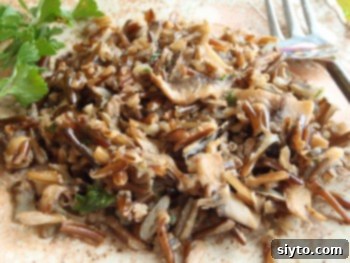
Embracing Canadian Flavors: Wild Rice & Mushrooms – A New Year’s Culinary Resolution
The Canadian Food Experience Project, an initiative that commenced on June 7, 2013, stands as a testament to the rich and diverse culinary tapestry of our nation. As participants, we collaboratively share our unique regional food experiences, hoping to weave a compelling narrative that transcends geographical boundaries. Through the collective cadence of our Canadian voices, our aim is to illuminate and clarify our distinct Canadian culinary identity on a global stage. This ongoing journey encourages us to explore, celebrate, and articulate what truly defines Canadian food, inviting everyone to join us in this flavorful exploration. This month, January 2014, the theme that guides our culinary reflections is aptly titled: A Canadian Resolution.
For many, the dawn of a new year brings with it a sense of anticipation and the promise of fresh starts. The act of opening a pristine calendar for the first time each year invariably sends a thrill of excitement through me. I often find myself pondering the possibilities: What adventures and invaluable life lessons will this new year unfold? What transformative thoughts will occupy my mind when I eventually set this calendar aside, twelve months later? What significant and minor notations will adorn its pages, chronicling the passage of time?
There’s a quiet satisfaction in inscribing those initial appointments and personal notes onto the January page. Once filled, the calendar finds its rightful place on our fridge, serving as the central hub for our bustling family schedules. More than just a planner, it becomes a tangible record of the year yet to come. I hold a deep appreciation for keeping my past calendars, as they collectively form a cherished chronicle of our family’s life. Every small notation – from major milestones to everyday happenings – is meticulously recorded. These calendars prove invaluable for verifying facts, resolving disputes over dates, or simply jogging my sometimes-scatterbrained memory about significant family events and the delightful minutiae of daily life.
Just last night, we returned from our festive Christmas holiday, a period joyfully spent visiting family. With a sense of renewed energy, I eagerly cracked open the new calendar. Already, it bears the marks of a busy January, filled with a handful of pre-scheduled appointments and commitments. The new year, it seems, is off to a characteristically brisk start.
Over the years, I’ve gradually abandoned the tradition of making formal New Year’s Resolutions. My past attempts have often been fraught with the pressure of rigid goals, leading to a disheartening track record of not keeping them. I’ve discovered a more effective approach for myself: setting smaller, more flexible life goals as and when they naturally arise. The notion that one must select grand, weighty objectives to achieve precisely on the first day of every new year feels inherently restrictive. Instead, I firmly believe that every new day presents a fresh opportunity to begin anew, to make small, impactful changes.
Nevertheless, this year, I have embraced a couple of small, adaptable goals. One is a recurring objective that comes to mind whenever I descend into my basement, confronting my extensive food storage shelves, extra fridge, and two freezers. The second goal is relatively new and ties in perfectly with this month’s theme for The Canadian Food Experience Project.
My primary goal for the year is to embark on a concerted effort to significantly pare down and utilize the vast quantities of stored food nestled on my basement pantry shelves and within my freezers. It. Is. Time. (Oh, it truly is past due time.) Down there, I have items accumulated over several years – an eclectic assortment ranging from intriguing jars of sauces and exotic canned vegetables to an array of spice packets. There are also cases of goods purchased at irresistibly low prices, and numerous frozen packages, once deemed crucial, whose contents now remain a mystery. Hidden behind rows of other jars are home-canned delights that I’ve completely forgotten making. I confess, I am something of a food hoarder; I simply cannot resist a bargain or an exciting new ingredient. The consequence, however, is a persistent surplus – far too much to consume in a timely manner. I’ve affectionately, or perhaps despairingly, dubbed my basement ‘the deep dark hole,’ often uttering the phrase with a theatrical italicization and a touch of audible disgust. I wonder, is this a problem any of you can relate to?
This year, that entire inventory has got to go! The unfortunate reality is that many of those wonderful ingredients, which initially sparked so much excitement and inspired visions of new culinary creations, often expire before I ever get around to using them. Thus, the crucial first task on my list is to cull the outdated items. Following this, I’ll undertake a thorough reorganization of ingredients, ensuring they are easily visible and accessible. And, most importantly, I am committed to actually using up these existing products, resisting the temptation to purchase new ones until the old stock has been depleted. I am framing this as a personal challenge, one I anticipate will be a rewarding project, culminating in a significantly less cluttered pantry within just a few months!
My second goal aligns with a deeper exploration of my extensive collection of cookbooks, prompting me to cook more recipes from them. (As you might infer from the sheer volume, I’ve clearly grappled with goal number one before – a rather telling, if sad, admission.) What sparked this renewed focus was a truly remarkable new cookbook I received for Christmas from my sister Rosalinda and her husband Steven. Titled ‘Modern Native Feasts,’ this book immediately captivated my interest and ignited a desire to delve deeper into its pages.
The esteemed author of ‘Modern Native Feasts’ is Andrew George Jr., a highly accomplished Canadian Aboriginal chef. Andrew grew up in Telkwa, a small community just outside of Smithers, British Columbia, and his brother shares a professional connection with my brother-in-law, Steven. Andrew George Jr. boasts an impressive array of culinary honors, underscoring his significant contributions to Canadian cuisine. Notably, he was part of the first-ever Aboriginal team (from anywhere in the world) to compete in the prestigious World Culinary Olympics in Frankfurt, Germany, in 1992, where his team earned numerous medals. His expertise was also sought after during the 2010 Winter Olympics in Vancouver, BC, where he played a pivotal role in crafting menus and preparing meals for various events. Chef George Jr.’s culinary philosophy centers on utilizing native Canadian ingredients and honoring traditional Aboriginal methods of food preparation. I am thoroughly engrossed in reading his cookbook and am incredibly excited to try many more of his recipes throughout the coming year. Indeed, this vibrant cuisine represents our only truly Canadian culinary heritage, a deep wellspring of history, culture, and flavor waiting to be widely celebrated.
The recipe for Wild Rice and Mushrooms, featured here, is thoughtfully adapted from his first cookbook, a collaborative effort with Robert Gairns, titled A Feast for all Seasons, Traditional Native Peoples’ Cuisine. If you have yet to experience the delight of cooking with wild rice, you are truly in for a treat. This distinctive grain, often referred to as Canada Rice or Indian Rice, is indigenous to Canada and holds profound cultural significance for many Indigenous communities. While it can sometimes be a pricier ingredient, its unique flavor and remarkable nutritional profile undoubtedly make it worthy of a special occasion. This naturally gluten-free grain is not only low in fat but also remarkably high in protein, antioxidants, essential minerals, B vitamins, lysine, and dietary fiber. Wild rice offers a delightful nutty and earthy flavor, coupled with a satisfyingly chewy texture, making it an exquisite complement to the rich, umami notes of mushrooms. It pairs wonderfully with a beautifully seared piece of salmon or any other robust, flavorful meat, elevating any meal it graces.
Our Christmas holiday journey began on Boxing Day, as we departed from Alberta to spend the remainder of the festive season with my beloved mother and three of my sisters and their families. Their homes are nestled in the picturesque northern British Columbia communities of Prince George, Smithers, and Terrace.
The drive itself was an adventure, spanning two days in each direction. The roads presented a challenging tableau of icy patches, rain-slicked surfaces, and treacherous conditions, characteristic of a Canadian winter. The air was crisp and cold, and a generous blanket of snow adorned the landscape everywhere we looked. Despite the demanding travel, the time spent reunited with my family was incredibly warm, wonderfully enriching, and undeniably worth every challenging mile. We rotated our stays, spending several delightful nights with each family, filling our days with boundless laughter, indulging in amazing home-cooked meals, enjoying invigorating walks, engaging in great conversations, and simply reveling in lovely, lazy moments of togetherness.
One memorable morning in Smithers, we were treated to an extraordinary visit: two graceful moose decided to grace our front lawn. By the time we managed to scramble for a camera, and my husband Raymond playfully ran after them, they had calmly sauntered down to the far end of the back alley. There, they paused, seemingly unperturbed by our presence, to leisurely munch on the tender twigs of some ornamental trees. It was a beautiful reminder of the wild beauty that permeates even the edges of Canadian towns.
It was a truly wonderful Christmas, filled with warmth, family, and memorable moments. Now, as the festive season fades, I find myself eagerly looking forward to a great and promising year ahead. I extend my heartfelt wishes that you all experience the same joy and fulfillment, sending the very best from our house to yours.
* * * * *
Kitchen Frau Notes: Expert Tips for Perfect Wild Rice and Mushrooms
When preparing wild rice, a grain renowned for its distinctive flavor and texture, it’s important to note that its cooking time can vary significantly. Chef Andrew George Jr. suggests a cooking time of approximately 35 minutes for the rice. In my experience, when cooking with plain water, wild rice typically achieves tenderness in about 45 minutes. However, a crucial observation I’ve made is that when wild rice is cooked in broth, particularly chicken or beef stock, the cooking process almost invariably takes much longer. I suspect the salt content in the broth plays a role in extending the cooking time by affecting the grain’s ability to absorb liquid efficiently. Some batches I’ve prepared have even required up to 1 hour and 45 minutes to fully absorb the liquid and achieve that desired fluffy texture, with many grains beautifully burst open. Despite the longer wait, cooking wild rice in broth undeniably imparts a much richer and more profound flavor compared to simply using water.
To circumvent the potential frustration of delaying your meal while waiting for the rice to cook, the best strategy is to prepare the wild rice in advance. You can cook it earlier in the day or even the day before you plan to serve it. This way, you avoid the scenario of guests waiting or, worse, serving rice that is watery and only half-cooked. Once cooked ahead, you simply need to sauté your vegetables, gently stir them into the prepared wild rice, and then delicately reheat the entire mixture. This ensures perfectly cooked, flavorful wild rice every time, ready to be the star of your meal.
Wild Rice and Mushrooms Recipe
Slightly adapted from ‘A Feast for all Seasons, Traditional Native Peoples’ Cuisine’ by Andrew George Jr. and Robert Gairns.
Ingredients:
- 1½ cups (375ml) wild rice
- 3 cups (750ml) chicken or beef stock (for richer flavor)
- 1 bay leaf
- ¼ cup (60ml) unsalted butter
- ½ cup (125ml) finely chopped yellow onion
- ½ cup (125ml) finely chopped celery
- ½ teaspoon dried sage
- ½ teaspoon dried thyme (or substitute with 1 teaspoon poultry seasoning for both sage & thyme)
- 3 cups (8 oz / 225 grams) sliced wild mushrooms (e.g., cremini, shiitake, oyster) or button mushrooms
- 2 tablespoons finely chopped fresh parsley, for garnish
Instructions:
- Prepare the Wild Rice: In a heavy-bottomed saucepan, combine the wild rice, chicken or beef stock, and the bay leaf. Bring the mixture to a full boil over medium-high heat. Once boiling, stir well, then reduce the heat to a very low simmer. Cover the saucepan tightly with a lid and allow the rice to cook until it is tender, the individual grains have split open, and all the liquid has been fully absorbed or evaporated.
- Monitor Cooking Time: The cooking time for wild rice can vary significantly, ranging from 45 minutes to potentially 1 hour and 45 minutes. This depends on factors such as the size and age of your specific rice grains, as well as the saltiness of the stock used. Periodically check the rice for doneness. To determine if it’s ready, scrape the bottom of the saucepan with a wooden spoon; there should be no remaining standing water. The rice grains should appear fluffy and almost dry, with many of them having split open to reveal their soft, creamy interiors. It’s advisable to start cooking your wild rice at least 2 hours before you plan to serve the meal. Once cooked, you can simply keep it warm until mealtime or gently reheat it just before serving.
- Sauté the Vegetables: While the wild rice is simmering, melt the butter in a separate heavy-bottomed skillet over medium-high heat. Add the finely chopped onion and celery to the skillet and sauté them, stirring occasionally, until the onion becomes soft and translucent, typically taking about 5-7 minutes.
- Add Mushrooms and Seasoning: Stir in the dried sage, dried thyme (or poultry seasoning), and the sliced mushrooms. Continue to sauté the mixture for another 5 to 10 minutes, or until the mushrooms have softened considerably and any liquid they may have released has completely cooked off, leaving them lightly browned and flavorful.
- Combine and Serve: Once the wild rice is perfectly cooked, remove and discard the bay leaf. Add the sautéed mushroom and vegetable mixture to the cooked wild rice, using a rubber spatula to scrape every bit of flavorful goodness from the skillet. Sprinkle generously with the freshly chopped parsley. Gently toss all the ingredients together until they are evenly combined and thoroughly heated through.
This savory Wild Rice and Mushrooms recipe yields approximately 6 to 7 cups, providing a satisfying side dish or light main course for 4 to 6 servings. Enjoy this authentic taste of Canadian culinary heritage!
Guten Appetit!
You might also enjoy these complementary recipes, exploring a range of delightful flavors:
Golden Vanilla Rice Pilaf: A fragrant and subtly sweet rice dish perfect for any meal.
Butter Chicken with Scented Basmati Rice: A classic Indian-inspired dish featuring tender chicken in a creamy, spiced tomato sauce.
Bannock Biscuits: Discover a traditional Indigenous Canadian bread, perfect for dipping or as a hearty accompaniment.
Seared Duck Breasts with Braised Apples and Cabbage: An elegant and flavorful dish showcasing rich duck paired with sweet and tangy accompaniments.
Honey Mustard and Seed-Encrusted Pork Tenderloin: A tender and flavorful pork dish with a delightful crunchy coating, often served with creamy parsnip mashed potatoes.
* * * * *
Explore Past Canadian Food Experience Project Entries:
Delve into our archives and discover more fascinating regional Canadian food stories and recipes:
June, 2013: My First Authentic Canadian Food Memory: Buttery Sauteed Mushrooms with Spruce Tips and Chives – A taste of the Canadian wilderness, foraging for edible spruce tips.
July, 2103: A Regional Canadian Food: Saskatoon Roll or Saskatoon Cobbler and How to Freeze Saskatoon Berries – Celebrating the beloved Saskatoon berry, a true prairie gem.
August, 2013: A Canadian Food Hero in Northern Alberta, and Pickled Beets and Creamed Vegetables – Honoring local culinary legends and their time-honored recipes.
September, 2013: My Cherished Canadian Recipe: Evans Sour Cherries in Brandy – A personal and deeply cherished recipe, preserving the bounty of Canadian orchards.
October, 2013: Preserving, Our Canadian Food Tradition – Sweet and Spicy Apple Butter – Delving into the rich tradition of food preservation across Canada.
November, 2013: The Canadian Harvest: Quinoa Harvest and Recipes (Quinoa Onion Frittata & Honey Vanilla Quinoa Pudding) – Showcasing Canada’s growing contribution to the global quinoa harvest.
December, 2013: A Canadian Christmas: Gumdrop Fruitcake – A festive and cherished prairie tradition, bringing sweetness to Canadian holiday tables.