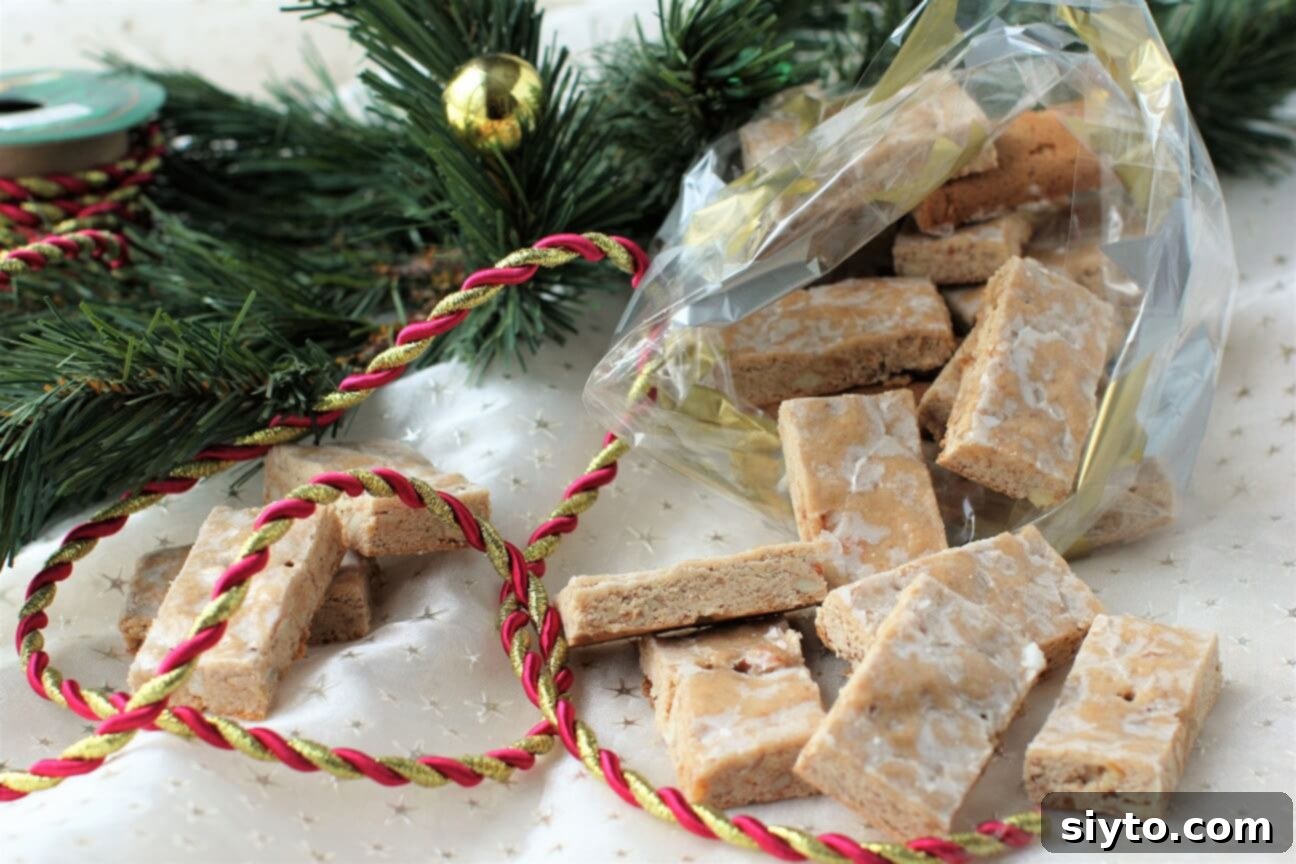
Basler Leckerli: The Beloved Swiss Spiced Christmas Cookie Bars
Basler Leckerli are not just cookies; they are a delightful tradition, famously known as ‘little delicious things from Basel’. And truly, that description couldn’t be more fitting. These iconic Swiss Christmas cookies are celebrated for their unique chewy texture, a perfect harmony of spicy warmth, and a bright, fruity sweetness. What makes them truly special is that, much like fine wine, they actually improve with age. The longer they’re stored, the more tender, flavorful, and wonderfully chewy they become. They are the quintessential accompaniment to a cozy cup of tea during the festive holiday season or a comforting treat on a crisp, snowy day in the New Year – that is, if they manage to last that long!
Embracing the Holiday Spirit with Traditional Swiss Baking
The festive season always seems to arrive faster than expected, bringing with it a whirlwind of activities and, for many of us, a strong desire to fill our homes with the comforting aromas of holiday baking. This year, for our Eat the World recipe challenge, we’re diving into the wonderful world of Christmas recipes and treats from various cultures. Despite a busy semester as a student, I couldn’t resist sneaking in some time to bake a few traditional cookies. The thought of spending Christmas in Bavaria, Germany, just around the corner, where we’ll meet some of our children currently exploring Europe, adds to the excitement. While I’m diligently wrapping up my final assignments for my Culinary Nutrition Course, a little bit of “procrastibaking” – a delightful term for procrastinating with holiday baking – has me bubbling with festive anticipation.
As I baked not one, but two batches of these irresistible Basler Leckerli (along with some authentic Lebkuchen, which I’ll share soon!), the enchanting scent of cinnamon, nutmeg, and cloves filled every corner of my home. These traditional Swiss Christmas cookies are incredibly popular not only in Switzerland but also widely cherished across Germany. Their diminutive size and delicate glaze belie a complex flavor profile: spicy, sweet, and distinctly fruity, making them absolutely perfect for savoring with a hot cup of tea or coffee. Even though I’ve only recently discovered the joy of making these little “deliciousli,” their taste instantly evokes the warmth of Christmas and transports me back to the holiday baking memories of my childhood.
The Rich History and Meaning Behind Basler Leckerli
The name itself, “Basler Leckerli,” tells a fascinating story rooted in Swiss culinary heritage. “Basler” refers to their city of origin, Basel, Switzerland, where these spiced biscuits were first crafted by ingenious local spice merchants back in the 1400s. The term “Leckerli” (or “Läckerli,” depending on the dialect) comes from the German word “lecker,” meaning ‘delicious,’ combined with the Swiss German diminutive suffix “-li,” which means ‘little.’ Thus, “Basler Leckerli” translates perfectly to ‘little delicious things from Basel’ – a name that truly captures their essence and enduring appeal.
My first encounter with these delightful treats was last fall, while assisting a Swiss friend in catering a Swiss dinner for a Culinary Art Day. The Basler Leckerli served that day were so utterly delicious that I knew I had to recreate them at home. Being a household that often opts for gluten-free options, I adapted her traditional recipe, making only a slight adjustment to the amount of gluten-free flour. The result was just as wonderful as the original, allowing my family to fully enjoy this centuries-old delicacy.
The Art of Making Basler Leckerli: A Labor of Love
While the end result is undeniably rewarding, preparing these traditional cookies does require a certain amount of dedication and “elbow grease.” The dough itself is famously stiff and sticky, demanding quick action and a fair bit of strength to handle it while it’s still warm. Similarly, cutting the baked slabs into their characteristic bars also necessitates considerable effort and must be done promptly before they cool and harden. However, every bit of effort invested is truly worthwhile. In fact, these cookies are at their absolute best when allowed to “age” for a few days – a week is even better. This resting period allows them to become even more tender, their flavors to deepen and meld, and their signature chewiness to fully develop. It’s a testament to patience paying off, transforming them from delicious to truly exceptional.
Step-by-Step Guide to Crafting Perfect Basler Leckerli
The process of making Basler Leckerli, while requiring some muscle, is straightforward and deeply satisfying. Here’s a detailed look:
You can finely chop the almonds and candied peel by hand, which is a traditional method, or opt for the quicker, more convenient way – using a food processor. I personally favor the latter for efficiency.
Once your nuts and candied peel are prepared, stir them together with the flour and all the aromatic spices. In a separate saucepan, gently heat the honey and brown sugar until the sugar has melted and the honey is warm, but careful not to let it boil. This warm, sweet mixture is then poured directly into the dry ingredients. Stir vigorously and quickly; you’ll notice it rapidly transforms into a very stiff, sticky dough – this is exactly what you want.
Next, evenly plop this firm dough onto two parchment-lined cookie sheets. The parchment paper is crucial here, as it will aid in lifting and handling the baked cookies later.
Now comes the muscle work: use dampened fingers to press the dough flat into an even rectangle on each sheet. Keep your fingers moist as you work, as this helps prevent sticking. Once flattened, dock the dough all over with a fork, creating small perforations across the surface. This helps with even baking.
Allow the dough to rest for a couple of hours at room temperature. This resting period is important for the flavors to meld. After resting, bake the cookies until their edges just begin to brown. Immediately upon removing them from the oven, brush a simple lemon-sugar glaze generously over the hot surface. This creates the signature shiny, slightly crisp topping.
The final step is to cut the baked and glazed slabs into small rectangles right away, while they are still warm and pliable. Again, this requires a firm hand and a sharp knife, as the cookies will become much harder to cut once completely cooled.
And there you have it! A batch of exquisite Basler Leckerli, ready to be stored, aged, and eventually savored. Happy Holiday Baking (even if it is procrastibaking)!
* * * * *
Basler Leckerli (Swiss Christmas Cookie Bars)
Margaret Bose Johnson
Save to Pinterest
Ingredients
- 2 cups (250gms) finely chopped almonds (1½ cups whole almonds, chopped)
- ⅓ cup (60gms) packed candied orange peel
- ⅓ cup (60gms) packed candied citron peel
- zest of one organic lemon
- 4¼ cups (600gms) regular flour (or 4 cups/550gms gluten free flour blend)
- 1 tablespoon ground cinnamon
- 1½ teaspoons ground nutmeg
- 1 teaspoon ground cloves
- 1 teaspoon baking powder
- ¼ teaspoon salt
- 1½ cups (500gms) honey
- 1 cup (200gms) natural evaporated cane sugar (or 1⅓ cups/200 gms coconut sugar)
For the glaze:
- ¾ cup (90gms) icing sugar/powdered sugar/confectioner’s sugar
- 1 teaspoon fresh lemon juice
- 2 tablespoons water
Instructions
- Line 2 cookie sheets with parchment paper that sticks up at least one inch (2.5 cm) on each side.
- Finely chop the almonds and candied peel. You can do this by hand or in the food processor (much easier). For the food processor, chop the almonds coarsely first, then add the peel and process together until they are evenly ground, with little chunks of the nuts still remaining.
- In a large bowl or the bowl of a stand mixer, combine the chopped nuts, peel, lemon zest, flour, spices, baking powder, and salt.
- Heat the honey and sugar in a small pot on the stove until the sugar is melted and the honey is warm. Do not allow it to boil.
- Pour the hot honey over the flour mixture and stir or mix (in the stand mixer) until the batter is blended into a thick, sticky dough. It will be very firm.
- Divide the dough in two and put half into each prepared pan. Use a metal spoon to scrape the remaining dough out of the mixing bowl and add it to the rest.
- Using damp fingers (keep dipping them in water as needed), push and pat the dough into a 9″ x 13″ (23 x 33 cm) rectangle on each cookie sheet. Work quickly while the dough is still warm, as it gets harder to work with as it cools. This takes effort and muscle. Pinch off pieces of dough from the thicker spots and press them into the thinner spots until the rectangle is of even thickness. Pat the top smooth with damp fingertips. Dock the dough all over with a fork (poke the fork straight down through the batter until it touches the cookie tin, 1 to 2 inches apart, all over the dough rectangle). Trim off excess parchment paper so it sticks up no more than one inch (2.5cm) above the cookie dough.
- Allow the pans to rest at room temperature, covered with a clean dish towel, for two hours or up to overnight.
- Preheat the oven to 425°F (220°C).
- Bake the cookie sheets for 15 to 18 minutes, rotating them halfway and using a spatula to press down any parts of the dough that have bubbled or bulged up. The edges of the dough should just be starting to brown.
- While the cookies are baking, whisk together the glaze ingredients.
- Brush the glaze all over the top of the two cookie rectangles as soon as they come out of the oven.
- While still warm, lift the cookie slabs from the cookie sheets using the parchment paper to hold onto, and transfer them onto a large cutting board. Cut the cookie slabs into 1″ x 2″ (2.5 x 5 cm) bars. You can trim off a thin strip from the outside edges first, if desired. Use a large, sharp knife and work quickly to cut the cookies while still warm, as they are hard to cut once they cool.
- Allow the cookies to cool.
- Store the cookies in an airtight, covered container. The are best if left for at least a week to soften and mellow the flavours, but need a minimum of one day in the container before they should be eaten.
- The cookies will keep for up to two months, in a sealed container at cool room temperature and up to six months in the freezer (age at room temperature for one week before freezing). If you’re storing the cookies at room temperature and they get too hard, put a few wedges of apple or some orange peels into the container with them and after a few days they will have softened considerably.
- Make 8 dozen Basler Leckerli cookie bars (that sounds like a lot, but they are small and keep forever! (They freeze well, too).
Notes
I have only made the gluten-free version of these cookies with my gluten free flour blend and they turned out beautifully, just like the original version. I have not tried them with other gluten free flours.
The candied peel adds a lovely citrus tang to go with the spices. You can use ⅔ cup (120gms) of mixed peel instead of separate orange and citron peel.
This recipe makes two pans of cookies – 4 dozen in each pan. That sounds like a lot, but while you’re doing the muscle work, I say make the effort worthwhile. The cookies keep well, and make great gifts. Won’t you be happy to find a stash of these in your freezer in the middle of a long, cold February (if they last that long)?
This is Sabina’s authentic Swiss recipe (though I’ve cut the sugar down by 50 grams from the original 250 grams and they’re still deliciously sweet).
Guten Appetit!
Join Our Global Culinary Journey
There’s nothing quite like exploring the world through its cuisine, especially during the festive season. I invite you to check out all the wonderful Christmas and holiday dishes and sweets prepared by fellow Eat the World members. Share your own creations with #eattheworld and be part of our delicious community. Click here to find out how to join and have fun exploring a new country’s culinary traditions with us each month!
Discover More Festive Recipes from Around the World:
- Culinary Adventures with Camilla: Glædelig Jul, Nisser, and Mormor Agnes’ Æbleskiver
- Literature and Limes: Makowiec
- Palatable Pastime: Danish Asier Pickles
- Amy’s Cooking Adventures: Lebkuchenherzen (German Cookies)
- Chipa by the Dozen: Pepperkaker (Norwegian Christmas Cookies)
- Evelyne: Oliebollen, the Dutch Doughnut
- Loreto and Nicoletta: Sandbakkelse, Norwegian Christmas Cookies
- Simply Inspired Meals: Classic Christmas Spritz Cookies
- A Day in the Life on the Farm: Bohemian Potato Salad
- Making Miracles: Scottish Steak Pie
- Margaret at Kitchen Frau: Basler Leckerli, Swiss Christmas cookies
Stay Connected with Kitchen Frau
Want to receive new Kitchen Frau recipes directly to your email? Sign up here and you’ll get a handy and useful kitchen tip along with each recipe, too. (No spam ever.)
If you like my recipes, follow me on Instagram, Pinterest, Twitter, and Facebook. You’d make my day!
PIN IT HERE to save the recipe for later:
Explore More “Eat the World” Recipe Challenges:
- Ireland: Dublin Coddle (A tasty Sausage and Potato Stew)
- Thailand: Shrimp Laksa (Khung)
- Kenya:Maharagwe with Ugali (Red Beans with Cornmeal Slice)
- Sweden: Swedish Meatballs with Cream Gravy
- New Zealand: Classic Pavlova
- France: Axoa d’Espelette (A Simple Stew from the Basque Country)
- Argentina: Red Chimichurri Sauce
- India: Kerala Upma (Fluffy, Kerala Style Breakfast Upma Recipe)
- Poland: Polish Honey Cake
- Ethiopia: Four Ethiopian Recipes for a Fantastic Feast
- England: Gluten Free Fish and Chips and Mushy Peas
- Georgia: Charkhlis Chogi (Beets with Sour Cherry Sauce)
- Mexico: Cochinita Pibil Tacos (Pit Barbecued Pig to Make in Your Oven)
- Cambodia: Noum Kong (Cambodian Rice Flour Doughnuts)
- Israel: Cucumber, Feta, and Watermelon Salad
- Finland: Lohikeitto (Creamy Salmon, Potato, and Dill Soup)
- Puerto Rico: Piña Colada Cocktail
- Egypt: Fava Beans and Feta
- Ukraine: Buckwheat Kasha with Beef
- Portugal: Tuna and Sardine Pâtés