German Lebkuchen & Marzipan Yule Log (Bûche De Noël): A Festive Holiday Masterpiece
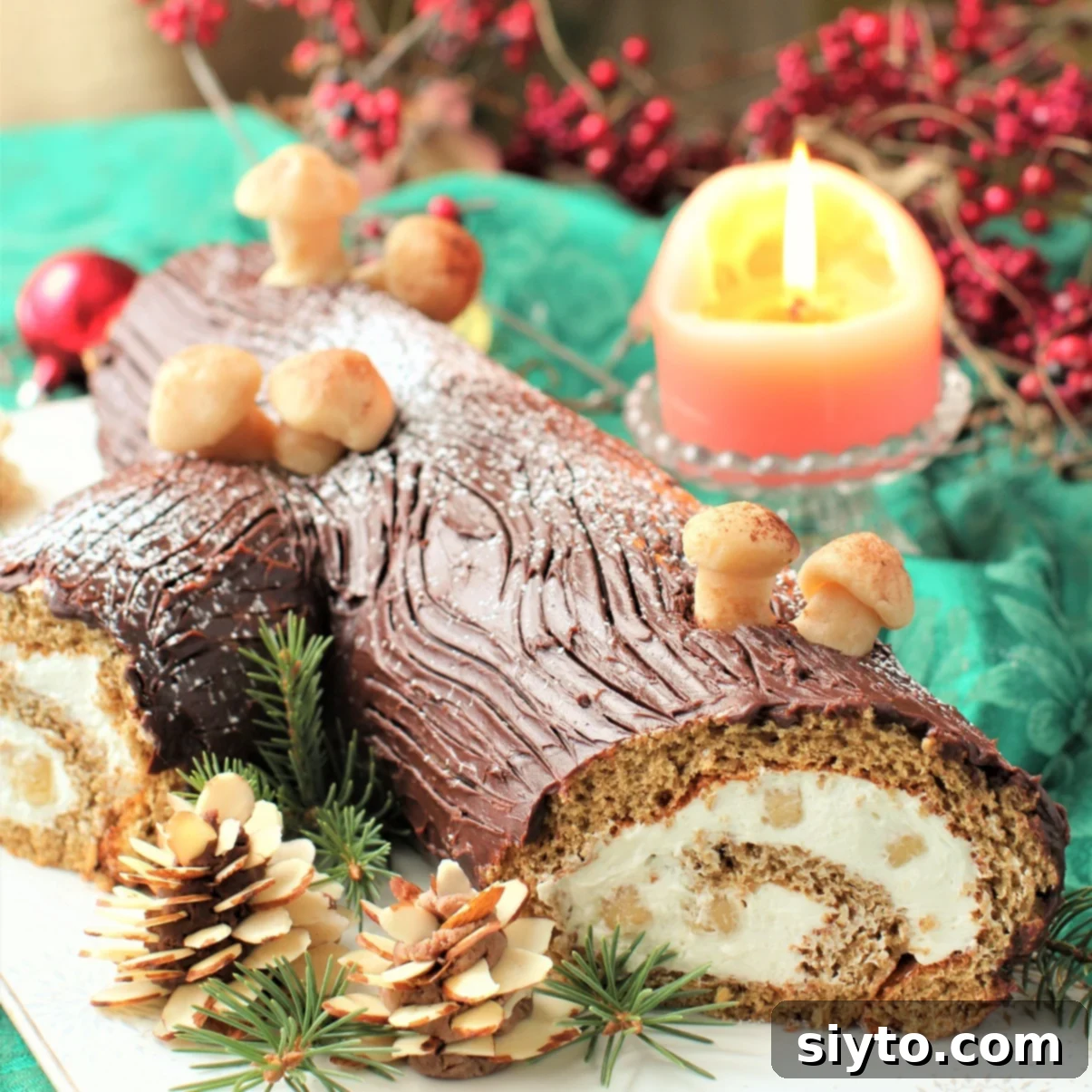
Prepare to captivate your guests this holiday season with a dessert that’s as stunning as it is delicious. Our festive Yule Log, a cherished French Bûche De Noël, receives a delightful German transformation, infusing it with the warm, aromatic spices of Lebkuchen and the sweet, almond essence of marzipan. This showstopping creation features a tender, spiced sponge cake delicately rolled around a rich, marzipan-studded whipped cream filling. A luscious chocolate ganache artfully replicates authentic tree bark, making this cake a true feast for the eyes. While its appearance suggests intricate culinary expertise, you’ll be pleasantly surprised by how approachable it is to make. For those who love to add a touch of whimsy, we’ve included detailed instructions for crafting charming little marzipan mushrooms and pine cones to complete your forest-inspired masterpiece. What’s more, this recipe is thoughtfully designed to be gluten-free, ensuring everyone can enjoy a slice of holiday magic!
Imagine combining the elegant charm of a classic French Bûche De Noël, also known as a Yule Log, with the distinctive and heartwarming flavors of German Christmas spices. The result is an extraordinary fusion dessert that promises to elevate your holiday table with unparalleled elegance and pizzazz. This culinary creation is guaranteed to elicit “oohs” and “aahs” of delight from all your guests, leaving a lasting impression long after the last bite.
This past holiday season, my friends Nicoletta and Loreto from SugarLoveSpices and I embarked on a festive baking adventure. We discussed our plans for crafting a showstopping Bûche De Noël for Christmas. While they envisioned an Italian-inspired version to complement their renowned Italian cuisine, I was eager to infuse mine with authentic German flavors, aligning perfectly with our German Christmas traditions. We spent a delightful day brainstorming innovative ways to adapt the traditional French Bûche De Noël, transforming it into something uniquely ours. The highlight was a collaborative baking session where we each brought our new versions to life. It was not only a fun day in the kitchen but an even more enjoyable experience taste-testing both delectable creations at the end. Scroll down to discover photos of our beautiful finished desserts.
What is the Fascinating History Behind the Bûche De Noël or Yule Log Cake?
The delightful tradition of baking a Yule Log cake traces its roots back to ancient pagan rituals and the symbolic burning of an actual yule log during the Christmas season. This practice dates back to medieval times, predominantly in Scandinavia, northern Europe, and Germany. Historically, a large, entire tree trunk would be brought into the home, with the thickest end placed into the hearth. A small portion of this log would be burned each day throughout the twelve days of Christmas. This ritual was believed to bring good fortune, prosperity, and protection against evil spirits into the New Year, symbolizing the renewal of light and life during the darkest part of winter. The Yule log tradition held significant cultural importance across many European countries. However, as homes evolved and fireplaces became smaller or were replaced by more modern heating systems, the custom of bringing a massive log indoors became increasingly impractical. Gradually, the edible Yule log cake, exquisitely decorated to resemble a wooden log, emerged as a charming and delicious replacement. This culinary tradition particularly flourished in France, Belgium, and former French colonies, where the Bûche De Noël remains an indispensable and iconic element of yuletide celebrations today.
Unraveling the Delicious Components of a Yule Log Cake
A Yule Log cake, in its essence, is a light and luxurious dessert traditionally constructed from a thin, airy sponge cake layer. This delicate cake is carefully wrapped around a creamy filling, often made of whipped cream or buttercream, then artfully coated with frosting and meticulously decorated to mimic the rustic appearance of a natural tree log. The beauty of this dessert lies not only in its stunning presentation but also in its modular construction, making it surprisingly manageable for home bakers.
Crafting a Yule Log typically involves orchestrating four distinct elements, and the wonderful news is that many of these components can be prepared several days in advance, significantly easing the baking process. In fact, the entire cake can be assembled the day before serving, allowing the flavors to meld beautifully (it often tastes even better after a day in the refrigerator!).
1. THE SPONGE CAKE LAYER: The Foundation of Flavor
The foundation of our Yule Log is a delicate Genoise sponge. This classic European cake is renowned for its lightness and airy texture, achieved by whipping whole eggs and sugar together until they form a voluminous, foamy mousse, then gently folding in flour. Unlike many cakes, a traditional Genoise often omits butter or oil, relying solely on the eggs for its tender structure. If you’ve ever tackled a jelly roll, the technique for rolling this Yule Log will feel familiar and straightforward. If not, fear not! It’s an easy and incredibly satisfying technique to master, and our process photos below will guide you every step of the way.
2. THE FILLING: A Creamy Centerpiece
Traditionally, a Yule Log is generously filled with either rich chocolate buttercream or light, fluffy whipped cream. However, the versatility of this cake allows for countless creative variations. For our German-inspired version, we elevate the classic whipped cream by infusing it with tiny, sweet cubes of marzipan, adding an irresistible almond flavor and delightful texture that perfectly complements the spiced sponge.
3. THE FROSTING: The Bark Effect
To create the iconic bark-like exterior, more chocolate buttercream is frequently used to ice the cake. Yet, for an equally stunning and often preferred finish, a smooth chocolate ganache is an excellent choice—and the one we’ve opted for. Ganache is not only significantly easier to prepare but also less intensely sweet than buttercream, offering a truly rich, decadent texture and deep chocolate flavor. Its pliable nature makes it incredibly easy to work with, allowing you to create realistic bark textures with just a simple fork.
4. THE DECORATIONS: The Whimsical Forest Touch
While not strictly essential for flavor, the decorations are paramount to the Yule Log’s visual appeal – after all, we often eat with our eyes first! A dusting of powdered sugar artfully scattered over the frosting mimics freshly fallen snow. Beyond this, your inner artist can truly flourish. Decorations can range from edible elements to natural or artificial accents. Consider using real or artificial evergreen twigs, miniature pinecones, vibrant berries, or sparkling Christmas baubles. Classic choices often include delicate meringue mushrooms, glistening sugared or plain cranberries, bright maraschino cherries, and fragrant sugared or plain rosemary twigs. For a truly enchanting and delightfully whimsical touch, I chose to craft charming marzipan mushrooms and pine cones. These edible decorations are surprisingly simple to make (see detailed instructions below) and offer the added convenience of being prepared several days in advance, ready to simply place on your log at the last moment.
Let’s Get Baking: Crafting and Assembling Your German Yule Log!
Our German interpretation of the classic Bûche De Noël truly shines through its unique sponge cake, which is richly flavored with our homemade German Lebkuchen spice mix. To further enhance this classic German gingerbread profile, we incorporate a hint of molasses for depth and a touch of fresh lemon peel for brightness. The Lebkuchen spice blend is distinguished by its inclusion of ground star anise and fennel or anise seeds, which impart that characteristic light licorice note, giving German baking its unmistakably special aroma and taste. It’s incredibly simple to whip up a batch of this versatile spice blend at home. Once you have it on hand, you can use it in various festive recipes, such as a comforting Lebkuchen Loaf or our cherished German Elisenlebkuchen cookies. In fact, you can substitute Lebkuchen spice whenever a recipe calls for a general spice blend, or simply add a pinch to your holiday coffee, hot chocolate, or eggnog for an instant festive boost. If you prefer not to make the Lebkuchen spice mix from scratch, a good quality pumpkin pie spice or apple pie spice blend will also yield a delicious and warmly spiced cake.
Mastering the Lebkuchen Sponge Cake:
The beauty of this particular sponge cake lies in its streamlined preparation. Unlike some recipes that require separating eggs and whipping whites and yolks individually, this method involves whipping the whole eggs and sugar together until they transform into a light, airy, and voluminous mousse. This “all-in-one” technique saves a step without compromising on texture. Once the egg foam is perfectly light, the molasses and fresh lemon zest are gently folded in, followed by the sifted flour and Lebkuchen spices. The resulting batter is then spread into a thin, even layer on a rimmed cookie sheet and baked for a short period, creating the perfect pliable base for our roulade.
The Art of Rolling the Sponge:
Pre-rolling the warm cake immediately after baking and allowing it to cool in that coiled shape is a critical step for any successful cake roulade, including our Yule Log. This technique “trains” the cake to hold its rolled form, ensuring it remains flexible and won’t crack when you later unroll it to add the filling and then re-roll it into its final log shape. This simple step guarantees a beautifully smooth and intact roll.
While your cake bakes, generously dust a clean, thin tea towel (avoid thick, fluffy ones) with powdered sugar through a sieve. Once the cake is baked, let it cool for just a minute or two. Then, quickly and confidently run a knife around the edges to loosen it from the pan. Invert the cake onto your sugar-dusted tea towel with a swift, smooth motion. Carefully peel off the parchment paper, then dust the now-exposed side of the cake with more powdered sugar. This prevents sticking and adds extra sweetness. Now, beginning from one end, firmly roll up the hot cake along with the tea towel. You have a choice here: roll from the short end for a shorter, thicker log, or roll from the long end for a longer, thinner log, which allows you to cut a diagonal piece to attach as a “sawed-off branch,” as I did for the logs featured in these photos. Allow the cake to cool completely, still rolled up in the towel. For convenience, you can wrap the towel-clad cake in plastic wrap at this stage and refrigerate it for 2 to 3 days before you’re ready to fill and frost it.
Preparing the Filling and Assembling the Log:
Our whipped cream filling is delicately sweetened to allow the other flavors to shine and is stabilized with a touch of gelatin. This crucial addition helps the cream maintain its elegant shape, ensuring clean slices when you cut into your beautiful Yule Log. To incorporate the gelatin, first sprinkle the powdered gelatin over a small amount of cold water and let it soften for about five minutes. Then, gently heat the softened gelatin, either in the microwave in short bursts or over a pot of simmering water, until the granules are completely dissolved and the mixture is clear. Once the whipped cream has reached soft peaks, slowly pour in the warm, melted gelatin while continuing to whip for another 30 seconds. For the marzipan component of the filling, roll a block of marzipan into a thick layer and then dice it into small, uniform cubes. If marzipan isn’t to your taste or readily available, you can simply omit it and instead add about ½ teaspoon of pure almond extract to the whipped cream, along with an extra tablespoon or two of sugar.
Once your sponge cake is fully chilled, gently unroll it from the tea towel. You’ll notice it now retains its shape beautifully, making the re-rolling process a breeze. Evenly spread the marzipan-studded whipped cream over the entire surface of the cake, ensuring you leave about a one-inch border uncovered along the far edge. This margin helps prevent the filling from squeezing out as you roll. Sprinkle the diced marzipan uniformly over the whipped cream, then carefully re-roll the cake back into a tight log. For a traditional “sawed-off branch” effect on your Bûche De Noël, slice one end of the log diagonally. Position this cut piece against the side of the main log. At this point, you can wrap the assembled log tightly in plastic wrap and chill it in the refrigerator for a few hours or even overnight. This allows the cake and filling to firm up, making it easier to frost and decorate on the day you plan to serve it. Alternatively, if time is of the essence, you can proceed directly to frosting and decorating, then chill the finished cake for a few hours before presenting it.
Frosting and Decorating Your Rustic Log:
To create the rich, bark-like frosting, prepare a luscious chocolate ganache. Simply combine equal weights of high-quality dark chocolate chips (or finely chopped dark chocolate) and heavy cream in a saucepan over low heat, stirring until almost fully melted. Remove from heat and continue stirring until the mixture is completely smooth and glossy. Alternatively, you can achieve this in the microwave by heating the chocolate and cream in 30-second intervals, stirring well after each, until smooth. Allow the ganache to cool at room temperature until it reaches a spreadable consistency – this typically takes about 30 to 45 minutes, but be sure to check it frequently to prevent it from becoming too stiff. Once ready, generously spread the ganache over the entire log, leaving the cut ends of the main log and any side branches exposed to resemble freshly sawn wood. To achieve the realistic ‘bark’ texture, simply drag the tines of a fork through the ganache in wavy, irregular lines across the surface. This creates a beautifully rustic and convincing finish.
Now, let your creativity truly run wild as you embark on decorating your Bûche De Noël! This is where you can personalize your festive creation to perfectly match your holiday vision. In one version shown, I adorned the log with charming marzipan mushrooms, realistic natural pine cones, and a scattering of artificial berries, creating a vibrant forest scene. In other photos, you’ll see a cohesive look achieved entirely with the edible marzipan mushrooms and pine cones. Whichever path you choose, the key is to have fun and make it your own. Detailed instructions for crafting both the delightful marzipan mushrooms and pine cones are provided below, making it easy to add these whimsical touches to your holiday masterpiece.
How to Craft Whimsical Marzipan Decorations for Your Yule Log
These charming marzipan decorations are not only delightful to look at but also incredibly versatile, as they can be prepared well in advance of your baking day. This makes them a perfect make-ahead element for stress-free holiday entertaining. You can shape them and store them in a single layer on a plate, uncovered, for up to 24 hours to allow them to firm up slightly. For longer storage, place them in an airtight container in the refrigerator for up to a week, ready to adorn your Yule Log at a moment’s notice.
For the Adorable Marzipan Mushrooms:
To create these miniature woodland treasures, you’ll need a block of marzipan, which can typically be found in specialty import stores, gourmet food shops, or even the baking aisle of some larger supermarkets. A small amount of unsweetened cocoa powder will provide the rustic dusting. Approximately 75 grams (2.5 oz or ¼ cup) of marzipan will yield enough for 5 to 6 charming mushrooms.
- Start by pinching off a teaspoon-sized piece of marzipan. Roll it into a smooth ball between your palms, then gently shape it into a classic mushroom cap with a slightly rounded top and a flatter underside. For the stem, pinch off a slightly smaller piece of marzipan and roll it into a thick, cylindrical shape. Carefully press the mushroom cap onto the top of the stem, securing them together.
- Repeat this process to create as many mushrooms as you desire for your Yule Log. Once all your mushrooms are shaped, take a small sieve and place a tiny amount of cocoa powder in it. Lightly dust the tops of the mushroom caps by gently tapping the sieve over them, creating a natural, earthy hue.
- Your cute little marzipan mushrooms are now ready! Carefully place them onto your frosted Yule Log, arranging them artfully to create a forest floor scene, or nestle them on the serving plate alongside the log for an equally charming presentation.
For the Intricate Marzipan Pine Cones:
Similar to the mushrooms, these charming marzipan pine cones can also be made up to a week in advance, offering fantastic flexibility in your holiday baking schedule. Once shaped, store them in a single layer on a plate, uncovered, for up to 24 hours to allow them to dry slightly. For longer storage, transfer them to an airtight container and refrigerate for up to a week, ensuring they are perfectly ready when you need them.
You’ll need a block of marzipan, about ¾ teaspoon of unsweetened cocoa powder for coloring, and a handful of sliced natural almonds (those with their skins still on provide the best realistic texture). Approximately 75 grams (2.5 oz or ¼ cup) of marzipan will be sufficient to create 5 to 6 pine cones.
- Begin by combining the chunk of marzipan (about 75 grams / 2.5 oz) with the cocoa powder. If your marzipan is at room temperature, you can initially mix it with a fork. Then, knead it gently with your fingers until the cocoa powder is fully incorporated and the marzipan achieves a uniform brown color. Be mindful not to over-knead, as excessive handling can release the natural oils from the almonds, making the marzipan overly greasy and harder to work with. (While the oil will eventually reabsorb as the decorations sit, it can make the shaping process messier.)
- Next, pinch off a piece of the brown marzipan, roughly the size of two teaspoons. Roll it into a smooth ball, then gently press and shape it into a rounded cone. Now, sort through your sliced almonds and select pieces that are mostly whole, saving any broken bits for another culinary use. Starting at the very base of your marzipan cone, carefully press in a row of almond slices. Angle them slightly upwards and overlap them a bit, ensuring the pointed ends of the almonds face outward, mimicking the scales of a natural pine cone. Add a second row of almonds, positioned approximately ⅛-inch above the first row, staggering them slightly. Continue adding rows of almond slices, gradually working your way up to the tip of the cone. As you ascend, select smaller almond slices to maintain the realistic tapering shape of a pine cone.
- Once all your pine cones are meticulously crafted, arrange them artfully around the base of your Yule Log. For an added touch of natural beauty and festive charm, tuck small sprigs of fresh spruce twigs or fragrant rosemary between the pine cones, completing your woodland tableau.
A Beautiful Bûche De Noël: The Perfect Centerpiece for Your Festivities
I sincerely hope this guide has inspired you to embark on the delightful project of creating your very own Bûche De Noël or Yule Log for your upcoming special occasion. While it may seem like a substantial endeavor, it’s truly a fun and rewarding project that is definitely worth the time and effort. The key to making it manageable is to spread out the preparation stages over a few days. By making the sponge cake and marzipan decorations ahead of time, the final assembly becomes far less daunting. So, put on some festive Christmas music, gather your ingredients, and immerse yourself in the joyful experience of holiday baking!
If your baking soul is calling for more unique and special desserts that exude that extra “oomph” and festive flair, consider exploring some of our other cherished recipes. How about a Dreamy Pumpkin Spice Pavlova, a cloud-like confection perfect for autumn gatherings, or a towering Mile-High Medjool Date & Apple Pie, bursting with sweet and spiced flavors? For a truly extraordinary and traditional German treat, delve into the intricate layers of a German Baumkuchen, often called a “tree cake” for its distinctive rings.
And if the allure of the Yule Log has truly captured your imagination, why not venture further and try an Italian rendition as well? You absolutely must check out Nicoletta’s incredible Cannoli Christmas Yule Log, a masterpiece she created during our joint baking day. This exquisite version features a light-as-air vanilla sponge cake base, generously filled with a creamy, sweetened ricotta filling that’s delicately spiked with bits of candied orange peel and decadent chocolate. It’s a little slice of authentic Italian Christmas joy. We had immense fun sharing tastes of each other’s cakes at the conclusion of our baking project, and confess, we truly couldn’t decide which one we liked better – both were exceptionally delicious! Our collaboration also provides a wonderful opportunity for you to gather ideas for different ways to roll and decorate your own log. Both of us opted for a rich chocolate ganache frosting, but we applied distinct finishes and decorative styles. Nicoletta’s Italian Yule Log was rolled the shorter way, resulting in a thicker log, which she beautifully adorned with bright maraschino cherries and fresh rosemary sprigs, creating a simple, vibrant, and incredibly festive aesthetic. My German Lebkuchen Log, on the other hand, was rolled the long way, yielding a more elongated shape, and decorated with our rustic marzipan mushrooms and pine cones, evoking a charming woodland, foresty feel. Both approaches have their unique charm, and both deliver an absolutely delicious and memorable dessert experience!
Both have their charm and both are absolutely delicious!
You might also be interested in trying a traditional Canadian prairie Gumdrop Fruitcake, a unique and colorful holiday classic. Or perhaps explore the world of famous German baked goods with our recipe for Stollen, a rich and buttery Christmas bread. For a decadently chewy Italian fruitcake, don’t miss the irresistible Panforte. If Christmas cookies are your passion, you’ll be excited to try these traditional fruit & nut based German Elisen Lebkuchen, the immensely popular Zimtsterne (cinnamon stars), the delightful marzipan-based Bethmännchen, or the spicy and addictive Basler Leckerli. And for a simpler yet equally satisfying treat, our Sicilian Almond Cookies are always a fantastic choice!
Guten Appetit!
Bûche De Noël (Yule Log, German Style)
Margaret Bose Johnson
Save to Pinterest
Ingredients
for the sponge cake roll:
- 6 large eggs
- ¼ teaspoon fine sea salt
- ½ cup (100gms) sugar
- 2 tablespoons fancy molasses (light molasses/table molasses)
- 1 cup (140gms) gluten-free flour blend or regular flour for non-gluten-free
- 1 teaspoon baking powder
- 2 teaspoons lebkuchen spice blend or substitute with pumpkin pie spice
- zest of ½ a lemon
- icing sugar for dusting
for the filling:
- 1½ cups (360ml) whipping cream (33% fat or higher)
- 1 tablespoon sugar
- 2 teaspoons powdered gelatin
- 2 tablespoons cold water
- 3.5 ounces (100gms) marzipan (⅓ cup packed or ⅔ cup finely diced)
for the ganache ‘bark’ frosting:
- ¾ cup (180ml) whipping cream
- 6.5 ounces (180gms) chocolate chips or chopped dark chocolate (1 cup + 1 tablespoon)
to decorate:
- a sprinkle of powdered sugar, fresh or artificial spruce twigs, berries, twigs, pine cones, or marzipan mushrooms or marzipan pine cones see Yule Log recipe post for instructions
Instructions
to make the sponge cake roll:
- Preheat the oven to 325°F (170°C). Lightly grease the bottom of a 12 x 17-inch (30 x 43 cm) rimmed baking sheet with butter or baking spray. Line the bottom with a piece of baking parchment paper cut to fit. Grease or spray the paper, too. (Leaving the sides of the pan ungreased will help the cake to ‘grip’ the sides and rise better.)
- Whip the eggs and salt with a stand mixer whisk or hand mixer until foamy. Add the sugar gradually, then beat on high speed for a full 8 to 10 minutes, until the mixture is really pale and fluffy and has expanded in volume 5 to 6 times.
- Add the molasses and lemon zest and whip for 30 seconds to incorporate them.
- Sift the flour, baking powder, and spices over the eggs and fold them in with a spatula until just combined.
- Pour the batter into the prepared baking sheet. Spread it to the edges and even out the top. Bang the pan sharply on the countertop to release any air bubbles.
- Bake for 18 to 20 minutes, or until the center of the cake springs back when lightly touched. Do not overbake, or the cake will crack when rolled.
- While the cake is baking, lay out a clean tea towel (use a thin cotton one without any towel nap or waffle weave). Sprinkle the whole towel liberally with powdered sugar shaken through a sieve.
- When the cake is finished baking, let it cool for 2 minutes, then cut all the way around the edges of the cake to loosen it from the sides of the pan. Invert it quickly and confidently with one smooth movement onto the sugar-dusted towel. Remove the baking sheet and carefully peel off the parchment paper. Dust the surface of the cake liberally with powdered sugar, too.
- Roll up the hot cake firmly with the tea towel. Start from the short side if you want a shorter, thicker log. Start from the long side if you want a thinner, longer log.
- Leave the log to cool completely, rolled up in the towel – for about an hour in the fridge, or wrap the cooled cake (still in the towel) in plastic wrap and leave it in the fridge for up to a day, if making the cake ahead.
to make the filling and assemble the yule log:
- Sprinkle the gelatin onto the water in a small bowl and leave it to soak for 5 minutes to soften it. Microwave it in 10 second increments until it is just melted (20 – 30 seconds) or set the bowl over a small pot of simmering water until the gelatin has melted.
- Whip the cream with the sugar until soft peaks form. Pour in the warm melted gelatin while whipping and whip for 30 seconds more.
- Dust a work surface with powdered sugar and roll out the marzipan to a ¼-inch (.6cm) thickness. Cut it into small cubes.
- Gently unroll the chilled cake and spread it with the whipped cream right to the sides of the cake, but leaving the last inch of the roll uncovered.
- Sprinkle the diced marzipan evenly over the cream.
- Re-roll the cake in the same direction it was rolled before, lifting the towel to help roll it and using your fingers to tuck it firmly as you roll it. As you roll, you may have to carefully pull the towel away from the cake if it was stuck in any spots.
- Lift the yule log carefully and place it onto a serving plate.
- If you’d like to have a side-branch, cut off one end of the log diagonally at about 3 to 4 inches and place it up against the side of the longer log piece. If you’ve rolled your log the short way, you can make a short side piece, or leave your log plain, without a side-piece.
- At this point, you can cover the cake with plastic wrap and chill it for a day before adding the ganache ‘bark’ and decorating it, or complete it now to serve in a few hours.
to make the ganache ‘bark’ and decorate the log:
- Combine the chocolate chips or chopped chocolate and the whipping cream in a small saucepan. Heat over low heat on the stovetop, stirring constantly until the chocolate is almost all melted. Remove from the heat and continue stirring until the mixture is smooth and glossy. (Alternately, heat the chocolate and cream in a bowl in the microwave by 30 second increments on high power until it is half melted. Remove and stir until it is completely melted.
- Set the ganache aside to cool at room temperature until it is thickened enough to spread – about 30 to 45 minutes. Check it often after the 30 minute mark, as you don’t want it to get too stiff to spread.
- Spread the ganache over the yule log to cover it completely, leaving the cut ends of the log and side-branch exposed.
- Leave it with the knife marks to look like bark, or drag the tines of a fork through the icing in wavy lines to look like bark.
- Optional – Dust the cake lightly in a few spots with powdered sugar shaken through a sieve, to look like a bit of fresh snow.
- Decorate your Yule Log as desired. Use little mushrooms made of marzipan and real pine cones or ones made with almonds pressed into marzipan cones that have been tinted with cocoa powder. You can also use maraschino cherries, sugared cranberries, sprigs of spruce or evergreen, sugared or plain rosemary twigs, or Christmas decorations.
- The cake will cake, covered in plastic wrap and chilled, for 2 to 3 days.
Notes
If you don’t have or don’t care for marzipan, you can omit it and increase the sugar in the whipped cream filling to 4 tablespoons and add ½ teaspoon of pure almond extract instead.
This cake can be prepared in stages a few days ahead. If serving the cake on the 25th of December, you can make the cake and the marzipan decorations on the 22nd or 23rd and chill them. Then fill and frost the cake on the 24th. On the 25th you just need to add the decorations before serving.