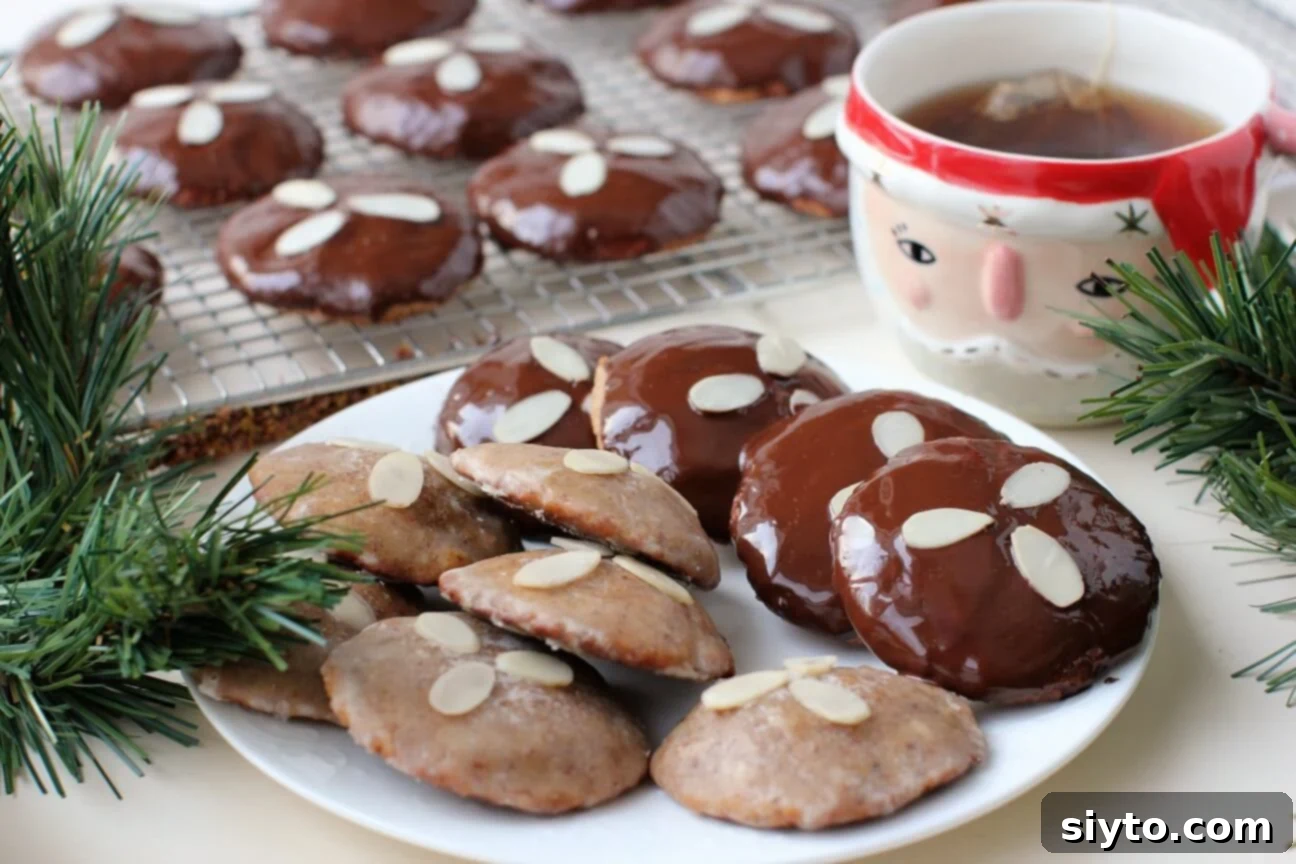
Authentic Elisenlebkuchen: Traditional German Flourless Gingerbread Cookies from Nuremberg
Experience the magic of German Christmas with Elisenlebkuchen, exquisite gingerbread cookies hailing from the historic city of Nuremberg. Unlike many traditional gingerbreads, these delightful treats are famously made with little to no flour, making them a fantastic gluten-friendly option. Their unique and fantastic flavor comes from a special blend of warm German spices, while a generous mix of finely ground nuts, candied fruit, and honey ensures they remain wonderfully moist, chewy, and utterly irresistible. (Jump to Recipe)
A Taste of Bavarian Christmas, Wherever You Are
This year, I am incredibly fortunate to be fulfilling a long-held dream: visiting the enchanting Christmas markets in Germany. Though our trip had to be delayed, leading to a whirlwind last-minute visit, my heart is overflowing with gratitude. Three of my children eagerly await us in Bavaria, reminding me deeply of the precious gift of family. Every shared memory is a treasure, and this year, hugs will be especially tight.
Anticipating this journey, I baked these delicious Elisenlebkuchen a few weeks ago. My daughter, who observes a gluten-free diet, expressed her sadness that she wouldn’t be able to enjoy the myriad of wonderful German baked goods at the Christmas markets, as most are made with gluten. This immediately brought to mind the renowned Lebkuchen from Nuremberg (or Nürnberg, as it’s spelled in German). These specific gingerbreads are celebrated for their minimal to no flour content, instead relying on a rich base of finely chopped nuts, fragrant candied citron and orange peel, honey, eggs, and an aromatic symphony of spices. They seemed like the perfect solution to bring a taste of Germany to her. Besides these, I also prepared gluten-free versions of other German favorites like Basler Leckerli and Pfeffernüsse, along with my special gumdrop fruitcake, all destined for my suitcase.
What Makes Elisenlebkuchen So Special?
German Lebkuchen boasts a rich history, dating back to the 13th century, with countless regional variations. Some are light and crispy, others dense and chewy, and some even resemble miniature cakes. Among this diverse family, Elisenlebkuchen stands out as one of Germany’s most celebrated Christmas delicacies. Its origins trace back to 1808, reportedly named after the daughter of a local Nürnberg baker, Elise.
The defining characteristic that sets Elisenlebkuchen apart from all other Lebkuchen varieties is its exceptionally low, or even absent, flour content. By German food law, authentic Elisenlebkuchen must contain less than 10% flour, with many master bakers proudly crafting them entirely flour-free. The true essence of these cookies comes from generous amounts of ground almonds and hazelnuts, creating a tender, nutty texture. They are exquisitely flavored with a distinct blend of German gingerbread spices known as Lebkuchengewürz, offering a profile significantly different from common North American gingerbread spices. While you can find this unique spice blend in specialty import shops, crafting your own homemade version (recipe included below) allows you to tailor the flavors to perfection.
Each bite of Elisenlebkuchen delivers a soft, chewy experience, bursting with nutty and fruity notes, enveloped by that unmistakably unique spice aroma. They can be elegantly finished with a delicate icing sugar glaze, a decadent chocolate coating, or simply left plain to showcase their natural beauty. Their unparalleled texture and profound flavor make them a truly unforgettable Christmas treat.
Due to their historical significance and specific composition, Elisenlebkuchen now holds a ‘Protected Designation of Origin’ status. This means only Lebkuchen produced within the city limits of Nuremberg can officially bear this name. Fortunately, this doesn’t stop us from creating our own wonderfully delicious versions at home, bringing a cherished taste of Bavarian Christmas right to our kitchens.
Crafting Homemade Elisenlebkuchen: A Step-by-Step Guide
If you have a food processor, these delightful gingerbread cookies come together incredibly quickly. The process is streamlined and efficient, allowing you to create sticky, aromatic dough in mere minutes, ready for shaping.
The journey begins with blending the nuts to a fine consistency, followed by mincing the candied peel. Then, all the elements are combined with the remaining ingredients, resulting in a wonderfully cohesive mixture.
Traditional vs. Modern Baking Methods
Traditionally, Elisenlebkuchen are baked on Back Oblaten – thin, flavorless, crispy wheat wafers that help the soft, sticky dough maintain its shape during baking. Historically, monks even used communion wafers for this purpose! However, Oblaten can be challenging to find outside of Germany, and they are not gluten-free. Fret not, for I’ve discovered that these Lebkuchen bake beautifully and hold their form perfectly well on parchment paper. A crucial step for ensuring they retain their shape and develop the ideal chewy texture is allowing them to dry overnight after baking.
Shaping Your Elisenlebkuchen
The dough’s soft and sticky nature requires a gentle touch during shaping. Using wet fingers helps immensely to prevent sticking and allows you to deftly roll, flatten, and form the cookies into neat, smooth-surfaced disks. This technique ensures each cookie is perfectly shaped before it goes into the oven.
Baking and Finishing Touches
Once baked, the cookies benefit greatly from being left out overnight to gently dry. This external drying process contributes to their characteristic chewiness, while the honey and candied peel inside keep them wonderfully soft. The final flourish involves glazing your cooled cookies with either a classic icing sugar glaze or a rich chocolate coating. Both methods are traditional and equally delicious, adding another layer of festive appeal.
Once glazed and set, these glorious cookies can be stored in an airtight container for up to two months, though their irresistible charm often means they disappear much sooner!
Frohe Weihnachten!
*****
Expert Baking Tips for Perfect Elisenlebkuchen
While the recipe instructions might appear lengthy, rest assured that the actual process of making Elisenlebkuchen dough is quite straightforward. Whether you opt for the convenience of a food processor or prefer to mix by hand, the steps are logical and simple, becoming especially quick with a food processor.
- Almond Garnish: For an elegant finish, you can decorate the tops of your cookies with blanched almonds, split in half, or by carefully selecting whole slices from slivered almonds.
- Avoiding Chocolate Bloom: When preparing the chocolate glaze, it’s essential to control the melting temperature to prevent “fat bloom.” This harmless whitish layer that can appear on hardened chocolate is merely cacao butter molecules migrating to the surface and doesn’t affect taste, though it can diminish appearance. The easiest way to prevent this is to melt chocolate in a silicone or plastic bowl in the microwave, as glass bowls can retain too much heat. Heat in short 20-second bursts, stirring thoroughly after each interval. Stop heating when about three-quarters of the chocolate is melted, then remove from the microwave and continue stirring until completely smooth.
- Reviving Bloomed Chocolate Glaze: Should your chocolate glaze develop a whitish bloom after a few days, a clever trick can save the day! Gently re-melt the chocolate glaze directly on the cookies using a blow dryer set to its highest heat and lowest fan speed. Allow them to re-harden. While the glaze might appear slightly less smooth than before, the chocolate color will return, and the reheating often helps to temper the chocolate enough for it to remain stable.
Elisenlebkuchen, Authentic Nürnberger Lebkuchen
(Flourless German Gingerbread Cookies from Nuremberg)
gluten free, dairy free
Ingredients:
- 2 cups (200g) almond meal (finely ground whole almonds, skins on, not blanched almond flour) or 200g (1¼ cups) whole almonds with skins
- 2 cups (200g) ground hazelnuts/filberts or 200g (1½ cups) whole hazelnuts
- 1½ cups (300g) diced mixed candied peel (citron and orange), lightly packed
- 1½ tablespoons (4½ teaspoons) Lebkuchen Gewürz (mixed German gingerbread spices), see recipe below for a good homemade version
- ½ teaspoon baking powder
- ¼ teaspoon salt
- ½ cup (100g) brown sugar, firmly packed (or 100g / ⅔ cup coconut sugar)
- ¼ cup (85g) honey
- 4 large eggs
For the Icing Glaze:
- 1 cup (130g) icing sugar/powdered sugar/confectioners sugar
- 2 tablespoons water
- 1 tablespoon rosewater or another tablespoon plain water (total 3 Tbsp. liquid)
- Sliced or slivered almonds – optional, for decoration
Or for the Chocolate Glaze (our favorite):
- ¾ cup (130g) dark chocolate chips (dairy-free) or good quality dark chocolate, chopped
- 1½ tablespoons coconut oil
- Sliced or slivered almonds – optional, for decoration
Instructions:
Mixing the Dough:
You can prepare this complete Elisenlebkuchen dough efficiently in a large capacity food processor. Alternatively, if you are using pre-ground nuts, the dough can be mixed by hand or in a stand mixer.
In a Food Processor:
- If using whole almonds or hazelnuts, begin by grinding them in your large capacity food processor until they achieve a fine, breadcrumb-like texture. Pulse intermittently to avoid over-processing them into nut butter. Transfer the ground nuts to a separate bowl.
- Place the candied citrus peel into the food processor. Grind it until very finely chopped. Add about one cup of the ground nuts and process for a few seconds until the mixture is finely minced and well combined. The added nuts help prevent the candied peel from clumping together.
- Return the rest of the ground nuts or nut meal to the food processor, along with the Lebkuchen Gewürz, brown sugar, baking powder, and salt. Pulse several times to thoroughly combine these dry ingredients.
- Add the honey and eggs. Process the mixture until a thick, sticky dough forms and moves freely within the food processor bowl. Be careful not to over-process into a completely smooth puree; you want to retain some delightful texture from the nuts and candied peel. The resulting dough will be notably thick and sticky.
In a Stand Mixer or by Hand:
- Use pre-ground almond meal and hazelnut meal. Finely chop the candied peel by hand, repeatedly running your knife over the mass on the cutting board until it is very finely minced.
- In a large mixing bowl, beat the eggs, sugar, and honey until well combined.
- Add the finely chopped candied peel, ground nuts, Lebkuchen Gewürz, baking powder, and salt to the bowl. Mix thoroughly, either by hand with a sturdy spoon or using a stand mixer with the paddle attachment, until all ingredients are well incorporated and you have a very thick, sticky dough.
To Form the Elisenlebkuchen Cookies:
- Preheat your oven to 300°F (150°C). Prepare two baking sheets by lining each with a piece of parchment paper.
- Find a round object with a diameter of approximately 2½ inches (63mm) for smaller cookies, or 2¾-3 inches (70-75mm) for larger cookies. Using a pencil or black marker, trace twelve circles onto the parchment paper. Flip the paper over so the traced circles are on the underside and place the parchment back onto the cookie sheet.
- Scoop out spoonfuls of dough onto each traced circle. For small cookies, use about 1½ tablespoons of dough; for larger cookies, use approximately 2½ tablespoons.
- Dampen your hands with water. Roll the dough into a ball and place one ball onto each visible circle through the parchment paper. You’ll need to re-dampen your hands after every 3 to 4 cookies to prevent the sticky dough from adhering to your fingers.
- To flatten and shape the cookies: Dip your fingers into a small bowl of water and shake off any excess. With damp fingers, gently press down on each dough ball, spreading it to neatly fill the traced circle. Shape the cookie so it’s about ½ inch (1 cm) thick in the center and tapers slightly towards the edges. Pat the surface smooth with your damp fingers. Remember to re-wet your fingers for each cookie for best results.
- *Small cookies: Approximately 1½ tablespoons of dough, rolled into 1½-inch diameter balls and flattened to 2½-inch disks.
- *Large cookies: Approximately 2½ tablespoons of dough, rolled into 1¾-inch diameter balls and flattened to 2¾-inch disks.
Baking and Cooling:
- Bake the cookies until their edges just begin to turn a light golden brown. This typically takes 18 to 20 minutes for smaller cookies, and 22 to 25 minutes for larger cookies.
- Allow the cookies to cool for five minutes on the baking sheets, then carefully transfer them with a spatula to a wire cooling rack to cool completely.
- Crucially, leave the cooled cookies out at room temperature, either on the cooling racks or in a single layer on clean towels on your counters, for a full 24 hours. This allows the outsides to dry thoroughly before glazing. Don’t worry, the combination of candied peel and honey will ensure the insides remain wonderfully soft and chewy.
Glazing the Cookies:
You have the option to glaze the cookies with icing, chocolate, or to enjoy them plain.
- To prepare for glazing, set a wire cooling rack over a baking sheet or a piece of parchment paper to catch any drips.
- For Icing Glaze: Whisk together the icing sugar and water/rosewater until smooth and free of lumps. Dip the top of each cookie into the glaze, or brush it on with a pastry brush, allowing any excess to drip off onto the rack below. For a thicker, more opaque finish, you may apply a second layer of glaze once the first has partially set.
- For Chocolate Glaze: Melt the chocolate and coconut oil together in a silicone or plastic bowl (avoid glass, which can get too hot) in the microwave. Heat in 20-second increments, stirring well after each, and stop when about ¾ of the chocolate is melted. Remove from the microwave and continue stirring until the residual heat melts the remaining chocolate completely smooth. Dip the tops of the cookies into the melted chocolate, then use a pastry brush to spread it evenly and brush off any excess, aiming for a thin, even layer. If the chocolate becomes too thick to work with, warm it for another 10 seconds in the microwave.
- If desired, while the glaze is still wet, decorate each cookie with 3 almond slices or a single whole almond on top.
- Allow the glaze to harden completely for several hours. Once fully set, store the cookies between sheets of wax paper in an airtight container at cool room temperature for up to two months.
Note: If your chocolate glaze becomes too hot during melting, it might develop a harmless whitish ‘bloom’. Refer to the Expert Baking Tips section above for easy methods to prevent and remedy this.
Yields approximately 36 small cookies or 24-26 large cookies.
*****
Homemade Lebkuchen Gewürz (German Gingerbread Spice Mix)
Note: For the freshest and most potent flavor, consider purchasing whole spices and grinding them yourself in a coffee grinder immediately before measuring. This simple step will elevate the aroma and taste of your Lebkuchen Gewürz significantly.
Ingredients:
- 4 teaspoons ground cinnamon
- 3 teaspoons ground coriander
- 1 teaspoon ground cloves
- 1 teaspoon ground anise seeds
- 1 teaspoon ground nutmeg
- 1 teaspoon ground star anise or fennel seeds
- 1 teaspoon ground ginger
- 1 teaspoon ground cardamom
Instructions:
Combine all listed spices in a small bowl. Stir them thoroughly until completely blended. Transfer the spice mix to a tightly sealed small glass jar and store in a cool, dark place. This homemade Lebkuchen Gewürz will retain its vibrant flavor for up to 6 months.
This recipe yields approximately 30 grams / 4 tablespoons of Lebkuchen Gewürz. It’s also fantastic in these Lebkuchen loaves!
Guten Appetit!
Want to receive new Kitchen Frau recipes directly to your email? Sign up here and you’ll get a handy and useful kitchen tip along with each recipe, too. (No spam ever.)
If you enjoy my recipes, I’d love for you to follow me on Instagram, Pinterest, Twitter, and Facebook. Your support makes my day!
PIN IT HERE to save the recipe for later:
You might also enjoy these traditional European treats:
Zimtsterne – Traditional German Cinnamon Star Cookies
Basler Leckerli – Traditional Swiss Spiced Cookies
Lebkuchen Loaves – A Hearty German Gingerbread Cake
Kransekake – Norwegian Almond, Lemon & Cardamom Cookies