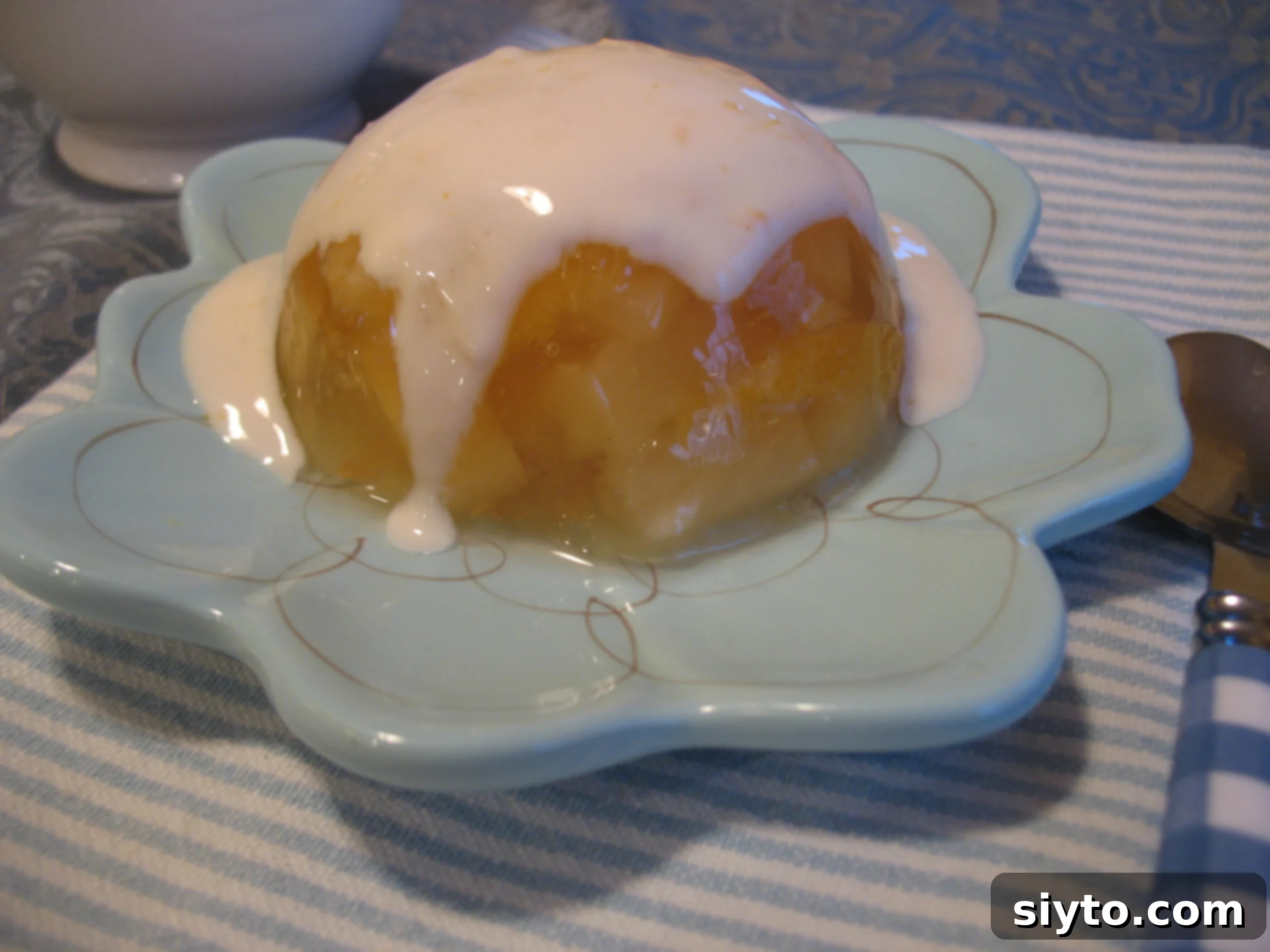
Homemade Fruit Juice Jelly: A Wholesome, Easy, and Delicious Dessert
Forget the artificial colors and flavors of store-bought mixes! This delightful fruit juice jelly, packed with real fruit chunks and crowned with a tangy yogurt sauce, offers a simple, healthy, and incredibly satisfying alternative to packaged gelatin desserts. It’s a treat that not only nourishes your body but also brings a touch of nostalgic joy to your table.
For many, jellied fruit salad evokes a rush of childhood memories, not necessarily because it was a gourmet masterpiece, but because it was intertwined with simple joys and significant milestones. It stands out as one of the first dishes my sisters and I felt truly capable of creating “all by ourselves.” The moment we reached that magical height where our eager hands could access the kitchen countertops and we were deemed responsible enough to boil water, a new world of culinary independence unfolded. Making jellied fruit felt like playing a grown-up version of house – carefully emptying the flavored powder from its vibrant box into a bowl, then pouring in the steaming hot water and stirring with intense focus until every last crystal dissolved. The transformation was always a marvel: a dull powder turning into a shimmering, jewel-toned liquid, its color often bearing little resemblance to the fruit it claimed to represent, yet undeniably captivating.
Of course, no batch was complete without a thorough “taste-test” – a delightful ritual performed by our willing, slurping mouths. Next came the thrilling challenge of operating the can opener to liberate the fruit cocktail from its tin, which was then ceremoniously dumped into the glistening brew. The bowl would then be carefully placed into the refrigerator, the setting process beginning its slow magic. If we remembered to pause our play and periodically stir the thickening gel, we’d be rewarded with a perfectly suspended fruit medley, each piece floating gracefully within the jellied juice. If not, all the fruit might gravitate to the top, but regardless of its aesthetic, the end result was always just as delicious and eagerly devoured.
Jellied fruit salads were ubiquitous throughout my childhood, appearing at every conceivable gathering. They were staples at potlucks, church suppers, family gatherings, and even found their way into our school lunches and after-school snacks. They were served in humble Tupperware bowls or elegantly unmolded onto plates, shimmering in their stately splendor. While the basic fruit and jelly combination was a beloved classic, the jellied mixture was often a canvas for endless creativity, frequently mixed with an array of other ingredients, both sweet and savory. Mayonnaise, cream cheese, chopped nuts, crisp celery or carrots, fluffy marshmallows, or even thinly sliced green onions were common additions, leading to an infinite variety of “salads.” While I admired the ingenuity, my heart always belonged to that simple, unadulterated variation with canned fruit, a true taste of uncomplicated childhood.
One particular memory involving jellied fruit salad remains etched vividly in my mind, a story from when I was about 14 years old. My mother was driving my littlest sister and me to a 4-H potluck dinner. Our contribution, a bowl of jellied salad meticulously covered with plastic wrap, sat securely on the console of our small blue truck. As we navigated a particularly muddy stretch of gravel road, the truck unexpectedly lost control. It executed a complete roll-over into the ditch, astonishingly landing upright again. The cab’s roof was crushed, and the vehicle sustained extensive damage. Miraculously, my mother, sister, and I escaped with only minor cuts and bruises, primarily from the shattered windshield, a testament to our luck and perhaps the absence of seatbelts, which weren’t mandatory in those days.
As we gathered our shaking selves together after the accident, a truly bizarre sight caught our attention. The bowl of jellied salad remained in its exact spot on the truck’s console, remarkably intact. A few crumbles of windshield glass lay scattered on its plastic wrap cover, but the salad itself was unscathed, preserved by the peculiar physics of centrifugal force. It felt utterly indestructible, a small, unwavering beacon amidst the chaos.
I don’t recall if we ever ate that particular jellied salad, or if we even made it to the 4-H function. What I do remember is the kindness of a trucker who picked us up and gave us a ride home. And I will forever carry the image of that perfectly preserved bowl of jellied salad, sitting serenely inside the utterly shattered truck, a symbol of resilient normalcy in an otherwise extraordinary moment.
But I digress. I did promise fond memories, and in a strange, roundabout way, that incident truly became one. At 14, I wasn’t concerned with the financial implications of replacing a vehicle or the close call with serious injury. Instead, my teenage mind processed it as the “coolness” of having been in a roll-over accident and possessing a gripping tale to share with my friends.
Fast forward to adulthood, and my perspective on jellied desserts evolved significantly. As a mother deeply invested in providing good nutrition for my children, I found it increasingly difficult to justify serving them the chemically flavored and artificially colored packages readily available on store shelves. The thought of those synthetic ingredients simply didn’t align with my desire for wholesome food. I soon discovered that preparing homemade fruit juice jelly was almost as quick as using a mix, and immeasurably more nutritious. The basic concept remains the same – dissolving gelatin in liquid and adding fruit – but the taste, quality, and peace of mind are vastly superior. This approach also allows for immense creativity; you can use whatever fresh or canned fruits and juices you have on hand to craft unique flavor combinations. Serving it with a simple, complementary fruity yogurt sauce elevates it into an elegant and truly tasty dessert, perfect for any occasion.
When venturing into homemade gelatin, it’s crucial to remember that some fresh fruits contain enzymes that can prevent gelatin from setting. Fresh pineapple, kiwi, papaya, and figs are common culprits. These fruits contain proteolytic enzymes that break down the collagen proteins in gelatin, rendering it unable to firm up. The good news is that cooking or canning these fruits deactivates these enzymes, so using canned pineapple or pre-cooked fruit will ensure your jelly sets perfectly. Plain, unflavored gelatin powder is readily available at most health food stores and grocery stores, often sold in boxes containing individual envelopes. Each envelope typically holds one tablespoon of gelatin, which is the standard amount needed to set two cups of liquid. For a firmer texture, or when incorporating extra liquid (like the fresh orange juice in this recipe), I often use a little more gelatin. This slight increase helps achieve a more robust set, ideal for unmolding individual servings. I simply snip open a second packet, use a portion, and then paper-clip it closed for my next batch of jellied delights.
Don’t hesitate to experiment and get creative with different combinations of fruits and juices. The beauty of homemade fruit jelly lies in its versatility. You can use berry juices with mixed berries, apple juice with finely diced apples and cinnamon, or even tropical blends with mango and passion fruit. This isn’t just a dessert; it’s an opportunity to revisit cherished childhood memories in a healthy, grown-up way, creating new traditions and wholesome treats for your own family.
Recipe: Pineapple Orange Gelatin with Orange Yogurt Sauce
This vibrant and refreshing dessert combines the sweetness of pineapple and the bright zest of orange, all bound in a naturally flavored gelatin and topped with a creamy, tangy yogurt sauce. It’s a perfect illustration of how simple, natural ingredients can create something truly special.
Ingredients:
- 2 cups (500ml) white grape juice, divided
- 1 tablespoon + ½ teaspoon (about 17.5ml) unflavored gelatin powder
- 1 14-oz tin (398ml) pineapple tidbits, with juice reserved
- 1 large orange
- ½ cup (125ml) Greek yogurt
- 1 teaspoon (5ml) grated orange zest
- 2 tablespoons (30ml) reserved juice from pineapple
- 1 tablespoon (15ml) liquid honey (or to taste)
- ½ teaspoon vanilla extract
Instructions:
- Begin by preparing your pineapple. Open the tin of pineapple tidbits and pour the contents into a fine-mesh sieve set over a bowl. Allow the pineapple to drain thoroughly, reserving all of the juice that collects in the bowl. This reserved juice will be used later in both the gelatin and the sauce.
- In a small heatproof bowl, combine ¼ cup (60ml) of the white grape juice with the gelatin powder. Stir gently to ensure the gelatin is fully moistened and “blooming.” Set this aside to soften while you prepare the remaining liquid.
- Pour the remaining 1¾ cups (440ml) of white grape juice into a saucepan. Heat it over medium heat on the stove until it is hot but not boiling – you should see steam rising but no vigorous bubbles. Remove the saucepan from the heat immediately.
- Add the softened gelatin mixture to the hot grape juice in the saucepan. Stir continuously until the gelatin is completely dissolved, leaving no granules. Allow this mixture to cool to room temperature. To expedite this process, you can place the saucepan into a larger bowl filled with ice water, stirring occasionally. If it’s winter and safely outdoors, you can even set the pot in the snow, just remember to keep it safe from curious pets!
- While the gelatin mixture cools, prepare your orange. Using a fine grater, carefully grate the zest from the orange. Be sure to only get the brightly colored outer layer and avoid the bitter white pith. Reserve the orange zest for the yogurt sauce.
- Next, with a very sharp knife (this is crucial for clean segments!), carefully cut the peel and all the white pith from the orange. Start by slicing off a small portion from the top and bottom of the orange to create flat bases. Then, stand the orange on a cutting board and slice downwards, following the curve of the fruit, to remove all the skin and pith.
- Hold the peeled orange over a separate small bowl to catch any escaping juices. Carefully cut down along each side of the membranes to free the individual orange sections (supremes). Once all sections are removed, gently squeeze the remaining orange core and membranes over the bowl to extract any last drops of flavorful juice. Slice each orange section into several smaller pieces, roughly the same size as your pineapple tidbits.
- Once the gelatin/juice mixture has cooled to room temperature, stir in the drained pineapple pieces, the prepared orange sections, and the fresh orange juice you collected.
- Chill the mixture in the refrigerator until it is slightly thickened, reaching a consistency similar to raw egg whites. At this stage, give it another good stir to ensure all the fruit is evenly distributed throughout the gelatin. This step helps prevent all the fruit from sinking to the bottom or floating to the top.
- Carefully pour the mixture into six ¾-cup individual bowls or baking dishes. Return them to the refrigerator and chill for at least one hour, or until they are completely firm and set.
- While the jellies are setting, prepare the Orange Yogurt Sauce. In a small bowl, combine the Greek yogurt, the 2 tablespoons of reserved pineapple juice, the grated orange zest, liquid honey (adjust to your preferred sweetness), and vanilla extract. Stir until all ingredients are well combined and smooth.
- To unmold the jellies, briefly run the outside of each dish under hot water (about 10-15 seconds). Then, invert the dish onto a serving plate. The heat helps release the gelatin from the sides of the dish.
- Drizzle the luscious Orange Yogurt Sauce generously over each unmolded jellied fruit dessert just before serving.
Guten Appetit!
Want to receive new Kitchen Frau recipes directly to your email? Sign up here and you’ll get a handy and useful kitchen tip along with each recipe, too. (No spam ever.)
If you like my recipes, follow me on Instagram, Pinterest, Twitter, and Facebook. You’d make my day!
You might also like:
Zabaglione with Mixed Berries
Blueberry Breakfast Pudding
Mangoes and Blueberries in Yogurt Cream
Chia Pudding with Strawberries