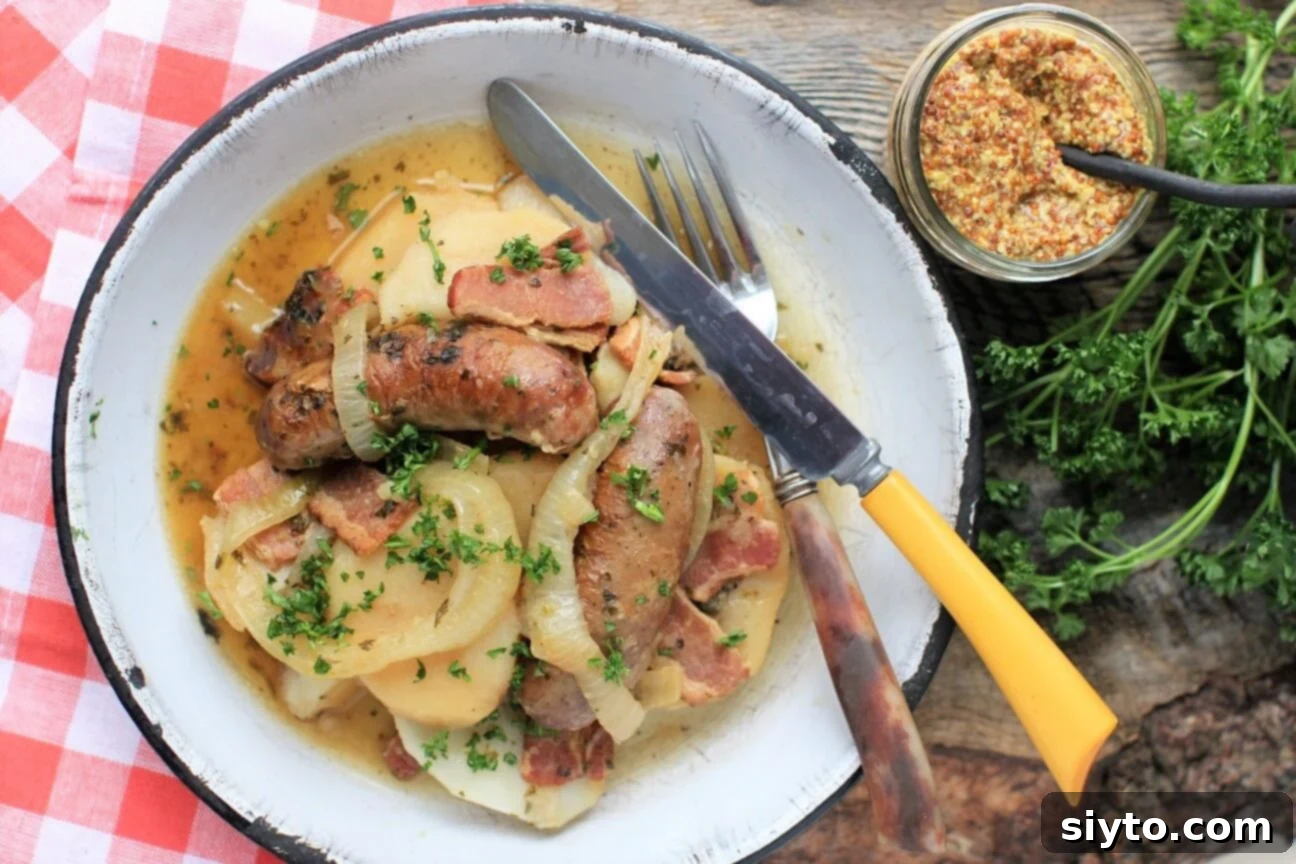
Dublin Coddle: An Authentic Irish Comfort Food Stew Recipe for St. Patrick’s Day and Beyond
Celebrate the spirit of Ireland with a truly classic dish: Dublin Coddle. More than just a meal, this hearty stew is a warm embrace, crafted from a handful of humble ingredients that, when braised long and slow, meld into a symphony of rich, comforting flavors. It’s a testament to simple cooking yielding profound satisfaction, featuring succulent bacon, savory sausages, tender potatoes, and sweet onions. A truly authentic taste of Irish home cooking awaits. (Jump straight to the recipe.)
While St. Patrick’s Day provides the perfect excuse to gather around a steaming pot of Dublin Coddle, this beloved Irish stew is far too good to be reserved for just one day a year. Imagine a chilly, damp evening when all you crave is warmth and a taste of home. That’s when Dublin Coddle truly shines, transforming simple ingredients into a deeply satisfying meal that chases away the gloom. This slowly simmered pot of goodness is guaranteed to warm the very cockles of your heart, whether your heritage is Irish or you simply appreciate the profound comfort of traditional, home-cooked food.
The Rich History of Dublin Coddle: A Culinary Journey from the 18th Century
The name itself gives a clue to its origin – Dublin Coddle is, quite appropriately, from Dublin. This fascinating dish boasts a history stretching back at least to the eighteenth century, born out of necessity and ingenuity in Irish kitchens. Traditionally, it was a practical and economical meal, designed to utilize any leftover sausages or ‘rashers’ (bacon) accumulated throughout the week, particularly before the lean Fridays when meat was foregone. Early versions of Coddle often incorporated leeks and oatmeal, reflecting the available produce of the time. However, over centuries, the recipe evolved, with potatoes and onions becoming the more popular and widely adopted staples we recognize today. The name ‘Coddle’ itself is believed to derive from the older English word ‘caudle,’ which beautifully describes the gentle cooking process: ‘to boil gently or stew.’ This historical context imbues every spoonful with a sense of tradition and resourcefulness.
The Magic of Simplicity: What Makes Dublin Coddle So Special
Dublin Coddle is a truly remarkable stew, brilliant in its profound simplicity. With just a handful of primary ingredients – typically five – it gently simmers into a fantastic, rich, and deeply flavorful dish. It’s a beautiful marriage of meat and potatoes, where bacon and sausages play a starring role alongside the humble spud and onion. The enduring appeal of this stew lies not just in its taste, but also in its practical nature. Historically, and even today, busy cooks could prepare a pot of Dublin Coddle in the morning, allowing it to braise slowly and then be kept warm for hours without compromising its deliciousness. This made it a perfect evening meal, ready and waiting after a long day. It’s no wonder it captivated the palates of esteemed Irish authors like Seán O’Casey and Jonathan Swift (of Gulliver’s Travels fame), who reputedly considered it their favorite meal. Its ability to satisfy and comfort, while also being forgiving in its preparation, speaks volumes about its place in Irish culinary heritage.
Intriguingly, Dublin Coddle holds a distinct place in Irish cuisine, often seen as a city dish in contrast to its more rural cousin, the classic Irish Stew. While Irish Stew traditionally featured mutton, which was more readily available in the countryside, Dublin Coddle thrived in the city, where ‘bangers’ and other types of sausages were more accessible and affordable. This geographical distinction hints at the differing culinary landscapes of urban versus rural Ireland. So, while it proudly remains a working-class dish – wholesome, homey, and universally appealing – it carries a certain urban charm, perhaps even a touch more ‘posh’ flair than the rugged simplicity of a traditional Irish Stew.
Essential Ingredients for Your Authentic Dublin Coddle
At its heart, Dublin Coddle celebrates the finest simple ingredients. The magic truly lies in how these core components transform through slow cooking. Here are the five essential elements that make up an authentic Dublin Coddle:
- Bacon or Ham: Traditionally, rashers (Irish bacon) or gammon are used. A good quality, thick-cut streaky or back bacon brings crucial flavor.
- Sausages: Authentic Irish ‘bangers’ are ideal, but any good quality lean pork sausages will work wonderfully.
- Potatoes: A staple of Irish cuisine, potatoes provide the stew’s hearty body and absorb all the delicious flavors.
- Onions: Sweet, slowly cooked onions form the aromatic base, adding depth and a touch of sweetness.
- Parsley: Fresh parsley brightens the dish, adding a touch of herbaceous freshness that cuts through the richness.
Embracing Tradition vs. Modern Enhancements: The Browning Debate
While exploring Dublin Coddle recipes online, you’ll encounter numerous variations, some incorporating additional vegetables, herbs, or pre-made broths. However, to truly honor its heritage, sticking to the original, minimalist ingredients with water as the primary liquid is recommended. Traditionally, both bacon and sausages were parboiled in water, and that resulting, sometimes murky, broth was then used as the stew’s liquid. While authentic, this method can seem a bit redundant and often yields a paler stew with less developed flavor.
In pursuit of both convenience and a richer flavor profile, I’ve taken the liberty of streamlining a step. Instead of parboiling, I brown the bacon first, then the sausages, directly in the pot. The idea of boiled bacon simply doesn’t appeal to my palate, and this extra step of browning (the Maillard reaction at work!) dramatically enhances both the visual appeal and the depth of flavor of the final stew. It creates those wonderful caramelized notes that a purely boiled method can miss. I did conduct a test batch using the traditional non-browning method (substituting ham for bacon, as boiled bacon can be unappetizing). While it was indeed paler in color and flavor, it was undeniably still very tasty, proving that even a quicker, less elaborate approach yields a decent and satisfying dinner for those times when you’re truly in a rush.
The Perfect Pairing: How to Serve Your Dublin Coddle
To truly complete the Dublin Coddle experience, serve your generous bowl with a hearty hunk of rustic bread. My gluten-free Irish Soda Bread is an excellent choice, perfect for soaking up every last drop of the savory, rich juices. To wash it all down, there’s nothing quite like a pint of classic Guinness stout, its creamy head a perfect complement to the stew’s robustness. For those preferring a gluten-free option or a crisper contrast, a refreshing hard apple cider makes a delicious alternative. Should you be curious about my own travels, I had the incredible fortune to experience St. Patrick’s Day in Dublin a few years ago – a truly unforgettable adventure! You can catch a glimpse of that journey, along with my gluten-free Irish Soda Bread recipe, by clicking this link. And for another festive St. Paddy’s Day recipe with a story, be sure to check out this vibrant Green Soup.
If a trip to Ireland isn’t on the cards this year to immerse yourself in the revelry and charm of a true St. Patrick’s Day celebration, fret not! Bring the celebration to your own kitchen. Grab a knife and fork, and tuck into a steaming plate of Dublin Coddle instead. Pour yourself a pint of your favorite brew, close your eyes, and imagine yourself in a cozy Irish pub, sharing laughter and stories with locals, as a lively fiddler plays a traditional jig in the background. It’s an experience that transcends geography, delivered right to your dining table.
Sláinte! (Cheers!)
* * * * *
I’ve joined a wonderful group of bloggers, expertly led by the intrepid Evelyne of CulturEatz, who embark on a culinary journey to showcase a recipe from a different country around the world each month (#eattheworld). This month’s featured country is, quite fittingly, Ireland. I am absolutely thrilled about this ongoing project and can’t wait to continue to ‘Eat the World’ and uncover all kinds of new and exciting international recipes! I had so much fun contemplating which traditional recipe would best represent the incredible culinary heritage of Ireland. Don’t forget to scroll down, after the recipe, to discover what other delightful Irish dishes have been cooked up by my fellow bloggers on this exciting project. And be sure to check back on the 10th of every month to see which captivating country we’ll be exploring next through our shared love of food.
* * * * *
Chef’s Note: While my preferred method involves browning the bacon and sausages for enhanced flavor and appearance, it’s worth noting the traditional approach where ingredients are simply layered and simmered without prior browning. This saves time and an extra step, and while it results in a paler, slightly less robust flavor, it still yields a comforting and delicious stew. If opting for this traditional, un-browned method, using ham instead of bacon can be more visually appealing, as boiled bacon tends to lose its appeal. For those short on time or seeking to avoid grease splatters, layering everything in the Dutch oven and simmering as directed will connect you with centuries of Irish culinary tradition.
Authentic Dublin Coddle Recipe
Ingredients:
- 8 slices (about 350gm/12oz) of lean, thick-cut bacon
- 2 lbs (900gms) potatoes (5 – 6 medium), peeled and thickly sliced or chunked
- 6-8 good quality lean pork sausages (about 600-800gms/1¼-1¾lbs), preferably bangers, but any type like bratwurst or other pork sausages will do (ensure gluten-free if necessary)
- 3 large onions, peeled and thickly sliced
- ¼ cup (4 tablespoons) chopped fresh parsley, plus extra for garnish
- Salt and freshly ground black pepper to taste (approximately ½ teaspoon of each)
- 3 cups (750ml) water, or enough to come up about 1 inch (2.5cm) high in the pot
- Grainy mustard and rustic, crusty bread to serve (find my gluten-free Irish Soda Bread recipe here)
Instructions:
1. Cut the bacon into 1½-inch (3cm) pieces. In a large Dutch oven or heavy-bottomed pot, partially cook the bacon over medium heat until it begins to turn golden but is not yet crispy. Scoop the bacon out with a slotted spoon and set it aside, leaving the rendered bacon fat in the pan.
2. Brown the sausages in the retained bacon fat. The sausages do not need to be fully cooked through at this stage, as they will finish cooking during the simmering process. Once browned, remove them from the pot and set aside. Do not drain the fat from the pot.
*Note: If you are using pre-smoked sausages, you can simply cut them into manageable lengths and add them without browning, after you’ve browned the bacon.
3. Begin layering your stew. Place half of the sliced onions evenly into the Dutch oven, directly on top of the bacon fat. Layer the potato slices over the onions. Season generously with salt and pepper to taste, then sprinkle with half of the chopped fresh parsley. Next, add the reserved partially cooked bacon.
4. Arrange the browned (or un-browned smoked) sausages on top of the bacon layer. Cover with the remaining sliced onions and sprinkle with the rest of the fresh parsley.
5. Pour in the water. Bring the liquid to a rolling boil, then immediately reduce the heat to a gentle simmer. To ensure a tight seal and prevent moisture loss, cover the pot with a piece of tin foil that extends beyond the rim. Then, place the lid of the pot on top, pressing it down firmly to create a tight seal over the tin foil, with the foil edges sticking out around the pot.
6. You can finish braising this hearty stew using one of two methods:
Method 1: Stovetop Simmering
Simmer the Dublin Coddle gently on the stovetop for 1 to 1½ hours. The stew is typically done after one hour of simmering, but it can easily handle up to 2 hours for even deeper flavor development and tenderness. I personally find it reaches its peak after about 1½ hours. If you notice too much liquid towards the end, remove the lid after 1 hour and allow it to simmer uncovered until the liquid reduces to your desired consistency.
OR
Method 2: Oven Baking
Bake the stew in a preheated 300°F (150°C) oven for 3 hours. Check the liquid level halfway through cooking; if it has dropped below 1 inch (2.5cm) deep, add a little more water. This method is incredibly forgiving; the stew can easily braise for up to 4 or even 5 hours in the oven, as long as the liquid level remains sufficient, making it perfect for a leisurely afternoon.
7. Once cooked, taste the stew and adjust seasoning with more salt and pepper if needed. Serve your warm, comforting Dublin Coddle immediately with a dollop of grainy mustard on the side and plenty of crusty bread to mop up the delicious broth.
This recipe generously serves 4 to 6 people, depending on their appetite for this wholesome Irish classic.
Guten Appetit!
Explore all the wonderful Irish dishes prepared by fellow Eat the World members and share your favorites using #eattheworld. Click here to find out how to join our global culinary adventure:
Evelyne: Irish Yellowman Candy
Amy: Cheesy Potato Soup with Irish Ale
Nicoletta and Loreto: Irish Chocolate Stout Cake
Wendy: Instant Pot Irish Stew with White Cheddar Crust
Camilla: Shamrock Salad-Topped Irish Boxty
Tara: Irish Baked Eggs with Spinach
Karen: Irish Potato Cakes
Sarah: Irish Parsnip Soup
Bernice: Potato Cabbage and Rutabaga Colcannon
Sign up here to receive new Kitchen Frau recipes directly to your email inbox, and get a handy and useful kitchen tip with each recipe.
If you like my recipes, follow me on Instagram, Pinterest, Twitter, and Facebook. You’d make my day!
Don’t forget to PIN IT to save the recipe for later:
You might also like these other comforting recipes:
Gluten Free Irish Soda Bread and Dublin for St. Patrick’s Day
Green Soup (It’ll Lure the Leprechauns)
Sweet and Sour LentilEintopf, a German One-Pot Stew
Hearty Sausage, Kale, and Bean Soup