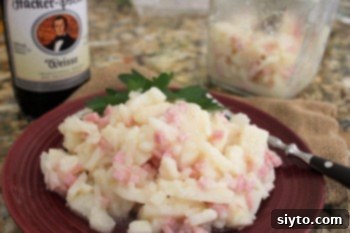
Authentic German Potato Salad: A Culinary Journey Through Central Europe
Experience the simple yet profound flavors of traditional German Potato Salad. This delightful side dish, cherished for its hearty taste and versatile appeal, is incredibly easy to prepare yet packed with a depth of flavor that will leave you wanting more. It’s the perfect complement to any summer barbecue, a welcome addition to picnics, or a much-loved contribution to potlucks. Prepare to discover a new favorite that embodies the spirit of German comfort food. (Jump straight to the recipe for this classic dish.)
Returning from an unforgettable month-long adventure through Germany and Eastern Europe, I’m thrilled to share a recipe for German Potato Salad that captures the essence of my travels. This trip was more than just sightseeing; it was a deep dive into the culinary traditions and breathtaking landscapes of a vibrant part of the world, inspiring me to recreate some of the comforting flavors we encountered.
Our journey began in the picturesque heart of Germany, where we reconnected with cherished friends. One of the highlights was a long-anticipated visit to Burg Eltz, a magnificent medieval castle that Raymond had yearned to explore since our last trip. Nestled amidst lush hills, its towering spires and timeless architecture felt like a scene from a fairy tale, perfectly setting the tone for our European adventure.
After several delightful visits and meals savored on sun-drenched terraces beneath sprawling grapevines, we ventured eastward in our rental car. Our destination: a quaint village in what was once East Germany, home to beloved cousins. We spent a memorable evening in their 300-year-old garden, sharing stories and laughter late into the night. The air was filled with the smoky aroma of grilled Thüringer bratwurst, perfectly paired with refreshing Weiβ beer – a truly authentic German experience.
Leaving the familiar comforts of Germany, our adventure truly began as we crossed into the Czech Republic. It was like stepping into a new world. The villages, though still featuring the red-roofed houses common in Germany, were now painted in a vibrant palette of warm golds, oranges, and peaches. Each town was marked by charming church steeples, now crowned with distinctive curving onion domes, a tell-tale sign of Eastern European influence.
Our initial stops included three major cities, each offering a unique charm over a few days. First was Prague, a city that captivated us with its breathtaking beauty, the meandering Vltava River, its majestic castle, and the iconic Charles Bridge. The panoramic view from the Petřín Tower was truly awe-inspiring, and as evening settled and the city lights began to twinkle, it transformed into pure magic.
Our next destination was Vienna, where we were constantly amazed by the sheer number of exquisitely beautiful buildings. Vienna is truly a city of light, exuding an opulent, old-world elegance at every turn. We thoroughly enjoyed an evening at the Opera house, despite the sweltering heat in our seats high up in the nosebleed section. And the captivating stories of Empress Elisabeth, or Sisi, recounted by our charismatic guide at the Sisi Museum, forever connected this intriguing and eccentric historical figure with the grandeur of Vienna for me.
Our journey continued to Budapest, where Andreas and I embarked on a culinary adventure that became a definite highlight: a cooking class. If you ever visit Budapest, I wholeheartedly recommend spending a day cooking authentic Hungarian dishes with the absolutely lovely Agnes (pronounced Agnesh). She greeted us at the Central Market Hall, two baskets in hand, and led us on a personal tour. This massive three-story building is a vibrant concentration of Hungary’s sights, sounds, tastes, and smells, offering an unparalleled sensory experience.
After gathering our ingredients, we headed to Agnes’s apartment to cook and feast on a traditional three-course meal: refreshing cold sour cherry soup, savory chicken paprikash served with nokedli dumplings (surprisingly similar to German Spätzle), a crisp cucumber salad, and Hungarian pancakes filled with apricot jam and cottage cheese. Oh, it was culinary heaven! I still fondly recall that wonderful day and the delicious flavors we created.
After exploring Budapest for a few captivating days, we drove into Croatia, making our way down its breathtaking coast. This country is stunningly beautiful, a feast for the eyes at every turn.
The villages are pristine and vibrantly colored, and the coastline truly takes your breath away. Dubrovnik, rightly hailed as “the pearl of the Adriatic,” is a magnificent walled city, embraced on three sides by the crystal-clear blue-green waters of the sea and bathed in endless sunshine. Here, Andreas experienced an exhilarating thrill, cliff jumping off the rocks through an opening in the ancient city wall.
Walking along the ancient city walls on a warm day, we were treated to magnificent views of the countless tiled rooftops, many of which were newly replaced after the city endured a siege during the 1990s war. The visible shrapnel damage and occasional bombed-out buildings served as poignant reminders of the immense suffering this region endured. Yet, the palpable spirit of optimism and growth among its people was incredibly heartening.
Our two days in Bosnia and Herzegovina further exemplified this resilient spirit. In Mostar, the devastation from the war was even more evident, with many buildings still bearing the scars of conflict and a cemetery where every grave was tragically marked with the years 1992 to 1995. It was hard to believe this was the very place I had watched being bombed on nightly news reports during my lifetime.
Yet, the iconic bridge we crossed to span the vibrant green Neretva River had been lovingly rebuilt and now stands proudly as a UNESCO World Heritage site, symbolizing peace and reconstruction. Mostar exudes a distinct Turkish flavor, with elegant minarets punctuating the skyline and bustling street bazaars overflowing with intricate copperware and colorful goods, a beautiful fusion of cultures.
And the food in Bosnia was simply wonderful. Bosnians are true masters of the grill, so we indulged in a wide array of smoky grilled meats, accompanied by simple, fresh vegetable side salads. And, of course, their exquisite Turkish-style Bosnian coffee was an absolute treat, a cultural ritual in itself.
From Bosnia, we journeyed northward along the Dalmatian coast, eventually arriving in Istria, the Italian-influenced peninsula in northern Croatia. Here, we stumbled upon the enchanting hilltown of Motovun, nestled in the heart of truffle country. The views from this ancient town were beyond spectacular, offering panoramic vistas that spoke for themselves.
Our meal in Motovun was, without a doubt, the most memorable of the entire trip! Seated at an outdoor table right next to the town wall, we indulged in a three-course truffle extravaganza: a rich truffled cheese platter to start, succulent veal medallions generously adorned with truffles (both in the sauce and shaved liberally over everything), and for dessert, a delicate panna cotta drizzled with honey and more exquisite truffle shavings. All of this was enjoyed while sipping wonderful Croatian wine and admiring the truly spectacular view as dusk settled. It was an experience that truly left us in awe.
The very next day, we returned to Motovun for lunch, where we relished a decadent truffle risotto, followed by a chocolate cake featuring even more truffles for dessert. It was beyond incredible, a testament to the region’s culinary treasures. (I even brought back some truffle oil and preserved truffles, eagerly anticipating future culinary experiments!)
Our journey then led us into Slovenia. Ljubljana (pronounced Loob-lee-an’-a), its capital, is a truly beautiful city – reminiscent of a smaller, perhaps simpler, Vienna. We spent two enjoyable days there, cycling through its charming streets, people-watching at quaint cafes, and of course, indulging in more delightful food.
Next, we re-entered Austria, and this time, the alpine landscapes truly stirred my soul. We ventured into the countryside, past majestic mountains and picturesque villages adorned with flower-bedecked, balconied houses, and sweeping alpine meadows, ultimately reaching a stunning small town called Hallstatt. Despite the soft rain that accompanied us throughout our stay, the breathtaking scenery of this town, nestled on a hillside right next to a tranquil lake, felt like something pulled directly from a fairy tale book.
The city of Salzburg also proved to be utterly magical. As devoted “Sound of Music” fans, Andreas and I couldn’t resist a dedicated tour that took us through the city and into Austria’s beautiful lakes district, showcasing the iconic filming locations from the beloved movie. Savoring a warm apple strudel at a charming café there was the perfect, sweet ending to our Austrian exploration.
And then, it was time to return to Germany for our final days abroad.
We spent our last few days with more dear friends, enjoying local tours in the scenic Odenwald region, attending a lively Schmuckerfest (a delightful mini-Oktoberfest), and savoring this incredible German potato salad. The recipe, a beloved creation of our friend Detlef, was served alongside perfectly grilled sausages and feta-stuffed grilled pork rouladen, accompanied, of course, by generous mugs of cold German beer. We wholeheartedly devoured a huge bowl of the potato salad, going back for second and even third helpings, despite feeling we had no more room. This potato salad became the perfect embodiment of the warm hospitality and delicious, hearty food we experienced throughout Germany.
It was a truly wonderful and enriching trip, filled with countless precious memories that will last a lifetime. While a part of me was sad for the journey to end, there’s always a comforting familiarity in returning home after such an adventure. Now, my garden beckons – it seems the weeds truly missed me!
* * * * *
Detlef’s Authentic German Potato Salad: Recipe Notes
Kitchen Frau Notes: Detlef, like many seasoned cooks, didn’t follow a precise recipe but rather intuitively described the ingredients. I’ve meticulously worked to translate his guidance into specific, measurable amounts, and I believe this version comes very close to his original creation. (As close as I can get, recreating German flavors here in Canada without that special German air and oom-pa-pa!) He typically made this salad with regular yellow onions and diced ham, but also frequently prepared it without meat. Since returning home, I’ve made this comforting side dish twice: once with vibrant green onions and no ham, and another time with regular onions and the savory diced ham. (Confession: I am a potato salad enthusiast!) This traditional German potato salad offers versatility for your preference.
Please note the two salt recommendations. Use 1 teaspoon of fine sea salt if you opt to prepare this recipe without ham. If you decide to include the diced ham, reduce the salt to ½ teaspoon, as the ham itself contributes a significant amount of sodium to the dish.
Mmm, if I close my eyes, I can almost transport myself back to Germany again, savoring this authentic flavor.
German Potato Salad Recipe
- 2½ pounds (1.2kg) potatoes – approximately 6 medium-sized potatoes
- 3 tablespoons (45ml) white wine vinegar or plain white vinegar
- ¼ cup (60ml) grapeseed or canola oil
- ½ to 1 teaspoon fine sea salt (use 1 tsp without ham, ½ tsp with ham)
- ½ cup plus 2 tablespoons (150ml) reserved water from boiling the potatoes (or use chicken broth for added flavor)
- ½ cup (120ml) finely chopped regular onion or green onion
- ½ to 1 cup (100 -150 gm) finely diced ham – optional, for a classic German taste
Instructions for Preparation:
1. Boil the potatoes whole and in their skins in about an inch of water. Cook until they are tender when pierced with a knife, which typically takes around 25 minutes. Once cooked, drain the potatoes, making sure to reserve the cooking water.
2. Allow the potatoes to cool for 10 to 15 minutes, or until they are comfortable enough to handle. Carefully peel off and discard the skins. Quarter each potato lengthwise, then slice each quarter crosswise into thin, even slices directly into a large mixing bowl.
3. While the potatoes are still slightly warm, pour the vinegar, oil, and the appropriate amount of salt (refer to notes above) over them. Add the reserved boiling water (or chicken broth) and the finely chopped onions. Tossing the ingredients while warm allows the potatoes to absorb the flavors more effectively. Don’t be concerned if there seems to be a generous amount of liquid; the potatoes will gradually soak it up as they cool. A truly authentic German potato salad is known for being delightfully moist.
4. If you choose to incorporate the finely diced ham, add it once the salad has cooled completely to room temperature. This ensures the best texture and flavor for the ham.
This traditional German potato salad is excellent when made a day ahead, allowing the flavors to meld beautifully. However, it also tastes fantastic enjoyed immediately, straight from the bowl, in secret spoonfuls after it’s prepared (not that I would know from personal experience, of course!).
Serves 6 as a generous side dish.
Guten Appetit! (Enjoy your meal!)
Sign up here to receive new Kitchen Frau recipes directly to your email inbox, and get a handy and useful kitchen tip with each recipe – perfect for expanding your culinary skills.
If you enjoy my recipes and travel tales, connect with me on social media! Follow me on Instagram, Pinterest, Twitter, and Facebook. Your support makes my day!
Don’t forget to PIN IT to save this delicious German potato salad recipe for later:
You might also enjoy these related recipes:
Sauerkraut Potato Salad: A Zesty Twist on a Classic
Asparagus and Shrimp Potato Salad with a Creamy Lemon Tarragon Dressing: Light & Refreshing
German Style Sweet & Sour Lentil Eintopf: A Hearty One-Pot Meal
A Typical German Meal – Authentic Recipes for a Full Experience