Discover Ethiopian Cuisine: Your Guide to a Traditional Injera Feast & Authentic Stews
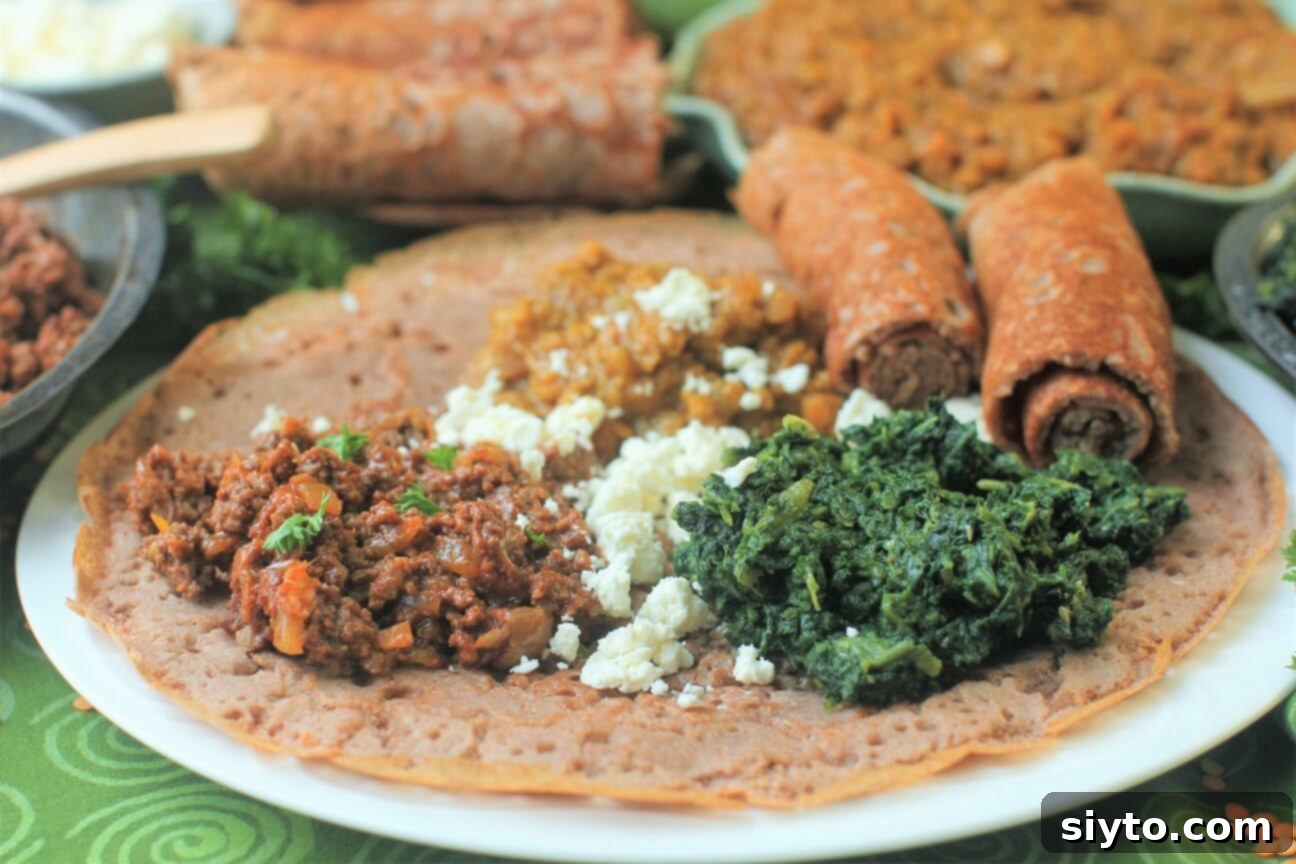
Embark on a culinary journey to the heart of Africa with a vibrant Ethiopian feast! Prepare to delight your senses and gather your loved ones for a truly unique dining experience, where utensils are optional and the food is scooped up with soft, spongy Injera flatbread. This comprehensive guide will walk you through crafting essential Ethiopian dishes: a savory batch of Misir Wat (red lentil stew), a robust and spicy Zigni Wat (ground beef stew), and a creamy, comforting Gomen Wat (stewed spinach or greens).
This month, as part of our exciting Eat the World recipe challenge, our culinary adventures take us to Ethiopia, a captivating country nestled in the Horn of Africa. Known for its rugged topography and diverse landscapes, Ethiopia is completely landlocked, bordering countries like Kenya, which we’ve previously explored. This vast land is home to highlands, lowlands, and a rich agricultural Lakes Region, all contributing to a vibrant and unique food culture that has captivated palates worldwide for centuries.
When one thinks of Ethiopian cuisine, the first image that often comes to mind is injera. This distinctive, large, and spongy sourdough flatbread, made from teff – considered the world’s tiniest grain – is not just a food item; it’s the foundation of the entire Ethiopian dining experience. My personal enchantment with this delicious cuisine began years ago upon discovering the wonderful Ethiopian restaurant, Langano Skies, in Edmonton. It was there I truly fell in love with the flavors and the delightful communal way of eating. An Ethiopian meal typically features an array of long-simmered, savory stews served directly onto a large injera flatbread, which is placed on a traditional flat basket or platter at the center of the table. Additional rolls of injera are provided alongside. Diners gather together, tearing off pieces of the flavorful teff flatbread to scoop up mouthfuls of the various delectable stews, fostering a truly interactive and shared meal.
At the heart of Ethiopian stews is the term “Wat” (or “Wot”), which simply translates to ‘food’ or ‘stew’ in the Ethiopian language. What makes these stews distinctively Ethiopian is their preparation, beginning with a base of slowly simmered onions, which not only provides a deep flavor but also acts as a natural thickener. Two indispensable traditional Ethiopian ingredients elevate these dishes: niter kibbeh and berbere. Niter kibbeh is a specially clarified butter, infused with a blend of aromatic spices, contributing a rich, nuanced flavor. Berbere, on the other hand, is a complex and fiery spice mix that forms the backbone of much Ethiopian cooking. To simplify the recipes that follow, I’ve opted for readily available ghee as a substitute for niter kibbeh, though if you happen to have traditional niter kibbeh on hand, it will certainly enhance the authenticity. Similarly, while I use store-bought berbere spice mix (which you can often find at specialty stores like Silk Road Spice Merchant in Edmonton), creating your own homemade blend is a rewarding endeavor for a truly customized flavor profile.
Traditionally, injera is crafted through a lengthy fermentation process, where a paste of teff flour and water is allowed to ferment for three to five days, developing into a sourdough-like starter. My attempts at this traditional method proved challenging; while the batter did turn sour, it failed to ferment properly, resulting in an unpalatably strong flavor and flatbreads that were hard and stiff. Subsequent research revealed that the teff flour commonly available in North America often doesn’t ferment as expected. Consequently, I’ve adapted a much quicker, yeast-based method that consistently yields excellent results: soft, spongy injera with a delightful taste and the perfect texture for soaking up all the delicious Ethiopian stews. A crucial final step involves stirring in a splash of vinegar just before cooking, which imparts that characteristic tangy flavor essential to these unique flatbreads.
Beyond the staple *injera*, an authentic Ethiopian meal is defined by its array of rich, slow-cooked stews. Here, we present three traditional recipes to complete your feast. Misir Wat is a deeply comforting red lentil stew, a staple at most Ethiopian tables. Its appeal lies in its luscious, oily texture and profound flavor; don’t be tempted to reduce the amount of ghee or oil, as this is key to its wonderfully rich consistency. It’s light yet satisfying, making it a perfect main or side dish. Next, we have Zigni Wat, a quick and effortlessly delicious spiced ground beef and onion stew. The fiery kick comes from the *berbere* spice mix, allowing you to customize the heat level to your preference. While I find a single tablespoon provides ample spice for my palate, online recipes sometimes call for up to half a cup of *berbere* for a similar batch, demonstrating its versatility! Finally, Gomen Wat offers a milder, savory contrast, featuring tender stewed spinach leaves. For this recipe, I’ve used blanched pumpkin leaves from my freezer, but any robust greens, such as collard greens (a popular choice in Ethiopia), will work beautifully. Keep in mind that some greens may require a longer cooking time than spinach to achieve that desirable tender, silky texture.
To perfectly round out your authentic Ethiopian meal, consider crumbling some fresh cheese – feta makes an excellent substitute – over the stews just before serving. A simple, refreshing salad of tomato and cucumber chunks, lightly dressed with a vinaigrette of vinegar and oil, provides a crisp counterpoint to the rich flavors of the *wats*. The beauty of preparing an Ethiopian feast lies in its flexibility. All the components can be prepared in advance, allowing you to simply reheat and assemble a spectacular meal. This makes it an ideal choice for an entertaining and novel dinner party idea for guests, or a surprisingly manageable and delicious weeknight meal for your family. Even preparing just one of the featured stews alongside the homemade flatbreads creates a satisfying meal. For a quicker twist, the stews can also be served with rice instead of *injera*, offering another delightful way to enjoy these incredible flavors.
* * * * *
For a Vegetarian/Vegan Version of the Following Ethiopian Recipes: To adapt these recipes for a plant-based diet, simply substitute olive oil for ghee when preparing the Misir Wat and Gomen Wat. For the Zigni Wat, replace the ground beef entirely with 1½ cups of small-diced potatoes and an equal amount (1½ cups) of small-diced butternut squash, increasing the cooking oil to 2 to 3 tablespoons to ensure proper sautéing and flavor development.
Ethiopian Recipes: Quick Injera
A Speedy Method for Making Tasty Ethiopian Flatbread
(Yes, it’s two hours of rising, but that’s speedy in comparison to the traditional five days of fermenting the batter!)
- 3 cups warm water
- 1½ cups (190gms) all purpose flour (or for gluten free; use 1½ cups/190gms of a gluten free flour blend + ½ teaspoon powdered psyllium husks)
- 1 cup (150gms) teff flour
- 1 tablespoon sugar
- 1½ teaspoons active dry yeast
- 1 tablespoon baking powder
- ½ teaspoon salt
- 1 tablespoon apple cider vinegar or white wine vinegar
- oil, ghee, or cooking oil spray for cooking the injera
Add all the ingredients to a blender except the vinegar and oil. Pulse just to mix the batter. Pour the batter out into a bowl and loosely cover it with a clean tea towel. Leave the batter to proof at room temperature for two hours. It will be doubled in size and full of little bubbles.
When you are ready to cook the injera, stir the tablespoon of vinegar into the batter. Heat a non-stick large skillet over medium heat. Brush it lightly with oil, ghee, or spray it with cooking oil spray.
Pour about a half cup of the injera batter into the skillet, then lift the skillet and quickly rotate it so the batter spreads evenly over the bottom. Place it back on the heat and cook until the bottom is brown and lacy and the top is full of little bubble holes, about 2 to 3 minutes. Flip the injera and cook the other side for about 30 seconds.
Slide the injera onto a plate to keep warm, then re-grease the pan and continue making the flatbreads until the batter is used up.
Makes 8 injera (about 10 inches each)
Ethiopian Recipes: Misir Wat
(Lentil Stew)
- ½ cup ghee or olive oil
- 2 medium onions (2 cups, finely chopped)
- 1 tablespoon finely grated ginger
- 2 garlic cloves, grated
- 1 tablespoon paprika
- 1½ teaspoons berbere spice mix
- 1 teaspoon ground turmeric
- ½ teaspoon ground coriander
- ½ teaspoon ground cumin
- ½ teaspoon ground cardamom
- ½ teaspoon salt
- 1 cup red lentils
- 2½ cups (600ml) water
Heat the ghee or oil in a small dutch oven or heavy bottomed saucepan. Add the onions and cook together over medium-high heat for 10 minutes, stirring often, until the onions turn golden brown. Add the grated ginger and garlic (a microplane grater works great for that), all the spices, and the salt, and cook for 2 more minutes, stirring often.
Add the red lentils and the water, and bring to a boil. Reduce the heat to low, cover the pot, and simmer the lentils for 20 minutes, stirring occasionally.
Serves 4.
Ethiopian Recipes: Zigni Wat
(Berbere Spiced Ground Beef Stew)
- 1 tablespoon oil
- 1 medium onion
- 1 – 2 tablespoons berbere spice mix
- 2 tablespoons finely minced garlic (about 6 cloves)
- 1 tablespoon finely grated fresh ginger
- ½ teaspoon salt
- 1 lb ground sirloin or lean ground beef
- 3 tablespoons tomato paste
- 1 -2 tablespoons water
Cut the onion in quarters, then cut each quarter crosswise into thin slices. Heat the oil in a skillet and sauté the sliced onions in the oil until they’re soft, about 2 to 3 minutes. Add the minced garlic, ginger, berbere seasoning, and salt. cook and stir for 1 more minute.
Add the ground beef and cook, breaking up the chunks with a spoon, until there is no pink remaining. Add the tomato paste and just enough water to moisten the meat. Cover the skillet with a lid, and simmer the meat mixture for 10 minutes, adding another splash of water if it gets too dry.
Serves 4.
Ethiopian Recipes: Gomen Wat
(Stewed Spinach)
- ¼ cup (60ml) ghee or olive oil
- 1 medium onion
- 2 teaspoons finely grated ginger
- 2 cloves garlic, finely grated
- ½ teaspoon fine sea salt
- 2 packages (300gms/10 oz each) frozen chopped spinach, partially thawed or completely thawed, or 4 cups blanched, chopped spinach leaves or other greens
Finely chop the onion by hand or in a food processor or mini chopper.
Heat the ghee or oil in a skillet. Add the onion and cook for 10 minutes, stirring often, until the onion is golden brown, with some darker brown edges. Add the ginger, garlic, and salt, and cook for 2 more minutes, stirring often.
If the frozen spinach blocks are partially thawed, cut them into 1 inch cubes with a serrated knife, and add the cubes to the onions in the skillet. If the spinach is completely thawed, add the spinach plus any of its melted liquid into the skillet. Cook until the spinach is thawed, if frozen, and heated through and bubbling. Cover the skillet with a lid and simmer the spinach for 15 minutes, then remove the lid and cook it for 5 to 10 minutes longer until the liquid is mostly evaporated.
Serves 4.
Guten Appetit!
Ready to explore more global flavors? Discover all the wonderful Ethiopian dishes prepared by fellow Eat the World members and share your culinary creations with #eattheworld. Click here to find out how to join our gastronomic adventure and have fun exploring a new country in the kitchen with us each month!
Juli: Misir Wot – Ethiopian Red Lentil Stew
Sue: Ethiopian Beef Tibs
Amy: Buticha – Ethiopian Hummus
Syama: Himbasha – Ethiopian Spiced Bread
Evelyne: Flavor-Packed Ethiopian Shekla Tibs
Lynda: Tikel Gomen (Ethiopian Cabbage & Potatoes)
Wendy: Doro Wat and Atkilt
Camilla: Ye’abesha Gomen (Ethiopian Collard Greens)
Margaret: An Ethiopian Meal with Misir Wat, Signi Wat, Gomen Wat, and Speedy Injera Flatbread
Want to receive new Kitchen Frau recipes directly to your email? Sign up here and you’ll get a handy and useful kitchen tip along with each recipe, too. (No spam ever.)
If you like my recipes, follow me on Instagram, Pinterest, Twitter, and Facebook. You’d make my day!
Don’t forget to PIN IT to save the recipe:
You might also like:
Maharagwe with Ugali: Kenyan Red Beans in Coconut Sauce
Kerala Upma: Indian Breakfast Upma Recipe
Philippine Chicken in Adobo Sauce
German Sweet ‘n Sour Lentil Stew